

About Susanne Walle
Midwife
Midwives had a prominent position within the female village population. Alongside other helpers, they stood by the women during the difficult hours of labour and played a decisive role in ensuring that the process, which was life-threatening for mother and child, came to a happy end.
We learn about the St. Ingbert midwife Susanne Walle from a document preserved in the Speyer State Museum and reported on by the St. Ingbert chronicler Wolfgang Krämer. It deals with the appointment of a new midwife and provides us with revealing insights into early modern society. In general, a woman could be appointed as a country midwife if she was already a mother several times over, was of an advanced age and had proven herself to be the most skilful in childbirth practice. She was chosen by secret ballot by the villagers on the basis of a majority vote.
This right of women to choose, the only one that had been handed down since the 16th century, had been repeatedly curtailed by church, medical and manorial institutions. While for centuries they worked on their own responsibility and acquired their knowledge from other women who were skilled healers and from their own experience, in the 18th century they were placed under the supervision of town doctors and surgeons. The midwives were joined by male obstetricians and "accoucheurs" who had learnt the trade of a surgeon from a barber. One of these was the city surgeon Reuther, who set up a "midwifery school" on Ludwigsplatz in Saarbrücken on the orders of Prince Wilhelm Heinrich and was given the task of examining future midwives. They received a fixed salary and were the only female members of the town's workforce.[1] In St. Ingbert, too, people suitable for the position of midwife had to be inspected and trained by the public health officer.
Beginning of May 1777 in St. Ingbert...
After the predecessor died on 1 May 1777, the authorities issued an order to have "all the women in the village elect a duly discreet person" as her successor without delay. Two women were chosen, both of whom had received more than 60 votes from the villagers. The parish priest wished that both candidates would be approved for the office in this "village full of people and women", especially as infant mortality was very high at the time and many women died in childbirth. Both women were also "highly reprehensible" in their moral behaviour and religion. Therefore, on 5 May, both the widowed Susanne Walle and the married Catharina Bastian were ordered to Blieskastel, the seat of the sovereign's administration.
It turned out that Bastian "had no female manager in her house, so she was forced to look after the household all by herself, as her husband was always working in the coal mines and therefore had no one at home." Walle, on the other hand, was a widow with five children to care for, only one of whom was already an adult. Nevertheless, they both wanted to take up the position of midwife, but demanded an increase in the "far too low fees", as they had to attend births for 8 and sometimes 14 days. Both women were examined by the count's personal surgeon Saal, whereby Walle was deemed fit, while Bastian apparently did not pass the examination. Unfortunately, it is not known how the "examination" was organised at the time and what training qualified the count's personal surgeon to carry out his duties. In any case, on 9 May, an official order was issued to the Meyer (a kind of local headman) of St. Ingbert to officially confirm Susanne Walle as a midwife[2].
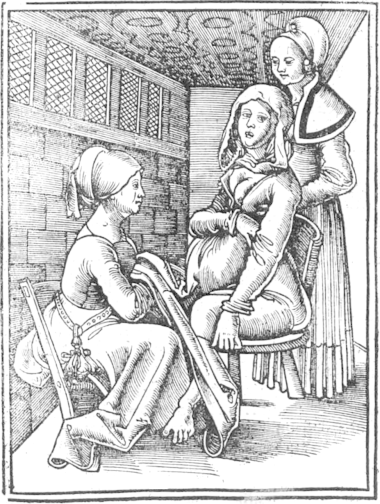
Regarding her tools and equipment, the records show that she was provided with a midwife's chair by the municipality. Complaints about the low pay of midwives continued in the following decades, with the herdsman of a medium-sized village expecting a higher annual salary than all the midwives of a district put together, i.e. they were at the lowest level of municipal employees. However, it is documented for St. Ingbert that Susanne Walle, also known as "Peter Großens Wittib", was still working as a midwife in 1790[3].
Written by: Dr Susanne Nimmesgern, historian and women's representative of the Saarpfalz district
Published: 15.09.2025; Last updated: 31.03.2026.
Quote
In the countryside, childbirth was a woman's affair. It was not a family affair, but a public event attended by the midwife, married and widowed female family members, neighbours and friends - usually between five and seven women."
Labouvie, Eva: Sofia Weinranck, midwife of St. Johann. Municipal midwifery up to the middle of the 18th century, in: Annette Keinhorst/Petra Messinger (eds.), Die Saarbrückerinnen. Beiträge zur Stadtgeschichte, St. Ingbert 1998, pp. 225-248, here p. 225.
Footnotes
[1] Eva Labouvie, Sofia Weinranck, midwife of St. Johann. Municipal midwifery up to the middle of the 18th century, in: Annette Keinhorst/Petra Messinger (eds.), Die Saarbrückerinnen. Beiträge zur Stadtgeschichte, St. Ingbert 1998, pp. 225-248, here p. 225 f.
Read more
Labouvie, Eva: Assistance in child labour. Midwives and female culture in the countryside (1550-1910), Frankfurt a. Main 1999
This: Other Circumstances. A cultural history of birth, Cologne/Weimar/Vienna 2000
Metz-Becker, Marita: Midwives and medical obstetrics in the 18th/19th century, in: Die Hochschule 1 (2013), pp. 33-42.
Supported by: