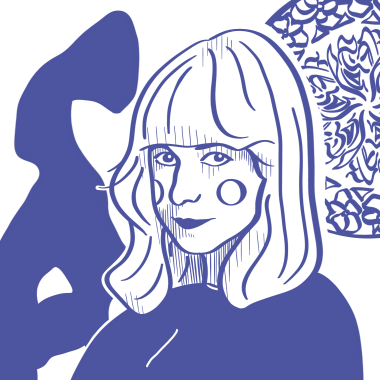
About Madeleine Mangold
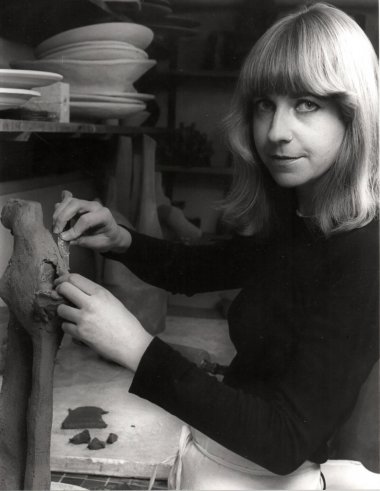
Madeleine Mangold was a German ceramist and art teacher in Homburg.
For me, ceramics are everlasting. The technique has been almost the same for centuries. It combines craftsmanship and creativity in a very special way."[1]
Paris, city of art
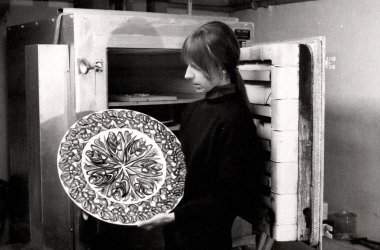
Her older sister Marion had provided the impetus: one day she brought clay home, where her little sister Madeleine was allowed to experiment with this material for the first time. From then on, Madeleine Mangold knew that clay was "her stuff". She was therefore drawn to Paris at an early age. There, from 1963, she attended school and workshops at the École des Metiers d'Art, where she trained as a ceramicist, and from 1964 she studied under the French sculptor Professor Jean Joachim Supéry (1905-1990), known as Jean Joachim.
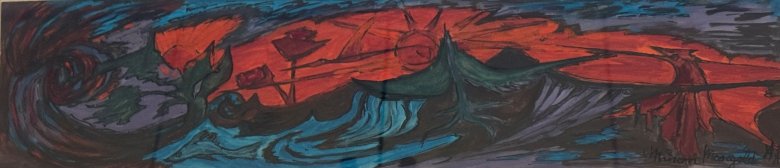
The big sister
After returning from Paris, Madeleine Mangold continued her training from 1964 to 1967 with her half-sister, the trained ceramist Marion Mangold-Hulayil (1938 in Berlin - 1991 in Homburg), who was nine years her senior. Marion Mangold-Hulayil had already begun her basic training at the State School of Arts and Crafts in Saarbrücken in 1954 and studied in the ceramics class of the Stuttgart ceramics master Anneliese Braunmüller until 1959, in between completing a scholarship at the École des Métiers d'Art in Paris in 1956/57 with a diploma. From 1960, she worked in her own studio in Ottweiler[2] and later worked in the graphics department for the Villeroy & Boch company in Mettlach. Two wall friezes with fish and birds for the Saarbrücken Chamber of Industry and Commerce date back to this time, which were removed in 1995 and brought to Ottweiler[3].
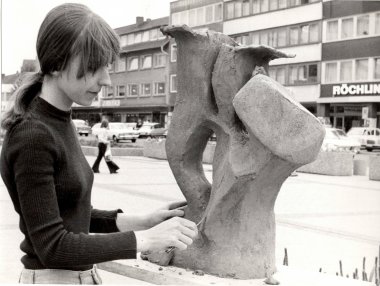
Madeleine Mangold goes her own way
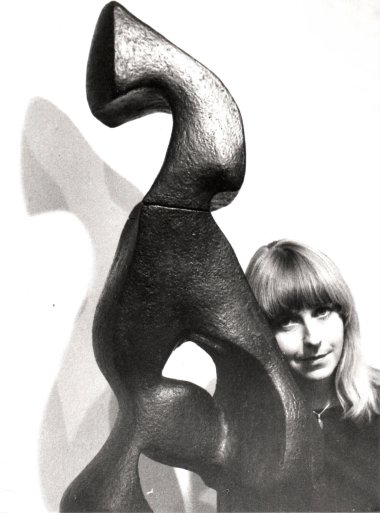
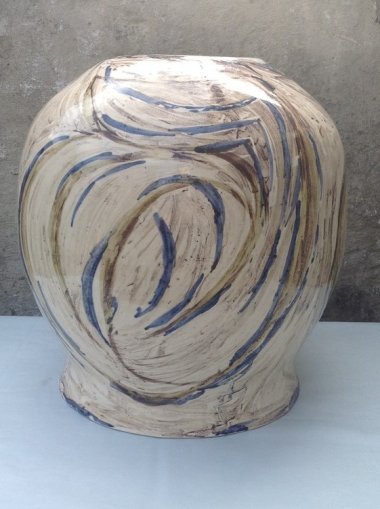
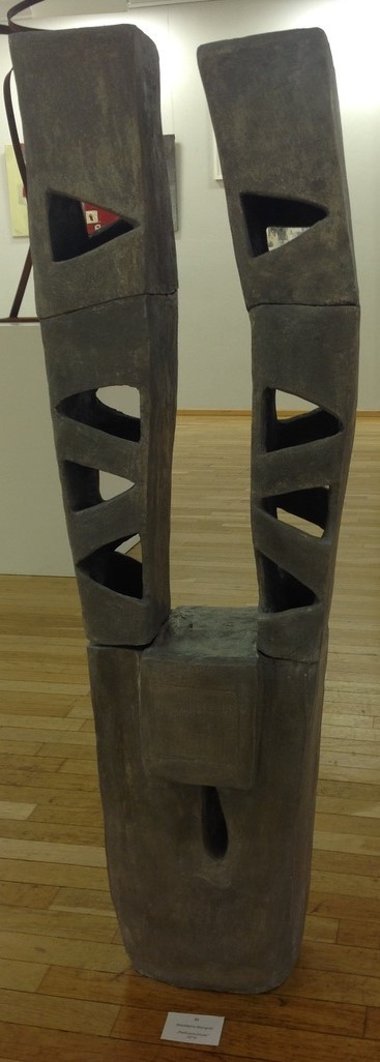
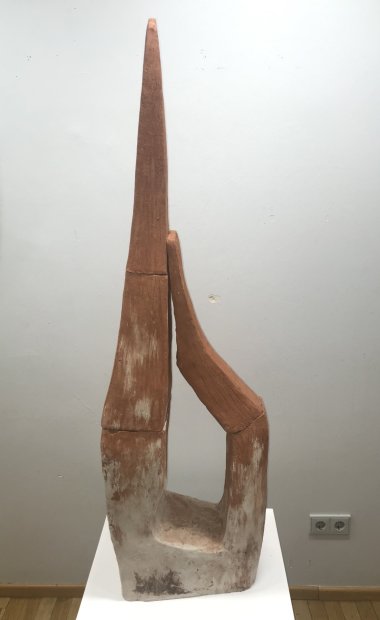
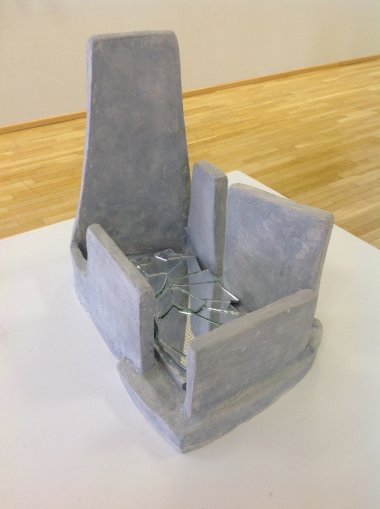
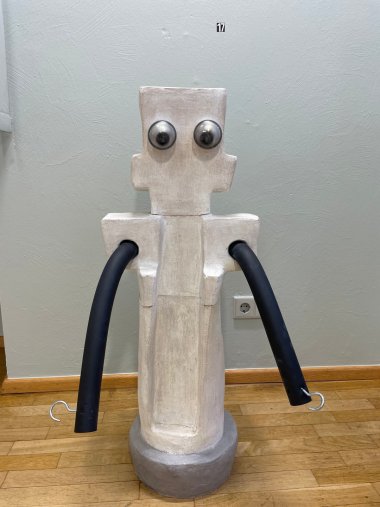
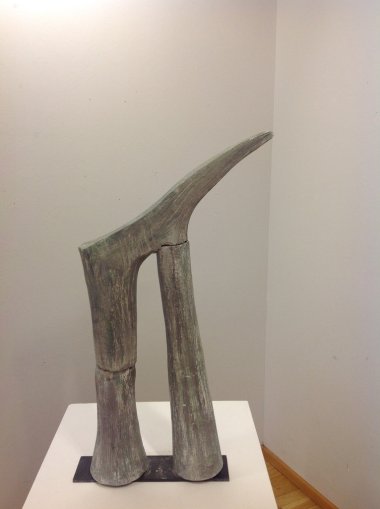
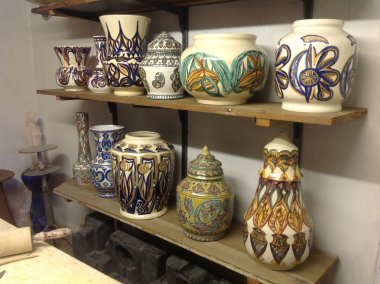
Madeleine Mangold had her own studio in Homburg since 1968. The material she preferred over all others was and remained clay of various colours in red, white or brown. Starting with traditional ceramic vessels such as plates, bowls or vases from her early creative period, her works evolved into clay figures and sculptures, which developed more and more from figurative to freer, more expressive representations. Wall paintings were just as much a part of the spectrum of her work as large-scale pieces. The circular form was always part of her repertoire, with the artist often taking design principles from the plant world as a model.[4] A vivid example of this can be found in the foyer of the district administration, dated 1979.
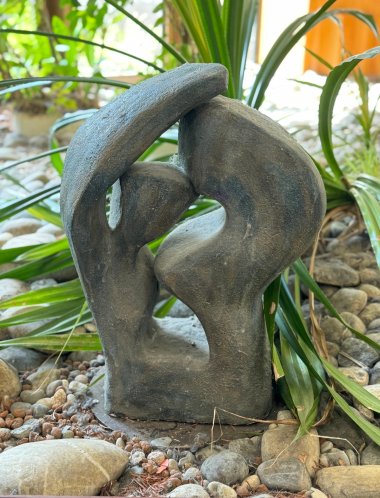
In 1968, the same year she opened her studio, her first exhibition took place at the Homburg City Museum. In the 1970s, she achieved national fame in Paris, Luxembourg, New York and Montreal with clay objects and vessels that featured increasingly unusual designs instead of traditional forms. In her later oeuvre, current events and what she saw in everyday life - reworked in new and different ways - were also reflected in her art[5].
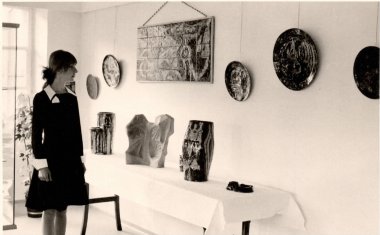
The artist group HOM 4 and Homburg
In 1995, she co-founded the artist group HOM 4 with the painters Heinz Ginkel, J.N.R. Wiedemann and the sculptor Klaus Glutting. With HOM 4, she has taken part in numerous regional and national projects and exhibitions, including the spectacular ambience of Homburg's Schlossberg caves as well as Homburg's twin towns Ilmenau and La Baule.
From 1979 to 2018, she worked as an art teacher at the Christian von Mannlich-Gymnasium in Homburg, the Saarpfalz-Gymnasium and the Gymnasium am Steinwald in Neunkirchen. She also taught ceramics courses at the adult education centre.
In 2024, art historian Dr Françoise Mathis-Sandmaier curated the exhibition "Fire and Flame - 60 Years of Ceramics" on the life's work of Madeleine Mangold. For around a month from 16 September, only works by this artist were shown in the Homburg Saalbau, documenting her impressive work and development over six decades. However, the artist was no longer able to attend the opening of her life's work - her son represented her on this special day. Madeleine Mangold died a short time later, on 24 October 2024.
Written by: Dr Jutta Schwan, art historian in the cultural management of the Saarpfalz district
Published: 03.09.2025; Last updated: 27.05.2026.
Pictures
Click on the pictures to enlarge or start a slide show.
Footnotes
[1] Quote from the artist on the memorial page for Madeleine Mangold: Keramikatelier-mangold.de; viewed on 11 May 2026.
[2] Költzsch, Georg W./ Schmoll gen. Eisenwerth, Helga: Skulptur, Plastik und Zeichnungen von Bildern des 19. und 20. Jahrhunderts aus der Sammlung der Modernen Galerie des Saarland Museums Saarbrücken, Saarbrücken 1989, p. 251.
[3] Enzweiler, Jo (ed.): Kunst im öffentlichen Raum, vol. 1, Saarbrücken, Bezirk Mitte. 1945 to 1996, Saarlouis 1997.
[4] Graf, Sabine: EnergieArt - Künstlergruppe HOM 4; brochure for the 2002 exhibition in the Stadtwerke Homburg building, "Energie sammeln" - zu Madeleine Mangold, unpaginated.
[5] Stumm, Ulrike: Jeder für sich und doch gemeinsam. On the exhibition of the HOM 4 group in Saalbau, Saarbrücker Zeitung from 18/09/2015.
Read more / Literature
Enzweiler, Jo (ed.): Kunst im öffentlichen Raum Band 1. Saarbrücken District Centre. Saarbrücken 1997, p. 239.
Graf, Sabine: EnergieArt - Künstlergruppe HOM 4; brochure for the 2002 exhibition in the Stadtwerke Homburg building.
HOM4 (ed.): Exhibition catalogue 1996.
HOM4 (ed.): Künstlergruppe HOM 4 - 1995-2005. Text: Sabine Graf, Homburg 2005.
Költzsch, Georg W./ Schmoll gen. Eisenwerth, Helga: Skulptur, Plastik und Zeichnungen von Bildern des 19. und 20. Jahrhunderts aus der Sammlung der Modernen Galerie des Saarland Museums Saarbrücken, Saarbrücken 1989.
Link, Andreas (ed.): Mangold, Madeleine, in: Künstler*innenlexikon Saar des Instituts für Aktuelle Kunst im Saarland, online at<https://institut-aktuelle-kunst.de/kuenstlerlexikon/mangold-madeleine>[last accessed: 27 August 2025].
Scharwath, Günter: Das große Künstlerlexikon der Saar-Region, Saarbrücken 2017, p. 674.
Stumm, Ulrike: Everyone for themselves and yet together. On the exhibition of the HOM 4 group at Saalbau, Saarbrücker Zeitung, 18/09/2015.
Supported by: