

About Elisabeth Koelle-Karmann
Painter
... children who are always ready for jokes and rascals - in a word: I love them."
Childhood in St. Ingbert
Elisabeth Karmann was the daughter of Heinrich Karmann, a coal miner, and his wife Elisabeth, née Lösch. The painter, pastel draughtswoman and graphic artist spent her childhood in St. Ingbert, her native town in what was then Bavaria. The girl's artistic talent was evident in her early enthusiasm for drawing. At the age of five, she covered every available surface - paper was expensive - with small drawings and, as she recalled in a 1965 interview with Irmengard Peller from Saarländischer Rundfunk, was disparaged as a "Kritzlersch". As a result, she no longer showed her pictures to anyone and withdrew to the furthest corner of the attic so that she could draw there unseen. At the same time, she hid herself, but above all her small works, even from her parents. Her father insisted on finding out what she was secretly doing when she didn't respond to her mother's calls. After seeing the results of her hidden work, he was not only very fond of her drawings, but supported her in them. They spent time together and he took her to the forest where she could draw trees as she wished. After the early death of her father, she attended boarding school at the St Magdalena Convent in Speyer at the age of eleven. There, she recalled, she was promised that she would be allowed to draw and paint, but to her personal disappointment this was ultimately limited to two hours a week. After school, she made her way through her own work and went to Munich to be able to paint.
One of the first women at the Munich Academy
It was not only in Munich at the beginning of the 20th century that expensive public schools were the only institutions where talented female students could take painting and drawing lessons. Such painting classes were mostly run by artists who used them as a sideline, but did not necessarily endeavour to provide a seal of approval for a high-quality education. It was not until the winter semester of 1920/21 that the Bavarian State Ministry granted women access to the Munich Academy at all, which was largely met with rejection by both professors and male students and did not change significantly in the period that followed[1].
Nevertheless, Elisabeth Karmann also initially embarked on her path to art via the public school of Prof Heinrich Knirr[2] (1862-1944) under Prof Andreas Sailer. During her time as a student in Munich, she lived in a boarding house for "higher daughters" run by a writer couple.[3] In 1921, she passed the entrance examination and transferred to the Academy of Fine Arts in Munich, where she was one of the first female students of the 1920s.[4] She received financial support from her brother, in addition to income she earned herself. In addition, the academy granted her an exemption from semester fees,[5] although little effort seems to have been made on the part of the academy to support female students, particularly in terms of providing opportunities for advancement, which included scholarships, exhibitions and competitions.[6] In any case, she became a master student in painting and graphics under Professor Karl Caspar (1879-1956) from 1923 and completed her studies in 1925. In the same year, she married the sculptor Fritz Koelle (1895-1953) from Augsburg, whom she had met two years earlier as a student at the academy and to whom she had been engaged since 1924. As she described in an interview with SR, they lived in an artistic community with mutual inspiration and critical encouragement. Even during her studies, she exhibited her own works in the Pinakothek, the Deutsches Museum and the Munich Glaspalast[7], the much-vaunted exhibition building that burned down in 1931. Numerous collective exhibitions and prizes for her work followed. From 1925, she exhibited in the "Munich New Secession". Joint exhibitions with her husband also led to them being referred to in the Munich press as the "artist couple". Their son Fritz Koelle Jr. was born in 1933.
Your artistic work
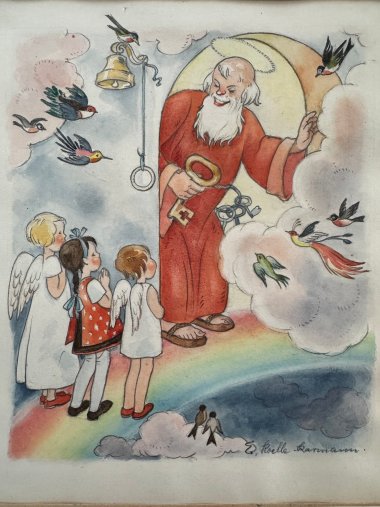
Elisabeth Koelle-Karmann painted still lifes, landscapes and portraits in Munich-Grünwald, where she lived with her husband. She continued to spend a lot of time with her family in St. Ingbert, through which her husband, some of whose bronzes can still be found in public spaces in the Saarland, also got to know the world of Saarland industrial workers and was able to make contacts himself. She became widely known above all for her naive children's paintings and drawings as well as watercolours, which influenced her later work. Her children's portraits show children of different characters and emotions, which are immediately recognisable to anyone who looks at them. The depictions always feature, as she herself put it, "rascally girls and rascals" and almost always have a connection to her native town of St. Ingbert, her own happy childhood and the miners' milieu of her Saarland homeland. Consistently, she also provided illustrations for the Saarland miners' calendar, which dealt with the milieu of people from the lower classes. In 1953, her husband died while travelling on the Munich-Berlin inter-zone train. She continued her work herself, and in 1963 the Schaezler-Palais in Augsburg, her husband's home town, dedicated the exhibition "The World of Children" to her with 200 works of her art. In the same year, the House of Wittelsbach awarded her the Crown Prince Rupprecht Medal for her work, including the "Ludwig Ferdinand Portfolio" with 15 pencil drawings and watercolours.[8] In St. Ingbert, Krummfuhrstrasse was renamed Koelle-Karmann-Strasse in 1964.
This was followed by honours such as the Federal Cross of Merit, the Bavarian Order of Merit, the Cross of Merit First Class, a special postmark from the German Federal Post Office and an exhibition of her work by the city of Saarbrücken at Funkhaus Halberg. In 1972, she established the "Elfriede Kohnstamm-Lafter Foundation" in St. Ingbert, which emerged from an "artists' aid organisation" and of which she was chairwoman for 18 years. The institution, which is still listed in the directory of foundations with legal capacity in Saarland in 2025, supports talented female artists from St. Ingbert.
The artist died in Altomünster in 1974. A large part of her artistic estate was publicly auctioned off at the Peretz auction house in Saarbrücken in 1975. Part of her written legacy is kept in the St. Ingbert town archives. Her works are in private ownership, in public buildings, in the Bavarian State Archives as well as in museums and churches.[9]
Written by: Dr Jutta Schwan, art historian in the cultural management of the Saarpfalz district
Published: 04.05.2026; Last updated: 04.05.2026.
Footnotes
[1] Mundorff, Angelika / Kink, Barbara (ed.): Frau darf... . 100 years of women artists at the academy. Museum Fürstenfeldbruck. Searching for Traces - Women Artists before 1920, Fürstenfeldbruck 2020, p. 66.
[2] Scharwath, Günter: Das große Künstlerlexikon der Saarregion, Saarbrücken 2017: Koelle-Karmann, Elisabeth, p. 547.
[3] Jooss, Birgit: An opportunist in three political systems. The sculptor Fritz Koelle and his work, pp. 29-49, here p. 36, in: Braun, Jutta / Süß, Winfried (eds.): Kunst und Kultur nach dem Nationalsozialismus. Contributions to the History of National Socialism 40, Göttingen 2025.
[4] https://www.vergessene-kunst.de/kuenstler/
[5] https://www.koelle-online.de/Pages_ek/ek_1.html: The painter Elisabeth Koelle-Karmann.
[6] Hopp, Meike: "But a [...] woman has never aspired to the very highest, let alone achieved it. Women at the Academy of Fine Arts Munich. Women at the Academy. Fürstenfeldbruck 2020, p. 80.
[7] The glass palace was built in 1854 by August von Voit, who also drew up the plans for St Michael's Church in Homburg.
[8] Bellinger, Gerhard J. / Regler-Bellinger, Brigitte: Schwabings Ainmillerstrasse und ihre bedeutendsten Anwohner. Ein repräsentatives Beispiel der Münchner Stadtgeschichte von 1888 bis heute, 2nd edition, Norderstedt 2012 (1st ed. 2003), p. 181.
[9] https://www.koelle-online.de/Pages_ek/ek_1.html. A miner's daughter makes her way.
Further reading / literature / sources
Literature
Bellinger, Gerhard J. / Regler-Bellinger, Brigitte: Schwabings Ainmillerstrasse und ihre bedeutendsten Anwohner. Ein repräsentatives Beispiel der Münchner Stadtgeschichte von 1888 bis heute, 2nd edition, Norderstedt 2012 (1st ed. 2003), p. 181.
Dahl, Michael: Elisabeth Koelle-Karmann (1890-1974). Not an honorary citizen for St. Ingbert. In: Heidemarie Ertle, Gerhard Sauder (eds.): St. Ingbert Biographies 2nd, St. Ingbert 2025, pp. 127-139.
Hopp, Meike: "But a [...] woman has never aspired to the very highest, let alone achieved it. Women at the Academy of Fine Arts Munich. Women at the Academy. Fürstenfeldbruck 2020, p. 80.
Jooss, Birgit: An opportunist in three political systems. The sculptor Fritz Koelle and his work, pp. 29-49, here p. 36, in: Braun, Jutta / Süß, Winfried (eds.): Kunst und Kultur nach dem Nationalsozialismus. Contributions to the History of National Socialism 40, Göttingen 2025.
Scharwath, Günter: Das große Künstlerlexikon der Saarregion, Saarbrücken 2017: Koelle-Karmann, Elisabeth, p. 547.
Online
https://www.koelle-online.de/Pages_ek/ek_1.html: The painter Elisabeth Koelle-Karmann
https://institut-aktuelle-kunst.de/kuenstlerlexikon/koelle-karmann-elisabeth
https://sr-mediathek.de/index.php?seite=7&id=120340: Elisabeth Koelle-Karmann: "I paved my own way after the war". Interview with Irmengard Peller, 19 December 1965.
Supported by: