

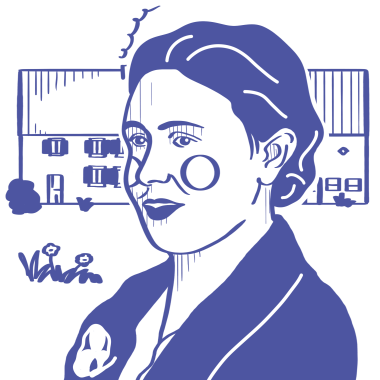
About Berta Folz
From lady-in-waiting and mother to novel character
She only lived for her family and rarely took time for herself. She never had a friend with whom she did anything. If her children were doing well, she was happy."
Source: Folz-Philipp, Erna Maria: Berta. A life story in the 20th century, Norderstedt 2000, p. 266.
A life that may seem simple at first glance turns out, on closer inspection, to be a significant testimony to the realities of women’s lives in the early 20th century. Wars, poverty and restrictive social norms characterised this era. The author, Erna Maria Folz-Philipp, also recognised this historical significance in the life story of her mother, Berta, and wrote a biographical novel about her.
First love and starting a family
Berta Folz was born on 30 December 1899 in Medelsheim, near Gersheim. She was the fourth of eight children born to Nikolaus Engelbert and Luise Allgaier. Her father was a craftsman and initially ran a workshop. However, after he had run it into financial ruin, he was forced to give up the workshop in 1909.
The family then moved to Lorraine. The time there was characterised by poverty and the absence of the mother, who suffered from a miscarriage. As a result, Berta had to take over the household and childcare from an early age. By 1912, the family's financial situation had improved and they were able to return to Medelsheim, where her father opened a workshop again. During the First World War, Berta's brother Erhard was called up and fell three years later.
At this time, Berta began a romance with a young man called Peter. However, as he was a Protestant, her father forbade further meetings with him. But Berta defied her father's orders and continued to meet her great love in secret. In 1919, however, her father sent her to work at the Drehbrunn farm. Life there was very isolated as she had few opportunities to get to Medelsheim and meet up with Peter due to the constant work.
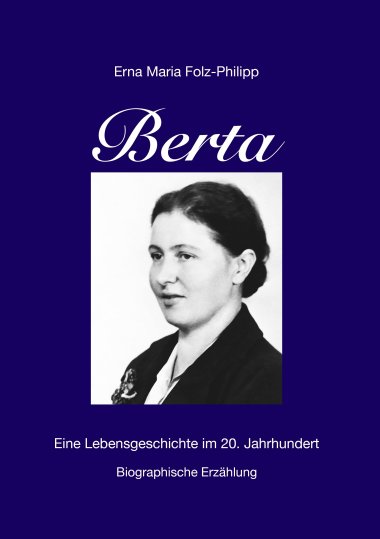
Meanwhile, a rumour grew in the village that Berta was having an affair with the lord of the manor, Georg Folz. In fact, however, this was not true. Although Georg had taken a liking to the much younger Berta, the relationship was not mutual. However, when Berta learnt that Peter had emigrated, she finally agreed to marry Georg. As his wife, she would be away from her controlling father and financially secure at the same time. Their wedding finally took place in Blieskastel. After the wedding, Berta became the lady of the manor, housekeeper and gardener. She initially had two children with Georg, daughter Hilde and son Otmar.
Move to Hanweiler
Although she was well looked after and Georg was a kind husband, Berta wanted more from life than to stay on the farm forever. When the agricultural crisis also hit the Drehbrunn farm and daughter Hilde reached school age, Berta saw her chance to come a little closer to realising this wish. She finally persuaded Georg to lease the farm and move to Hanweiler Bad-Rilchingen for a few years while the children were at school. Around 1929, they took out a loan for a house with a café and guest rooms. Nevertheless, the income remained low. In addition, after some time the lease payments for the farm were also cancelled.
As Berta and Georg still had to pay the farm's duties and taxes, they were no longer able to bear the costs incurred. Even when they found a new tenant for their land, the financial situation did not improve, so they ultimately had to hand over the Drehbrunn farm to the bank. In the meantime, Berta and Georg had two more children, son Hermann and daughter Erna Maria. In order to continue to support the family, Georg then had to work in road construction.
The Second World War and the years that followed
During the Second World War, Berta and her family had to be evacuated twice. First they went to the Harz Mountains, and later to Vilseck in Bavaria. Due to severe food shortages, Berta went begging for her family during this time. Her eldest son, Otmar, survived the war as a soldier. Berta’s brother Hermann, however, lost his life. In 1953, her husband Georg also passed away. As he had only started paying into the pension scheme late in life, Berta’s pension was very small. Until she was able to live off her share of an inheritance, she therefore had to be supported by one of her sons.
It was not until her 1970s that Berta was gradually able to enjoy life for herself. She joined a knitting group, got to know other women and travelled to Lourdes and Austria for the first time. However, she then suffered a stroke and her health deteriorated. Her daughter Erna looked after her before Berta had to move into the care home in Auersmacher near Kleinblittersdorf. She passed away there at the age of 80.
Written by: Luisa Spindler, student of Historically Oriented Cultural Studies and intern at the Women's Office of the Saarpfalz District
Published: 30 March 2026; Last updated: 6 August 2026.
Quotes
They drove to the edge of the village. Beneath an old chestnut tree stood a small, dilapidated house with a run-down shed. The shutters were shut and the stone steps leading up to the front door were overgrown with moss. The walls were deeply cracked; some tiles were missing from the roof. It was the local council’s poorhouse. [...]
Berta could hardly imagine that her father wanted to move into this dilapidated house with them. But he stopped, took a key – which the mayor had given him – out of his trouser pocket and said to Luise: ‘This is our new home. [...]’.”
Folz-Philipp, Erna Maria: Berta. A life story in the 20th century, Norderstedt 2010, here: S. 25.
Christmas Eve. The smell of roast goose, sauerkraut and roast potatoes drifted through the house. Berta saw Schorsch coming across the courtyard through the kitchen window. He carried the stable lantern in one hand and trudged through the snow to the smithy. He's going to call Heinrich for dinner, she thought. I wonder if he'll manage to get the two crossheads to the festive table."
Folz-Philipp, Erna Maria: Berta. A life story in the 20th century, Norderstedt 2010, here: S. 75-76.
After two years, Schorsch travelled to the farm for the first time to see what was going on. He was completely flabbergasted when he saw how everything had been run down in such a short time. [...]
They had once owned eighty hectares of land and now they were heavily in debt within three years. Berta's calculations had not worked out."
Folz-Philipp, Erna Maria: Berta. A life story in the 20th century, Norderstedt 2010, here: S. 127.
Read more / Literature
Folz-Philipp, Erna Maria: Berta. A life story in the 20th century, Norderstedt 2010.
Saarpfalz District Savings Bank Foundation for Culture and the Environment (ed.): ‘It was a house full of work’, in: Museum of Remembrance. ‘Life and Work in the Bliesgau – A Journey into the Memories of the Local People’. Ottweiler 2015, pp. 42–59.
Supported by: