


About Ruth Ricarda Bruch
Poet
Others enjoy their well-earned retirement at that age, but she was just getting started. At the age of almost seventy, the St. Ingbert native began publishing her first poems. In an interview with a reporter from the Saarbrücker Zeitung newspaper in March 1981, she said:
I'm always in love with something. With a picture, a book, a man, a woman, the colour of a flower, the sound of a voice, a sculpture - sometimes with everything and everyone at the same time."[1]
Waiting means collecting
When her first volume of poetry was published, Ruth Ricarda Bruch was already 71 years old. It was entitled "Waiting means collecting". The volume contains poems from almost every decade she had experienced up to that point. After all, she didn't just start writing yesterday. She began writing poems regularly at the age of 14, some of which made it into her first book. For a long time, she hesitated to go public with it. In the end, she gave in to the urging of her family and friends and began to publish her first poems in newspapers and magazines. Ruth wrote her first texts at the age of 14 about her parents' birthdays, the weddings of family friends, but also about the loss of one of her two sisters. Serious topics such as death and grief were a recurring theme in her life and her poems.
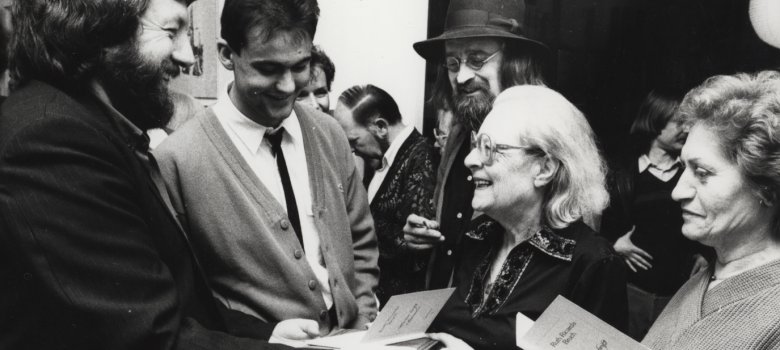
A lyricist from the Saarland
Ruth Ricarda Bruch was born on the twentieth of December 1911, the daughter of the lawyer Ludwig Bergmann. She began writing her first poems as a teenager. The themes quickly became serious after the death of one of her two sisters and helped her to cope with her grief. Ruth graduated from high school in Saarbrücken in 1932. Her husband, teacher Jakob Wilhelm Bruch, died young. He was killed in action during the Second World War in 1944. Some of her poems deal with the death of her husband, with grief and suffering. Others offer hope and comfort. Perhaps the times in which she grew up and the many losses were the reason why she was "always in love with something" - an attitude and quality that many people today still wish they had. Just a few months after the publication of her first book "Warten heißt Sammeln", her son Michael Bruch also died at the age of 44. His death has left its mark on her second volume of poetry "Wind im Haar". However, this was contrasted by her love of detail, of the little things. In addition to lines full of melancholy and sadness, her texts contain the motif of dreams: the escape from the world, away from transience.
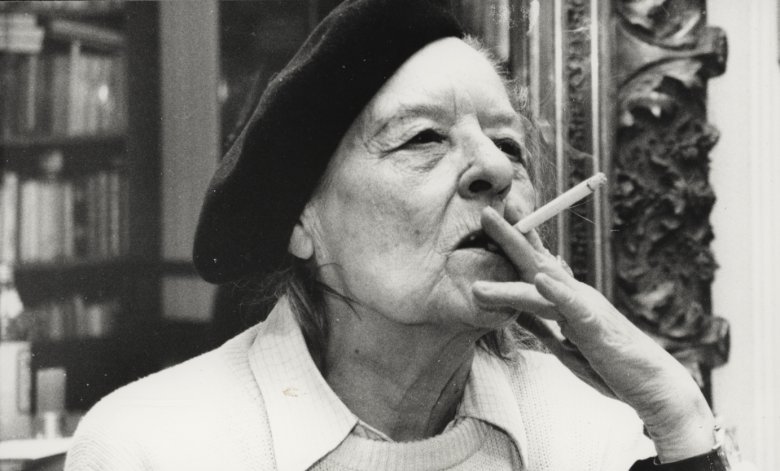
In an interview on the occasion of her eightieth birthday, she said that love that comes from the heart is not age-related. And that's that! She is also represented with five poems in the anthology "Glashaus", a collection of poems by Saarland authors. This was published in 1991. Even in old age, she continued to write poetry. Despite the bereavements and suffering she experienced, there was always one main theme in her life: Love! The visibly emancipated lyricist, who visually reminded us a little of a female Heinrich Böll, can only be admired. Her way of thinking and the lightness captured in many of her poems, combined with the serious themes of life, have the potential to last for generations.
Written by: Jonathan Batz, Bachelor student at Saarland University
Published: 21.10.2025; Last updated: 30.03.2026.
Quotes
You want to find me,
but who
knows where I am.
Does the binding
of words still have a meaning
and every gesture
towards life?
Am I still lying across
in the womb of the earth,
which holds me and does not give me,
and must die
in the courting
for light,
unborn?
Perhaps God has loved me
and lost me again
and does not seek me
and wants my offence
before the beginning.
You want to see me,
but I am
still without a face."
Ruth Ricarda Bruch: Dying and Becoming, 2 August 1999.
from: Emil Dillmann estate in the St. Ingbert town archives
Ruth Ricarda Bruch has [...] written her poems only for herself, 'to cope with what touches and moves me, hurts and delights me, makes me happy and depresses me, frightens and encourages me'.
Her poetry is herself."
Excerpt from the obituary of Ruth Ricarda Bruch.
Emil Dillmann: Having been in love with everyone and everything, in: Saarbrücker Zeitung, 16 August 1999.
Footnotes
[1] Ruth Ricarda Bruch in an interview with the Saarbrücker Zeitung. Dillmann, Emil: Always in love with something, in: Saarbrücker Zeitung, 21 March 1981.
Read more / Literature
Bruch, Ruth Ricarda: Waiting means collecting. Dillingen/Lebach 1983.
This: Wind in the hair. St Ingbert 1988.
Leonhardt, Katja: Weibliches Schreiben in regionalen Strukturen - Saarländische Lyrikerinnen der Gegenwart. Munich 2008.
Supported by: