

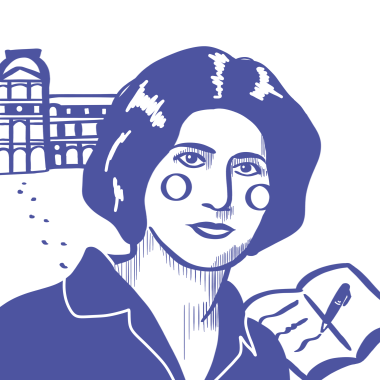
About Edith Aron
Author and translator
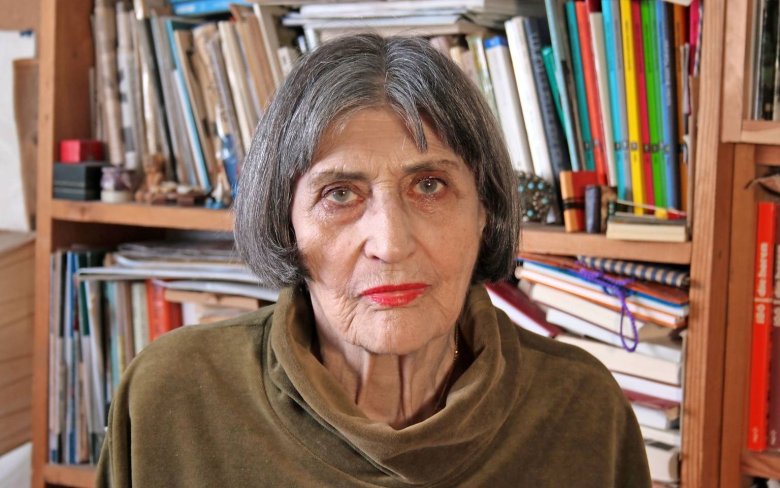
Edith Aron was a writer, translator and journalist. Her life took her from her birthplace of Homburg via Argentina and Paris to London. In her work as a language mediator, she shaped the German-language reception of Latin American literature, above all through her translations of Jorge Luis Borges. Her works are characterised by flight and exile. Although she lived abroad for many years, her origins in the Saarpfalz region remained an important point of reference in her life and work.
Childhood and early emigration
Edith Aron was born on 4 September 1923 in Homburg/Saar (region) and grew up there in a Jewish family. She was the daughter of the merchant Sigmund Aron (1883-1958) and his wife Elisabeth ("Else"), née Wolf (1894-1966).
She spent her childhood in Homburg. The family lived in a beautiful, large house in the leafy suburbs. Edith Aron attended the Jewish school in Homburg. Her teacher Ludwig Samuel was also the prayer leader of the Jewish community.
Her parents separated in 1934. Even before the Saar referendum in 1935, Edith Aron emigrated with her mother to Buenos Aires in Argentina at the age of eleven. Her mother emigrated for personal reasons, as she wanted to start a new life, and not primarily because of Hitler's rise to power. Her father initially stayed in Homburg and later fled to the south of France near Valence, where he survived the Holocaust.
Time in Buenos Aires
In Buenos Aires, Aron attended the Pestalozzi School, which helped her to preserve her mother tongue and was opposed to Nazi Germany. She spent an exciting youth in the "most European city in Latin America", learnt to dance the tango and worked as an office worker. She later worked at the Instituto Cultural Argentino Norteamericano (ICANA) in the music department, where she trained in music.
Return to Europe and the Paris years
Edith Aron returned to Europe in 1950. She met the Argentinian writer Julio Cortázar for the first time in the harbour of Nice. She first visited her father in Sarreguemines (Lorraine) and then settled in Paris. In Paris, she continued her education, attended the Sorbonne, went to the Louvre every day and used the city as a cultural centre.
Pioneer of Latin American literature and muse
Edith Aron began her work as a translator in Paris. She is regarded as the first person to successfully translate contemporary Latin American literature into German. Among the authors she has translated are Julio Cortázar, Jorge Luis Borges and Octavio Paz.
She began her translation work with texts by Cortázar to enable her German friends to read the works of her Argentinian friends. The translator Ré Soupault encouraged and supported her.
Edith Aron was the muse and inspiration for the character of La Maga in Cortázar's famous novel Rayuela (Hickelkasten). Cortázar himself called their relationship a "strong friendship". The fact that she was the inspiration for La Maga only became known in 2003.
Networks and personal life
In Paris, Aron cultivated close contacts with the literary scene. She met Paul Celan, with whom she was connected through their shared linguistic and cultural background, and his wife Gisèle Celan-Lestrange, with whom she remained friends until Gisèle's death in 1991. Celan called Aron "le petit centre" because of her large network. Aron and Celan exchanged ideas, and Aron translated Celan's poem Die Todesfuge into Spanish.
At the end of the 1950s, Aron moved to Berlin for three years, where she met Günter Grass, Heinrich Böll and Hans Magnus Enzensberger, among others. She worked there for Hessischer Rundfunk on Latin American literature.
In 1960, she travelled to Buenos Aires to care for her mother. In the same year, she married the British illustrator John Bergin (1930-1996), whom she had met at the end of the 1950s. Their daughter Joanna was born in 1968.
Break in the translation process
In 1966, the year of her mother's death, Aron suffered a serious setback in her career: Cortázar withdrew the translation rights to his stories. This was one of the worst things that ever happened to her and led to an abrupt end to her career as a translator and the break-up of her friendship with Cortázar. Luchterhand Verlag had previously cancelled translation contracts with her after a new editor, Wolfgang Promies, had negatively assessed her manuscript translation of Cortázar's novel Los Premios due to alleged language deficiencies in German.
Life in London and literary work
In 1969, Edith Aron left Argentina for good and moved to London with her family. She worked there as a German teacher at the Goethe-Institut and later at Imperial College for 15 years.
In London, she devoted herself increasingly to writing autobiographical stories. German served as her "inner home" and helped her to come to terms with her experiences.
Important works (selection):
- The time in the suitcases - stories (1989)
- The Wrong Houses. Stories (1999)
Her stories reflect her experiences from her childhood in Homburg, her emigration and the various (post-)exile stations. The eponymous story The False Houses describes the realisation that there was no home except that of memory and the particular PLACE where she had chosen to live.

Late recognition and death
In 2003, Edith Aron visited her native town of Homburg for the last time and took part in the inauguration of the redesigned ruins of the synagogue as a guest of honour.
The city of Homburg donated the "Edith Aron School Prize" (2011-2013) in her honour for projects on migration and integration. However, Edith Aron asked for the prize to be discontinued, as she did not want to be remembered as a Jewish emigrant, but rather honoured for her own literary work.
Boris Penth, the former director of the Max Ophüls Festival in Saarbrücken, made a documentary film about Aron in 2015: "The paper says nothing, listen". In the film, Aaron talks about her time at the Jewish school in Homburg and the Nazis' rise to power, which she witnessed as a ten-year-old.
Edith Aron died in London on 25 May 2020 at the age of 96. She once summarised her understanding of home: "My home is in literature, with Joseph Roth, in the German language".
Written by: Olivia Zitzmann, Bachelor student at Saarland University
Published: 09.02.2026; Last updated: 30.03.2026.
Quotes
My home is in literature, with Joseph Roth, in the German language."
Edith Aron quoted from Schmuck, Lydia: Translation, Autobiography and Fiction in the Context of Exile, in: Stefanie Kremmel, Julia Richter, Larisa Schippel (eds.): Translation and Exile (1933-1945) III, Berlin 2024, p. 365.
If one of the sentences that Edith Aron says in the film characterises her nature most aptly, it is probably this one: 'I was always inquisitive'."
Portrait of Edith Aron on SR on Sunday. "A peculiar parental home - I had no real support", in: Saarbrücker Zeitung, 18/06/2020
Further reading / literature / sources
Marmit, Jochen: The language in the suitcases. The eventful life of Edith Aron, in: Saarbrücker Hefte. Die saarländische Zeitschrift für Kultur und Gesellschaft, H. 110/111, Saarbrücken 2014, pp. 109-114.
Schmuck, Lydia: Translation, Autobiography and Fiction in the Context of Exile - Edith Aron (1923-2020), in: Stefanie Kremmel, Julia Richter, Larisa Schippel (eds.): Translation and Exile (1933-1945) III: Motifs, Functions and Effects, Berlin 2024, pp. 365-387.
Aron, Edith: Edith Aron: On paths and trails. A reader, edited by Ralph Schock, St. Ingbert 2023.
Supported by: