
About Nina Stantschenkowa
Forced labourer at the Alte Schmelz in St. Ingbert
As part of our project ‘Women’s Traces in the Saarpfalz District’, we also wish to include the life stories of women who were not originally from the region that is now the Saarpfalz District. This article tells the story of a young woman who was deported to St. Ingbert to perform forced labour at the iron and steel works.
Deportation and forced labour
On 25 February 1926, Nina Stantschenkowa was born in Smolensk, in western Russia on the border with Belarus. Her home town was repeatedly a bone of contention between the powers of Belarus, Lithuania and Poland. During the Second World War, Smolensk was once again the scene of fierce fighting between the Red Army and the Wehrmacht, and came under German occupation in 1941. Thousands of people were killed or deported to Germany, including Nina Stantschenkowa, who was just 17 years old and had only just completed her teacher training. On 14 July 1943, after a long journey crammed into a cattle wagon with many other young women, she arrived at the St. Ingbert ironworks. There, she was first issued with her work permit and assigned to work as a core dryer in the foundry, where shells were cast and other war material was produced during the Second World War.[1]
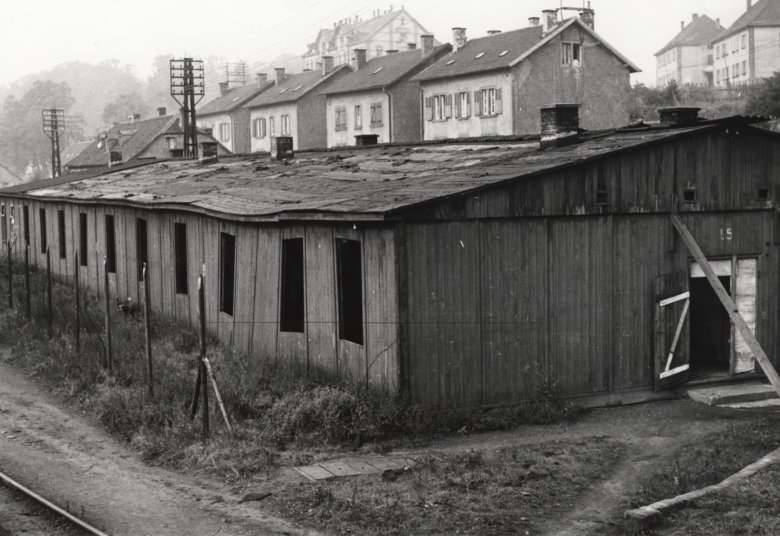
In the late 1980s, her pay slips were even found in the wire factory’s archives, revealing that she ‘earned’ around 80 Reichsmark a month.[2] It must be borne in mind here that forced labourers were generally charged exorbitant sums for board and lodging, leaving them with hardly anything of their already meagre wages. The Russian civilian deportees were housed in barracks built especially for them on the factory premises, where the women slept in bunk beds in large rooms. Shower facilities were set up for them in the basement of the nearby power station. They were fed rather poorly in the so-called ‘Russian kitchen’ in the area of what is now the wire works, whose walls and ceilings the Russian civilian deportees had embellished with fresco-like depictions of their homeland.
Just under nine months later, due to her poor state of health, Nina Stantschenkowa was assigned as a domestic helper to Munzinger, a master butcher in St. Ingbert, who was to ‘nurture her back to health’. She worked side by side with German and foreign labourers on the family’s farm. Together they tilled the fields and ate their meals together, which also led to the development of friendly relationships. This relatively pleasant period came to an abrupt end on 19 January 1945: Nina Stantschenkowa was denounced because an outsider had observed her slipping a piece of dried meat to a pregnant Russian woman, which was regarded as a serious offence at the time. As punishment, she was sent back to the ironworks, where she had to perform hard labour in the foundry. [3] A colleague from the Munzinger butcher’s shop, with whom she had become friends during her time there, would often drop by the camp at the Alte Schmelz to secretly slip her a small piece of meat through the wire from time to time. The food provided to the forced labourers was extremely meagre; hunger was their daily companion. Consequently, many people felt pity for the emaciated figures, but personal contact between Germans and the ‘foreign workers’ was strictly forbidden, and under no circumstances were they to be caught doing so.
During the war, the poor living conditions endured by the Soviet forced labourers led to several escape attempts, including one on 9 November 1942 at the ‘Schmelz’. It is not known what became of the 12 people who escaped from the ironworks on that day.[4] Given the constant surveillance, it is conceivable that many forced labourers were recaptured and severely punished, or shot whilst attempting to escape. Others died of malnutrition, in the bombardments or from infectious diseases. The 27 graves of Russian forced labourers at the St. Ingbert cemetery, including four graves of women, give only a small glimpse of the suffering endured by these people.[5]
Return home
Nina Stantschenkowa, however, had survived and returned to her Russian homeland in March 1945, following the arrival of the Americans in St. Ingbert. By chance, we received information about the rest of her life: in 1987, during the era of glasnost and perestroika, she read a newspaper article about the town twinning between Saarbrücken and Tbilisi and recalled her time in St. Ingbert. On the spur of the moment, she wrote a letter to the editor of a Moscow newspaper, in which she recounted that, even during her difficult time as a forced labourer, there were people who had helped her in her hour of need. As a result, the Russian newspaper’s Bonn correspondent travelled to St. Ingbert to investigate the background to this fascinating story first-hand. It was then that the idea arose to invite Nina Stantschenkowa to the upcoming town festival.
A visit to Germany
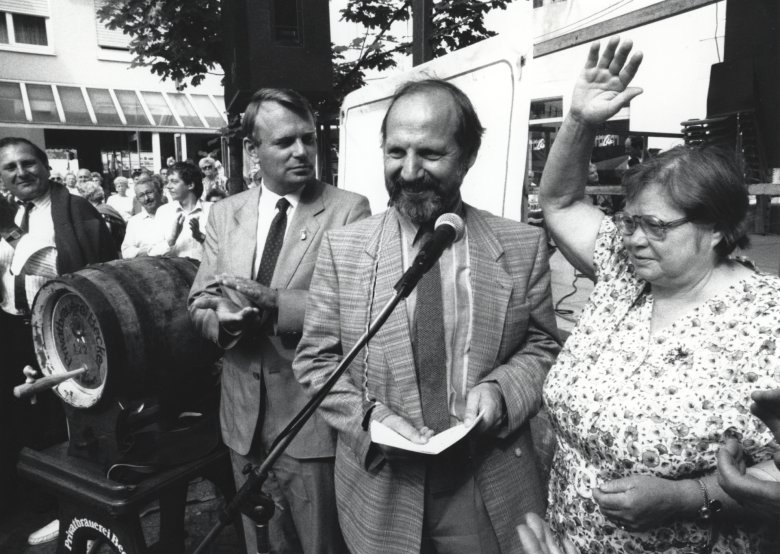
As part of the 1,100th-anniversary celebrations, she visited St. Ingbert for eleven days, where she was welcomed not only by Mayor Winfried Brandenburg but also by the then Minister-President of Saarland, Oskar Lafontaine. The money for the train journey and her stay was raised through private donations – in particular from the Niederwürzbach entrepreneur Wilfried Post – whilst the programme had been organised by the local history and tourism association. At the time, this initiative was unprecedented in the Federal Republic of Germany and generated a huge media buzz; even ZDF sent a television crew.
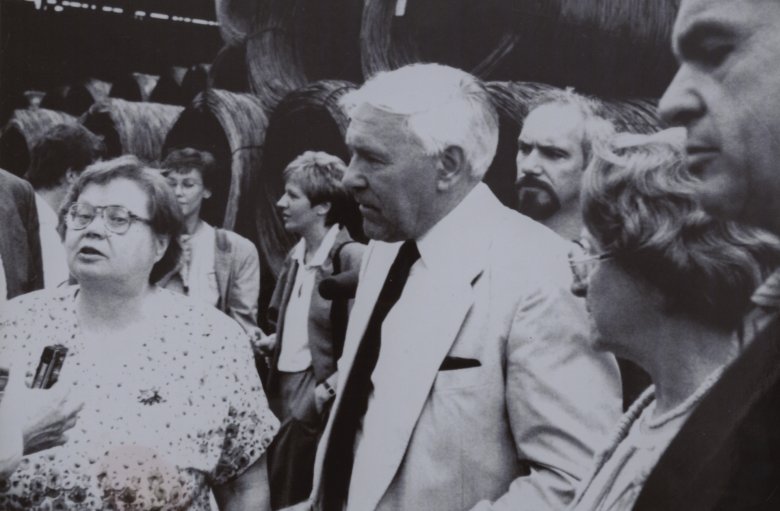
This unexpected reunion after decades provided an opportunity to renew old friendships, for example with her former colleagues at the Munzinger butcher’s shop. Nina Stantschenkowa told them that her ordeal had by no means come to an end with her return to her homeland. Even the journey back took place under difficult conditions and dragged on for a full seven months, during which some of her fellow travellers did not survive the hardships. In Smolensk, however, the returnees were not met with a warm welcome, but with suspicion and, in many cases, the penal camp, for in Stalin’s empire they were suspected of being agents working on behalf of Germany. For a long time, Nina Stantschenkowa was not allowed to practise her original profession as a teacher, but had to work in a plastering firm, where daily contact with plaster caused her health problems with her eyes and internal organs, which plagued her for the rest of her life. Ten years after her visit to the Saarland, a plea for help from her friends in St. Ingbert reached the *Saarbrücker Zeitung*.[6] Nina Stantschenkowa had by then become seriously ill and was in urgent need of financial support and medication. Unfortunately, there is no record of whether the campaign was successful. In any case, she succumbed to kidney disease a few years later in Smolensk.
In 1999, there was a nationwide debate on compensation for former ‘civilian deportees’. This brought back memories of the Soviet citizen Nina Stantschenkowa and her spectacular visit to St. Ingbert one last time.[7]
Written by: Dr Susanne Nimmesgern, historian and women's representative of the Saarpfalz district
Published: 26 October 2026; Last updated: 26 October 2026.
Footnotes
[1] Article in the *SZ* dated 27 June 1988: A farewell to the Ingobertus Festival.
[2] SZ, 22 June 1988: A reunion after 43 years.
[3] See *SZ*, St. Ingbert edition of 29 December 1999 and ibid., 30 December 1999.
[4] Hermann Volk: A Local History Guide to the Sites of Resistance and Persecution 1933–1945, Vol. 4: Saarland, Cologne 1989, p. 155.
Further reading / literature / sources
Nimmesgern, Susanne: *The Women of the Smelter*. Female entrepreneurs, smelter workers and forced labourers at the St. Ingbert Ironworks, edited by the Initiative Alte Schmelz St. Ingbert e.V., St. Ingbert 2012.
Ibid.: Nina Stantschenkowa from Smolensk (born 1926): Forced labourer at the Alte Schmelz, in: St. Ingberter Biografien 2, edited by Heidemarie Ertle and Gerhard Sauder, St. Ingbert 2025, pp. 211–218.
Supported by: