

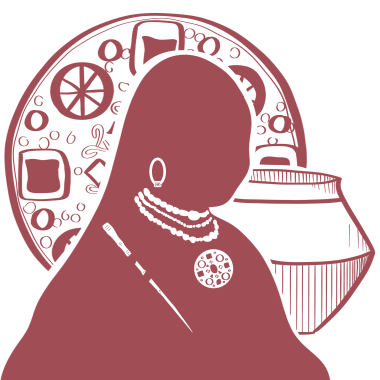
About a Merovingian woman from Altheim
The cemetery as an insight into pre-modern women's history in the Saarpfalz district
The biographies of the women who inhabited the area of today's Saarpfalz district in the period around 600 AD can no longer be reconstructed in detail. However, this does not mean that we have no access to the reality of their lives. An important contribution to this in archaeology is made by the study of grave furnishings. The tradition of burying the deceased with objects of everyday use in so-called row cemeteries became established in the Saar at the beginning of Frankish rule.[1] The grave goods were individual and included both weapons and ritual objects.[2] In the case of women's graves, clothing and jewellery in particular can provide information about the social status, but also personal preferences and habits of those buried.[3]
The largest known early medieval cemetery of this type in the Saarland is located in the Altheim district of the town of Blieskastel.[4] After the archaeological site was discovered during construction work in the mid-1970s, a total of 115 burials were uncovered, the oldest of which date back to the last quarter of the sixth century.[5] Even determining the biological sex poses a challenge. Reliable information can only be provided for 50 graves[6].
A rich grave in a sacred place
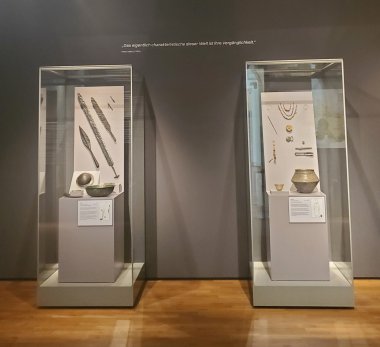
Among the female burials in Altheim, grave number 44 occupies a special position. Its owner was buried here in the first quarter of the seventh century at the age of around 20 to 30 years.[7] She thus reached the average age of the women buried in Altheim.[8] Remarkable is the extremely rich decoration of the grave, which testifies to the high social status of the buried woman.[9] A bronze pin with ornaments was placed diagonally across her chest, which was presumably attached to her robe.[10]
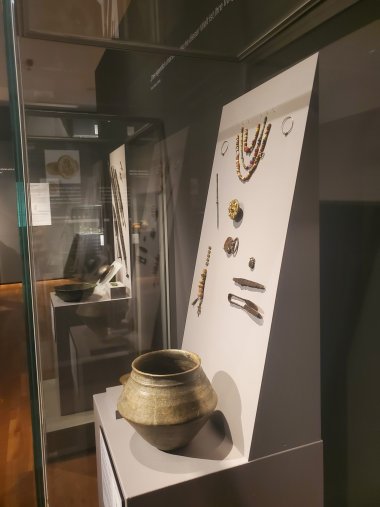
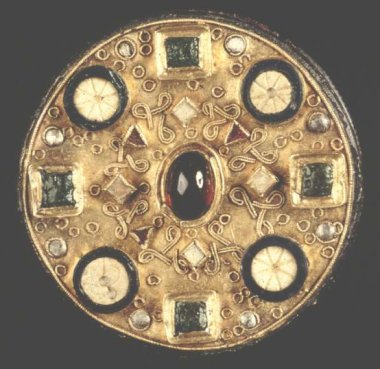
She also wore two silver earrings, the cube-shaped ends of which were also decorated.[11] The necklace around her neck was composed of colourful glass and gold beads and blue-violet gemstones.[12] The grave owner was also in possession of a gold disc brooch with a red jewel (alamandine) set into its centre.[13] This type of brooch, which was generally used to fasten a garment, could only be afforded by the wealthy upper class of early medieval society.[14] Another indication of their social status is the location of the burial site within a wooden church. 15] Burial in sacred buildings is often an indicator that the buried person belonged to a privileged class. 16] It is possible that the grave owner donated the building as her own church and had herself buried there. 17]
Female life and life paths in early medieval Europe
What was the world of the late sixth century like into which the woman from Altheim was born? After the land on the Saar had remained a Roman province until the end of the fifth century, the Frankish king Clovis I integrated the area into the Merovingian domain.[18] In the Merovingian law of the people, the so-called "Lex Salica", she was disadvantaged as a woman in some respects.[19] She was presumably subject to a male munt, who could be either her father, her guardian or her husband.[20] She was also subject to other legal disadvantages. On the one hand, only the male members of a family were entitled to inherit, so that she was excluded from succession.[21] On the other hand, she was also disadvantaged in matrimonial matters, as she was threatened with the death penalty in the event of adultery, while men were often not held accountable for the same offence, or only to a limited extent.[22] In addition, she was generally excluded from exercising public functions in the administration[23].
Contrary to these legal norms, however, in reality women did have room for manoeuvre, especially if they belonged to the upper class of Frankish society, like the tomb owner.[24] For example, they could dispose of property independently of the marital dowry.[25] In addition, many cases have been recorded in which free women acted as heirs and landowners[26] or actively participated in legal transactions by issuing deeds.[27]
It is highly probable that the grave owner was already married during her lifetime, as women in the Merovingian Frankish Empire were usually married between the ages of 15 and 18.[28] She had no decision-making power over the marriage itself. This step was the responsibility of the bride's parents or the paternal munt.[29] Nevertheless, early medieval women were able to act autonomously within the marriage union to a certain extent. In her role as head of the household, she was not only responsible for preparing food or cleaning, but also for managing the entire house and property, which gave her options for action.[30] In addition, women from the "nobility" were generally able to exert influence on political matters. 31]
As an alternative to marriage, female members of the Merovingian upper class could enter a monastery.[32] In the monastic realm, it was even possible to rise to the rank of abbess, the head of the monastery. In this position, women had the power to help shape ecclesiastical affairs, so that they had a decisive influence on the process of Christianisation in early medieval Europe[33].
The life path of the woman buried in Altheim remains an open question. However, her unusual grave furnishings at least give an impression of her importance and social status during her lifetime.
Written by: Aaron Henz, B.A. Historically Oriented Cultural Studies
Published: 09.02.2026; Last updated: 31.03.2026.
Footnotes
[1] Weidemann, Konrad: Die Merowingerzeit im Saarland, in: Römisch-Germanisches Zentralmuseum Mainz (ed.): Führer zu vor- und frühgeschichtlichen Denkmälern, vol. 5, Saarland. mit einer Einführung in die Vor- und Frühgeschichte des Saarlandes, Mainz 1966, p. 72.
[2] Sasse, Barbara: Frauengräber im frühmittelalterlichen Alamannien, in: Affeldt, Werner (ed.): Frauen in Spätantike und Frühmittelalter. Lebensbedingungen - Lebensnormen - Lebensformen, Sigmaringen 1990, p. 45.
[3] Müller, Hermann F..: Das alamannische Gräberfeld von Hemmingen (Kreis Ludwigsburg), Stuttgart 1976, p. 135 f.; quoted in: Martin, Max: Bemerkungen zu Ausstattung der Frauengräber und zur Interpretation der Doppelgräber im frühen Mittelalter, in: Affeldt, Werner (ed.): Frauen in Spätantike und Frühmittelalter. Lebensbedingungen - Lebensnormen - Lebensformen, Sigmaringen 1990, p. 89.
[4] Merkel, Michael: Das frühmittelalterliche Gräberfeld von Altheim, Stadt Blieskastel, Saar-Pfalz-Kreis, Homburg 2004, p. 6.
[5] Ibid, p. 21; p. 135.
[6] Ibid, p. 31.
[7] Ibid, p. 136; p. 227.
[8] Ibid, p. 31.
[9] Ibid, p. 136.
[10] Ibid., p. 113 f.
[11] Ibid., p. 115 f.
[12] Ibid., p. 227 ff.
[13] Ibid, p. 123.
[14] Ibid, p. 121.
[15] Ibid, p. 143.
[16] Werner, Joachim (ed.): Die Ausgrabungen in St. Ulrich und Afra in Augsburg, Munich 1977, p. 219; cited in: Steuer, Heiko: Frühgeschichtliche Sozialstrukturen in Mitteleuropa, Göttingen 1982, p. 361.
[17] Merkel, Michael: Das frühmittelalterliche Gräberfeld von Altheim, p. 143.
[18] Weidemann, Konrad: Die Merowingerzeit im Saarland, p. 72.
[19] Cf. Hartmann, Martina, Die Merowinger, 2nd ed., Munich 2021, p. 71 ff.; cf. also Goetz, Hans-Werner: Frauenbild und weibliche Lebensgestaltung im Fränkischen Reich, in: ders. (ed.): Weibliche Lebensgestaltung im frühen Mittelalter, Cologne 1991, p. 8 ff.
[20] Ibid, p. 9.
[21] Hartmann, Die Merowinger, p. 72.
[22] Ibid.
[23] Goetz, Frauenbild und weibliche Lebensgestaltung, p. 9.
[24] Ibid., p. 21 ff.
[25] Ibid, p. 10.
[26] Ibid.
[27] Heidrich, Ingrid: Besitz und Besitzverfügung freier Frauen, in: Goetz, Hans Werner (ed.): Weibliche Lebensgestaltung im frühen Mittelalter, Cologne 1991, p. 133 f.
[28] Hartmann, Die Merowinger, p. 72.
[29] Ibid.
[30] Goetz, Frauenbild und weibliche Lebensgestaltung, p. 21 f.
[31] Ibid., p. 22 ff.
[32] Ibid, p. 14.
[33] Ibid. P. 22; P. 29.
Further reading / literature / sources
Goetz, Hans-Werner: Frauenbild und weibliche Lebensgestaltung im Fränkischen Reich, in: ders. (ed.): Weibliche Lebensgestaltung im frühen Mittelalter, Cologne 1991, pp. 7-44.
Hartmann, Martina: The Merovingians, 2nd edition, Munich 2021.
Heidrich, Ingrid: Besitz und Besitzverfügung freier Frauen, in: Goetz, Hans-Werner (ed.): Weibliche Lebensgestaltung im frühen Mittelalter, Cologne 1991, pp. 119-138.
Martin, Max: Bemerkungen zu Ausstattung der Frauengräber und zur Interpretation der Doppelgräber im frühen Mittelalter, in: Affeldt, Werner (ed.): Frauen in Spätantike und Frühmittelalter. Living conditions - living norms - forms of life. Beiträge zu einer internationalen Tagung am Fachbereich Geschichtswissenschaften der FREIEN UNIVERSITÄT BERLIN. 18. bis 21. Februar 1987, Sigmaringen 1990, pp. 89-104.
Merkel, Michael: Das frühmittelalterliche Gräberfeld von Altheim, Stadt Blieskastel, Saar-Pfalz-Kreis, Diss., Homburg 2004, available online at: https://macau.uni-kiel.de/receive/diss_mods_00001047 (23 November 2025).
Müller, Hermann Friedrich: The Alamannic cemetery of Hemmingen (Ludwigsburg district). (Forschungen und Berichte zur Vor- und Frühgeschichte in Baden-Württemberg, vol. 7) Stuttgart 1976.
Weidemann, Konrad: Die Merowingerzeit im Saarland, in: Römisch-Germanisches Zentralmuseum Mainz (ed.): Führer zu vor- und frühgeschichtlichen Denkmälern, vol. 5, Saarland. mit einer Einführung in die Vor- und Frühgeschichte des Saarlandes, Mainz 1966.
Werner, Joachim (ed.): Die Ausgrabungen in St Ulrich und Afra in Augsburg, Munich 1977.
Sasse, Barbara: Frauengräber im frühmittelalterlichen Alamannien, in: Affeldt, Werner (ed.): Frauen in Spätantike und Frühmittelalter. Living Conditions - Living Norms - Life Forms. Contributions to an international conference at the Department of History of the FREIEN UNIVERSITÄT BERLIN. 18-21 February 1987, Sigmaringen 1990, pp. 45-64.
Steuer, Heiko: Early historical social structures in Central Europe. Zur Analyse der Auswertungsmethoden des archäologischen Quellenmaterials (Abhandlungen der Akademie der Wissenschaften in Göttingen, Philologisch-Historische Klasse, Folge 3 Nr. 128) Göttingen 1982.
Supported by: