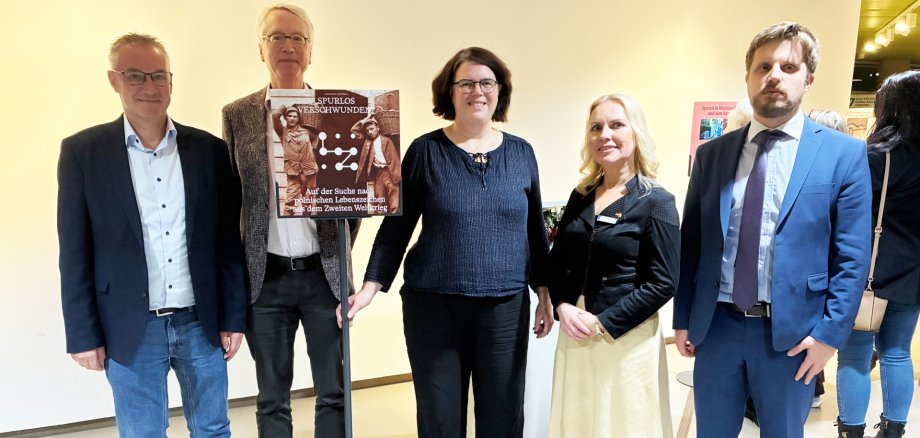
The new exhibition "SPURLOS VERSCHWUNDEN? In Search of Polish Signs of Life from the Second World War" was recently opened in the Saarpfalz district administration and is now open to the public. The exhibition, conceived by the German Poland Institute (DPI), focuses on the fates of the almost three million people from Poland who stayed on German soil due to the war and searches for the hidden "signs of life" in places such as Homburg, Völklingen and Lebach. The fates of Germans who were severely punished by the regime for their humane behaviour towards the Poles have also been discovered in these places.
The exhibition is about Poles who had to perform forced labour in Saarland and Rhineland-Palatinate. Even in the Saarpfalz district, traces of this labour are often no longer visible at first glance. Numerous forced labourers from Poland, but also from Ukraine and other parts of the former Soviet Union, were deployed here. For example, the Reichsbahn maintained a camp for forced labourers in Homburg-Beeden. Men, women and even children from the former Soviet Union, who were then forced to work for the Reichsbahn, were housed there in a gymnasium. In addition, many forced labourers had to work in the industry in Homburg, Bexbach and St. Ingbert under the most difficult conditions, in addition to the Reichsbahn mentioned above, including in the ironworks or in local businesses. Many people did not survive this time. Although over 60 deaths are documented in Homburg, the actual number is likely to be far higher, as many victims were later reburied or never registered. Even if the sites are no longer visible today, it is all the more important to come to terms with the fates and not forget them. Only those who are aware of history can help to ensure that such events are never repeated.
Numerous guests attended the opening of the exhibition, including the Consul for Economic and Cultural Affairs from the Consulate General of the Republic of Poland in Cologne, Bartlomiej Ksiazek, and the Director of the German Poland Institute in Darmstadt, Prof Dr Peter Oliver Loew.
In his speech, District Administrator Frank John emphasised the special significance of the exhibition for the Saarpfalz district and placed the show in the context of the European dialogue:
"Coming to terms with this painful history is a European duty for us. The Saarpfalz district stands for dialogue and for the fact that the fates of the people who shaped Europe during this time must not be forgotten. Only by honestly making the past visible can we build the necessary bridges of understanding and friendship into the European future," emphasised the District Administrator.
Consul Bartlomiej Ksiazek warmly thanked all those involved in the preparation of this exhibition for their openness and willingness to engage in dialogue, which made it possible to present difficult topics in a factual, sensitive and responsible manner. He noted in his speech:
"We live in times in which historical memory is politicised and disinformation can drown out the voices of witnesses and researchers. This makes initiatives that ensure that remembrance is based on facts, empathy and mutual respect all the more valuable."
Dr Violetta Frys, the Saarpfalz district's European representative, made a direct reference to the current partnerships:
"Our close relations with our Polish partner districts are living proof that we have learnt from history. This exhibition is not just a look back, but the basis on which we will continue to deepen our German-Polish friendship. With further projects, we want to give people from the Saarpfalz district more opportunities for exchange with our Polish partner districts."
The Director of the German Poland Institute, Prof Dr Peter Oliver Loew, gave an example of the human relations between Germans and Poles at the time, reporting on a love affair between a German and a Pole in Beckingen in 1942, from which a child was born. This was strictly forbidden. The German woman died in Ravensbrück concentration camp shortly before the end of the war, while the Polish forced labourer threw himself in front of a train out of desperation.
The creators of the exhibition, project manager Julia Röttjer and Christof Schimsheimer from the DPI, picked up on such stories and told them in their introductory presentation about the different fates of some Poles and Germans who were severely punished for their humanity in inhumane times. These stories can be read on the 23 panels in the Homburg Forum.
The exhibition can be seen during the opening hours of the Homburg district administration, Am Forum 1, until 9 January 2026 and is aimed at all citizens and, in particular, schools and educational institutions in the region.
Due to access restrictions to the district administration (security service), it is necessary to make an appointment in advance by emailing [email protected] or calling (06841) 104-8587. Admission is free.
Opening hours of the district administration:
Monday to Thursday from 8am to 12pm and 1pm to 3.30pm, Friday from 8am to 12pm and 1pm to 3pm.