

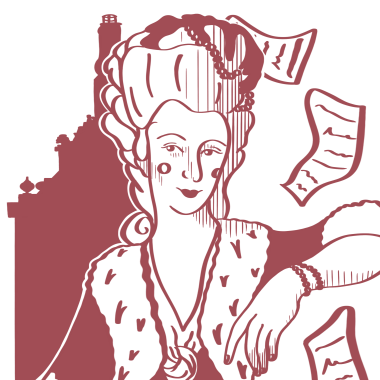
About Marianne von der Leyen
Countess of the realm
Marianne has created a Leyen residence in Blieskastel in around ten years of hard work and sacrifice. What was bought with heavy labour is dear to a person. The Blieskastel residence was for Marianne. Blieskastel had become her town."[1]
From Herrnsheim Castle to the Belgian province of Limburg (1745-1765)
Maria Anna[2] was born in Mainz on 21 March 1745 as the eldest daughter of Franz Heinrich von Dalberg and Maria Sophie Anna von Eltz-Kempenich.[3] She spent her childhood and youth between the von Dalberg family residence at Herrnsheim Palace and her parents' city palace in Mainz. She was brought up according to the family's Catholic faith and educated in the knowledge of a young noblewoman. After her mother's death, Marianne was taken in by her aunt[4], abbess of the Münster-Bilsen convent. As a lady of the convent, Maria Anna lived there in 1764/65 in a spiritual community of noble ladies who dedicated themselves to charity[5].
Koblenz and Blieskastel (1765-1773)
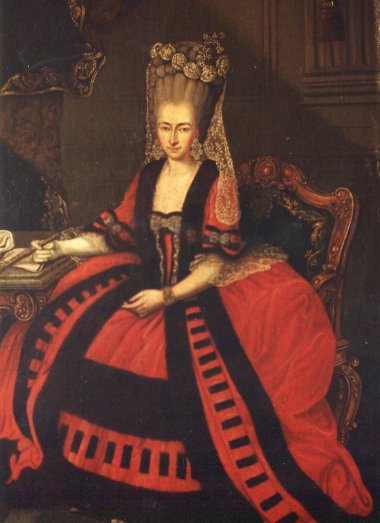
On 16 September 1765, Maria Anna and Franz Georg Carl Anton von der Leyen[6] tied the knot in Mainz. From there, the couple travelled to the Leyen court in Koblenz, the family's ancestral seat. Their marriage produced three children, of whom Philipp[7], the only son, was to become Franz Carl's heir. In 1773, Koblenz's time as the residence of the Imperial Counts von der Leyen came to an end, while the expansion of Blieskastel into Franz Carl's new seat of power began. The move of the imperial count's family and staff in May 1773 required, among other things, structural changes within the town and an expansion of the infrastructure. New buildings had to be erected to accommodate the court officials and councillors with their families, the servants and the count's administration[8]. Streets were widened and extended to create space for trade and businesses, which in turn served as a source of income and supplies.[9] Within a few years, the town of Blieskastel grew beyond its previous boundaries to become an imperial count's residence town in the contemporary style.
Widow, head guardian, regent (1775-1791)
After Franz Carl's sudden death on 26 September 1775, Maria Anna was appointed head guardian[10] for the three children Philipp, Charlotte Maria and Maria Sofia, who were still minors, in accordance with the family order.
The head guardian acts independently in the current and urgent matters of the family and the government; in urgent and important cases she has to call in the advisory board and the authorisation of the guardians. Her residence is Blieskastel."[11]
For Maria Anna, the death of her husband meant not only bringing up and guarding her children, but also exercising the regency over the family's estates until Philip was able to reign. She devoted herself to her son "otherwise tending towards patriarchal rigour - in exaggerated maternal care."[12]
As deputy sovereign, Maria Anna held the title "of the Holy Roman Empire, widowed Countess von und zu der Leyen und Hohengeroldseck etc., born Imperial Baroness of Dalberg, Lady of the Order of the Star Cross, as the reigning chief guardian of our minor son and regent of his lands."[13] She continued the building work in Blieskastel in the spirit of Franz Carl, promoted agriculture, industry, trade and crafts within the Oberamt and implemented her own measures of sovereign welfare. An example of this is the creation of a widows' and orphans' fund for the surviving dependants of all servants (1784/75)[14].
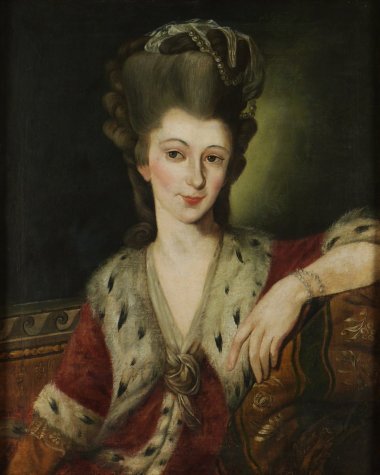
The provisions contained therein went beyond the usual level of provision between the lordship and the families of the servants at the time. Marianne laid the financial foundations and contributed a fixed amount each year. She wanted to ensure that the widows and children (up to the age of 20[15]) of her servants could continue to support themselves after their death. She also promised herself "that all the servants on her side would recognise this exceptional grace and charitable provision with due gratitude and, in its wake, would redouble their zeal for service, as well as being willing to make a proportionate contribution to supplement and strengthen the necessary fund."[16] The fund's benefits consisted of financial support and gifts in kind[17]. If a servant was no longer able to fully perform his duties due to age and/or physical limitations and his salary was therefore adjusted, the basis for calculating the allowance after his death was based on the original (higher) salary.[18] Dr Wolfgang Krämer assessed this institution of Marianne's in his book on the Blieskastel widows' and orphans' fund as follows:
Although the term and name were still lacking at the time, the widows' and orphans' fund offered its members real life insurance."[19] [...] "Many, if not most, of the economic and cultural foundations of the Blieskastel counts' time were failures and doomed to failure from the outset [...] The widows' and orphans' fund established by Countess Marianne is one of the few exceptions. It arose from a sound social idea and was built on a sensible basis, taking into account the experiences in other countries."[20]
In today's parlance, Marianne also implemented measures in the areas of hygiene, disease prevention and medical care in line with the latest knowledge. For example, she established new burial regulations that ordered the cemeteries to be located outside the inhabited area to protect the health of the population: "according to the unanimous opinion of all doctors, it is extremely harmful to human health because of the evil vapours that remain locked inside."[21] Marianne appointed her own doctor, a wound doctor and a pharmacist to provide health care for the inmates of the poorhouse and orphanage.
Years after the regency (1791-1804)
In 1791, when her son reached the age of 25, Maria Anna's guardianship and regency came to an end.[23] On 1 August 1791, Philipp assumed the dignity of Imperial Count and Prince von der Leyen as well as the rule over the estates. Marianne remained in Blieskastel until she fled before being arrested by French troops.[24] She documented this experience in May 1793, which had a profound impact on her and her family, in handwritten notes under the title: Journal de mes malheurs dans la révolution L[an] 1793.[25] Marianne concluded with the words:
I must add that my arrest had been ordered under the reign of Robespierre, and that I would not have escaped the guillotine by false accusation on the part of a criminal if I had been unhappily seized during my flight."[26]
With considerable help from her subjects, she managed to escape and left Blieskastel for good at the end of May 1793. The dowager countess died in Frankfurt on 10 July 1804. She was buried in St Cecilia's Church in Heusenstamm until 1981, when she was moved to the crypt of the castle church, where Franz Carl also rests.
Written by: Raffaela Berger, Head of the Blieskastel City Archive
Published: 28.10.2025; Last updated: 31.03.2026.
Quotes
Her judgement was sharp and quick, and she had a practical eye, energy and knowledge of human nature. [....] Admittedly, her government did not deal with all the ailments from which her subjects suffered. She herself was often subject to - what was more natural in a woman? - emotional decision. But on the whole, the Regent of the Blies proved to have a clear head and a firm will, even when measures had to be taken independently later on. As difficult as it may have been for her at first to bear the yoke of threefold responsibility, after a short time she went her own way, serious and gentle, firm and kind, friendly and conscientious - as a highly respected governor."
Oath: Marianne von der Leyen, p. 75.
Maria Anna favoured a personal style of government with direct contact to her subjects [...] demonstrated considerable abilities in the unforeseen assumption of governmental duties in the spirit of the enlightened times, but without being able to escape the absolutist vicious circle of high court expenses and financial difficulties of the state. In the harsh trials of fate, she showed courage and greatness of soul. It was not until the end of the 19th century that she finally gained the not undeserved fame of the people of her Saarland homeland as the great imperial countess of the Westrich."
Dotzauer, Winfried, "Marianne" in: Neue Deutsche Biographie 16 (1990), pp. 209-210 [online version]; URL: https://www.deutsche-biographie.de/pnd123726832.html#ndbcontent [21 OCT. 2025].
Consequently, it was in my interest, as well as that of my son and his subordinates, to return to my home to undergo whatever the grave moment of my concern might dictate."
Marianne on her return to Blieskastel at the end of 1792 and shortly before the occupation of the castle and the town by French troops.
In the original in French "[...] par la suite il était d `ailleurs nécéssaire pour mes intérêts autant que pour ceux de mom fils, et de ses sujets, que je retournâsse dans mes foyers; pour m`y livrer à tout ce que l`importance du moment pouvait dicter à mes soins." in: Quasten: Stadt und Herrschaft Blieskastel, 2015, p. 189.
Footnotes
[1] Ludwig Eid: Marianne von der Leyen. Leben Staat Wirken, edited by Dr Wolfgang Krämer, Saarbrücken 1937, p. 72.
[2 ] There are different variants of her other first names. According to the inscription on her sarcophagus in the crypt of the church of St Anna and St Philipp (Schloßkirche) in Blieskastel and on the tombstone in St Cäcilia in Heusenstamm, her full name is: Maria Anna Sophia Franziska Walburga; see also: Marianne von der Leyen. Transfer of the coffin with the remains of the Imperial Countess Marianne von der Leyen from the crypt of the parish church of St Cecilia in Heusenstamm to the crypt of Blieskastel Castle Church. In the birth register of 1745 and the marriage register of 1765 of the city archives of Mainz, her first name is: Maria Anna Helena Catharina Josepha, Stadtarchiv Blieskastel (StaB), Bestand 1 Nr. 4. The latter variant can also be found in the monograph by Ludwig Eid, where it says on page 4: "On 21 March 1745 she entered life. She was baptised on the same day at St. Emmeran's in Mainz. The godmothers were the two grandmothers who, united as sisters, poured out all their first names on the one happy little daughter. First the Herrnsheim grandmother gave her two first names Maria Anna, then the Mainz grandmother gave her three: Katharina Helena Josepha." The Hessian Biography contains the variant: Maria Anna Helene Josephina, see "Leyen und zu Hohengeroldseck, Maria Anna Gräfin von der", in: Hessian Biography https://www.lagis-hessen.de/pnd/123726832 [21 October 2025]. For the sake of simplicity, the short form Maria Anna or Marianne is used in this text.
[3] Baron Franz Heinrich, chamberlain of Worms called von Dalberg (1716-1776), Privy Councillor, Oberamtmann in Oppenheim, governor in Worms. Maria Sophie Anna, Baroness of Eltz-Kempenich (1722-1763), name variant Sophie Maria Anna. See also: "Cämmerer von Worms Freiherr von und zu Dalberg, Franz Heinrich", in: Hessische Biografie https://www.lagis-hessen.de/pnd/136913458 [21 Oct. 2025] and Dalberg, Franz Heinrich Freiherr von, index entry: Deutsche Biographie, https://www.deutsche-biographie.de/pnd136913458.html [21 Oct. 2025].
[4] Antonetta Maria, Countess of Eltz-Kempenich, imperial princess, abbess of Münster-Bilsen Abbey in the province of Limburg. See also: Oath: Marianne von der Leyen, p. 6f; "Leyen und zu Hohengeroldseck, Maria Anna Gräfin von der", in: Hessische Biografie https://www.lagis-hessen.de/pnd/123726832 [21 Oct. 2025].
[5] Oath: Marianne von der Leyen, p. 7.
[6] Franz Georg Carl Anton von der Leyen (1736-1775), Count of Petra (Leyen) and Hohengeroldseck, Lord of Adendorf, Blieskastel, Münchweiler etc., Privy Councillor and Chamberlain, Grand Commander of the Order of St Joseph. Privy Councillor and Chamberlain, Grand Commander of the Order of St Joseph, see: Death register of the parish of Blieskastel 1775, StaB, fonds 58-1-S-1, marriage register of the parish of St Emmeran for the year 1765, StaB fonds 1-4 and "Leyen und zu Hohengeroldseck, Franz Georg Carl Anton Graf von der", in: Hessische Biografie https://www.lagis-hessen.de/pnd/136927467 [21 Oct. 2025].
[7] Philipp Franz Wilhelm Ignaz Peter, Imperial Count and Prince von der Leyen (1766-1829) http://www.saarland-biografien.de/frontend/php/ergebnis_detail.php?id=849 [21 October 2025], Charlotte Maria Anna Sofia (1768-1832), Maria Sofia Antoinette Charlotta Klara Elisabetha Thekla (1769-1834), see: Oath: Marianne von der Leyen, p. 21.
[8] These include, for example, the buildings known today as the Hofratshäuser on the upper Schlossberg and the construction of the Oberamt- und Waisenhaus in 1774/75 on the newly created Paradeplatz. Franz Carl also brought about the establishment of a Franciscan monastery, whose monastery church still exists today as St Anna and St Philipp (castle church). See also: Wolfgang Laufer: Stadt und Herrschaft Blieskastel unter den Grafen von der Leyen und unter französischer Hoheit 1660-1793/-1815, edited by Heinz Quasten, Saarbrücken 2015, p. 239f.
[9] Franz Carl supported the founding of several businesses, e.g. a siamoise and cloth factory (1774) and a porcelain factory (1775). Later, under Maria Anna's regency, a talc and starch factory (1778) and a hat factory (1780) were added. In addition, between 1779 and 1786, several smelters (alum, soot, brick and resin smelters) were established in the St. Ingbert area, which were under the control of the Imperial Count's sovereignty. See also: Quasten, Stadt und Herrschaft Blieskastel, 2015, p. 239.
[10] German Legal Dictionary, available online at: https://drw.hadw-bw.de/drw-cgi/zeige?index=lemmata&term=obervormuenderin [22 October 2025]. The brothers Franz Carls, Damian Friedrich von der Leyen and Franz Erwein von der Leyen acted as counsellors.
[11] Oath: Marianne von der Leyen, p. 59.
[12] Dotzauer, Winfried, "Marianne" in: Neue Deutsche Biographie 16 (1990), pp. 209-210 [online version]; URL: https://www.deutsche-biographie.de/pnd123726832.html#ndbcontent [22 OCT. 2025].
[13] For this see, for example, StaB, fonds 1 no. 16, Maria Anna's decree of 27 September 1784.
[14] StaB, Bestand 1 Nr. 16, Ordinance of 27 September 1784, which came into force in 1875.
[15] Ibid, § 5.
[16] Ibid., in the text preceding the paragraphs.
[17] Ibid., § 2 and 3.
[18] Ibid, §4.
[19] Dr Wolfang Krämer: Die Blieskasteler Witwen- und Waisenkasse vom Jahre 1785, special edition of Palatina 1934, p. 8.
[20] Ibid, p. 26.
[21] StaB, fonds 1 no. 44, Maria Anna's decree of 18 May 1784.
[22] StaB, Bestand 2 Nr. 47, Rechnung der Verwaltung des Waisen- und Armenstifts in der Stadt Blieskastel nebst einer beigefügtten Geschichte seiner Entstehung, seines Verfalls und Wiedererhebung 1804-1805, written by Franz Carl Derkum in January 1806, Zweite Abteilung, § 3.
[23] According to state law, Marianne's guardianship of Philipp would have ended at his wedding in 1789, but according to family law, he only reached the age of 25 on 1 August 1791. See Eid: Marianne von der Leyen, p. 233.
[24] Marianne, like the neighbouring sovereigns, was to be accused of being hostile to the republic, arrested and transferred to Paris. This was preceded by the so-called Liberation Decree of 19 November 1792, in which the new French Republic promised help to all other peoples oppressed by the nobility. "The Frankish nation declares that it will treat as its enemy any nation that does not accept the freedom and equality offered to it [...]." Quoted from: Quasten: Stadt und Herrschaft Blieskastel, 2015, p. 241. On Marianne's flight, see ibid. chapter: New sources and observations on the flight of Countess Marianne von der Leyen in 1793, pp. 183-197.
[25] StaB, fonds 60 no. 9, copy of the handwritten original from the former Fürstlich von der Leyensches Archiv Schloß Waal (FLA Waal no. 603), today in the Landeshauptarchiv Koblenz (LHA Ko) fonds 48, no. 767.
[26] Ibid., in the original in French: Il faut ajouter à mon arrestation qu`elle était faite sous le règne de Robespierre et que par une fausse arrestation d`un brigand je ne pouvais échapper à la guillotine, si par malheur j`étais reprise dans ma fuite . Translation taken from: Dr Wolfgang Laufer: Neue Quellen und Beobachtungen zur Flucht der Gräfin Marianne von der Leyen 1793, in: Quasten: Stadt und Herrschaft Blieskastel, 2015, p. 196.
Further reading / literature / sources
Sources from the Blieskastel town archive (StaB):
Fonds 1 No. 4, birth register of the parish of St Emmeran 1745 and marriage register of the parish of St Emmeran for the year 1765.
Inventory 1 No. 16, Maria Anna's decree of 27 September 1784.
Inventory 1 No. 44, Maria Anna's decree of 18 May 1784.
Fonds 2: No. 47, account of the administration of the orphanage and almshouse in the town of Blieskastel together with an appended history of its creation, decline and re-establishment in 1804-1805, written by Franz Carl Derkum in January 1806.
Fonds 58 No. 1-S-1, death register of the parish of Blieskastel 1775.
Fonds 60 no. 9, Journal de mes malheurs dans la révolution L[an] 1793, copy from the former Fürstlich von der Leyensches Archiv Schloß Waal (FLA Waal no. 603), original in the Landeshauptarchiv Koblenz (LHA Ko) fonds 48, no. 767.
Online sources:
"Leyen und zu Hohengeroldseck, Maria Anna Gräfin von der", in: Hessian Biography https://www.lagis-hessen.de/pnd/123726832
"Cämmerer von Worms Freiherr von und zu Dalberg, Franz Heinrich", in: Hessische Biografie https://www.lagis-hessen.de/pnd/136913458
"Dalberg, Franz Heinrich Freiherr von", index entry: German Biography, https://www.deutsche-biographie.de/pnd136913458.html
"Leyen und zu Hohengeroldseck, Franz Georg Carl Anton Graf von der", in: Hessian Biography https://www.lagis-hessen.de/pnd/136927467
"Philipp Franz Wilhelm Ignaz Peter, Imperial Count and Prince von der Leyen", in Saarland Biographies: http://www.saarland-biografien.de/frontend/php/ergebnis_detail.php?id=849
Obervormünderin, in: German Legal Dictionary, available online at: https://drw.hadw-bw.de/drw-cgi/zeige?index=lemmata&term=obervormuenderin
Dotzauer, Winfried, "Marianne" in: Neue Deutsche Biographie 16 (1990), pp. 209-210 [online version]; URL: https://www.deutsche-biographie.de/pnd123726832.html#ndbcontent
Literature:
Ludwig Eid: Marianne von der Leyen. Leben Staat Wirken, edited by Dr Wolfgang Krämer, Saarbrücken 1937.
Marianne von der Leyen. Transfer of the coffin with the remains of the Imperial Countess Marianne von der Leyen from the crypt of the parish church of St Cecilia in Heusenstamm to the crypt of the castle church of Blieskastel, documentation from 28 to 30 August 1981.
Wolfgang Laufer: Stadt und Herrschaft Blieskastel unter den Grafen von der Leyen und unter französischer Hoheit 1660-1793/-1815, edited by Heinz Quasten, Saarbrücken 2015.
Dr Wolfang Krämer: Die Blieskasteler Witwen- und Waisenkasse vom Jahre 1785, special edition of Palatina 1934.
Supported by: