


About Ledwina Lechner
NS resister
As a teacher of the girls at school, I repeatedly educated them about National Socialism and its terrible consequences and I am certain that these girls will never flirt with such extreme political world views". [1]
Parental home and profession
Ledwina Lechner was born on 20 March 1913 in Rodalben, the fifth of eight children in a Roman Catholic family. Her parents Franz Lechner and Dorothea, née Klein, raised Ledwina and her siblings in a strictly religious manner and their Christian life set the tone for Ledwina. Her father taught her about Hitler and his ideas at an early age. After Ledwina saw men in brown uniforms in 1928, her father explained that they were not soldiers, but Nazis and "not people of our persuasion."[2] A decisive statement for Ledwina's future, which she followed for the next few years and, with the passage of time and her own observations, developed her own aversion to National Socialism and thus rejected it.
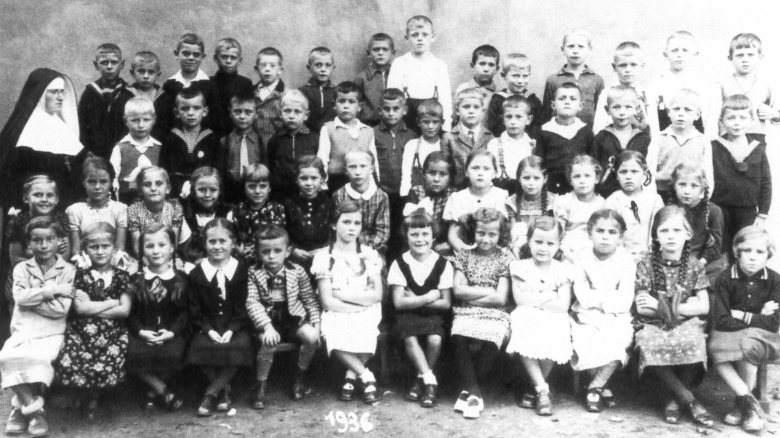
In April 1926, she entered the Dominican Teachers' Seminary in Speyer as a candidate and after successfully completing her studies in March 1932, she was ordained as a Dominican in August 1932 and was accepted into the novitiate. She took her profession (vows) in August 1932, even though Hitler had already seized power. Her religious name was Abscondia or Abscondita. [3]
Resistance against the NS
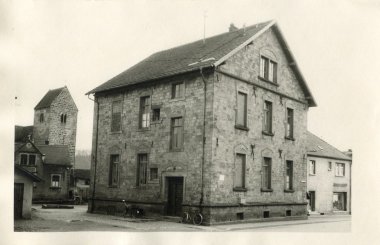
She came to Blickweiler in September 1933 and taught at the primary school until 1937. However, on 1 April 1937, all convent teachers were dismissed from their posts by Nazi law. Ledwina Lechner continued to work as an organiser, choirmaster, managed the parish library and taught religion. As early as 1933, she organised the youth in the Catholic Scout Association.
At this time, Lediwna Lechner worked closely with Änne Meier, who was the Gaufeldmeister for the Saar-Palatinate-Baden tribes at the time. Their work was undisturbed until 1935, when the fight against the Nazis began. Together they tried to keep the youth together so that the BDM - the League of German Girls - could not gain a foothold in Blickweiler.
This led to trouble with the party leadership and the BDM and HJ leaders. They tried to persuade Ledwina to join the BDM, which she naturally refused. From this time of refusal, the period of agitation began. There were even posters inviting the girls to join the BDM "even if certain educational elements wanted to hold them back"[4], referring to Ledwina Lechner. When the Gestapo arrived on the scene, the situation came to a head for her. When they were about to confiscate the Christ and Lily banners, Ledwina "bequeathed them to the church as property"[5] and thus saved them in time.
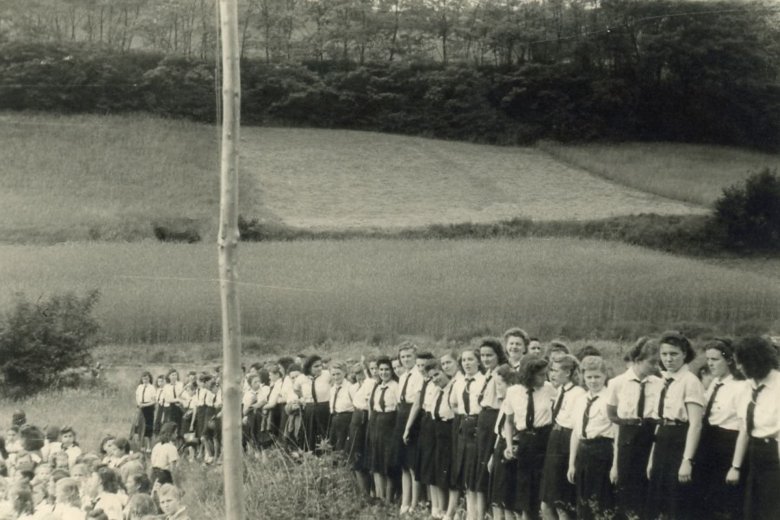
Catholic youth organisations were also banned in the meantime, but thanks to Ledwina they continued to exist and she led these groups as singing and Bible study groups. Together they read the Mölders and Galen letters, the circular letters of the Federation and the instructions they received from their spiritual leader (curate), so they were always informed about the goals of the National Socialists and held on to their own ideals all the more. They not only saved the banners from the Gestapo, but also beat them to it with the parish registers. When they arrived, they only found empty shelves with old books, all the others were "on loan" because Ledwina had given them to reliable people for safekeeping. According to her statement, her well-known derogatory attitude towards the National Socialists infuriated so-called "super National Socialists"[6]. She was accused of refusing to give the Hitler salute. When she was working in the flower bed on one of the "Führer's" birthdays, the HJ 30 metres away from her started a chant: "Only Nazi opponents work on the Führer's birthday"[7].
Prison and its consequences
They were then evacuated to Thuringia in 1939. There they were obliged to serve with the school for the duration of the war and when the Saarlanders were able to return in 1940, they submitted their notice of release, which was granted. Many residents from Blickweiler were evacuated to Münsterschwarzach, where they were housed in a Benedictine abbey. In May 1941, however, this abbey was also forcibly closed as part of the abolition of the monastery. Benedictines sent circular letters to friends to report on their exile and what was happening there. The Gestapo searched for the letters and their authors. Ledwina Lechner had also received such a letter. When a chaplain in Kaiserslautern asked her whether the events were true, she gave him her letter to read. However, he made use of it among his confreres and so Ledwina Lechner was ultimately arrested alongside those who had reference to this letter.
She refused to say who the letters were from, even after 1 1/2 hours of interrogation and after all kinds of coaxing and threats. In the end, she was charged with "malice". From 25 July to 21 December 1941, she was remanded in custody in Saarbrücken Lerchesflur. She was released by the special court in Berlin without trial and without punishment. Just one day later, the Gestapo searched for her, first in prison and then in Blickweiler. But Ledwina Lechner was already in Munich, having been advised to leave Saarland-Palatinate in order to avoid re-arrest. The arrest warrant was cancelled in March.
Ledwina herself reports on the hardship and humiliations to which she was subjected as a political prisoner. The deprivation and overstimulation of her nerves left her with severe physical damage. She worked as a housemaid in the prison and had the task of "hauling" the heavy crates of coke into the heating system with others. In doing so, she suffered a cervical spinal dislocation, which became worse and worse over the years. An operation in 1953 is said to have brought no improvement and Ledwina received regular medical treatment for the rest of her life. The psychological traces in her body lasted until after her release. Only when the Americans stood before them, albeit as enemies, did the fear of the Nazi regime recede. "I watched the resurgence of the Nazis in the NPD with horror, but also with even greater satisfaction at their defeat in the last elections."[8] Ledwina Lechner died in 2000.
Written by: Janine Lea Koch, Bachelor student of historically orientated cultural studies
Published: 09.02.2026; Last updated: 31.03.2026.
Footnotes
[1] Report by Ledwina Lechner, written in 1969 in St. Ingbert, in: Elling, Hanna: Frauen im deutschen Widerstand 1933-45. Frankfurt am Main 1978, p. 120.
[2] Ibid. S.118.
[3] Gudrun, Müller: Frauen vor Ort. In search of traces in the Saarland districts. Series of publications by the Saarland Chamber of Labour on labour and social history, Volume 4. St. Ingbert 2024, p. 296; Historischer Interessenverein Blickweiler (ed.), Blickweiler im Wandel der Zeit, 2000, p. 214.
Further reading / literature / sources
Bies, Luitwin: Resistance from the Kazholian millieu. St. Ingbert 1993, p.27.
Elling, Hanna: Women in the German Resistance 1933-45, Frankfurt am Main 1978, pp. 117-120.
Gudrun, Müller: Women on site. In search of traces in the Saarland districts. Series of publications by the Saarland Chamber of Labour on labour and social history, Volume 4. St. Ingbert 2024, p. 296f.
Wenke, Bettina: Interviews with survivors. Persecution and resistance in south-west Germany. Stuttgart 1980.
Supported by: