

About Maria Kraemer
Entrepreneur's wife and patron
Maria Kraemer was the sister, one year younger, of Carl Ferdinand Stumm, who ruled the Neunkirchen ironworks with carrots and sticks and was dubbed the "King of Saarabia" by the up-and-coming social democrats. Although she grew up in a very privileged position in the magnificent neoclassical Stumm mansion on Saarbrücker Straße, she had to cope with many a stroke of fate in the course of her life. She became a half-orphan at the age of 11 when her father committed suicide. She was 19 when she married Heinrich Kraemer, eight years her senior, the commercial manager of the St. Ingbert ironworks, who later shared the management of the company with his cousin Oskar.
Hostess at Schloss Elsterstein and supporter of the Protestant parish
After the wedding, the young couple made their home at Schloss Elsterstein, which was nestled in a spacious park and towered majestically over the town of St. Ingbert. Maria took care of the upbringing of her two sons Heinrich (born in 1858) and Friedrich (born in 1863) and was also active in charitable work: During the Franco-Prussian War, whose battles were also fought near St. Ingbert, she organised the care of the wounded. For this commitment, she not only received the Iron Cross with the black and white ribbon, but was also awarded a medal of honour by the French[1].
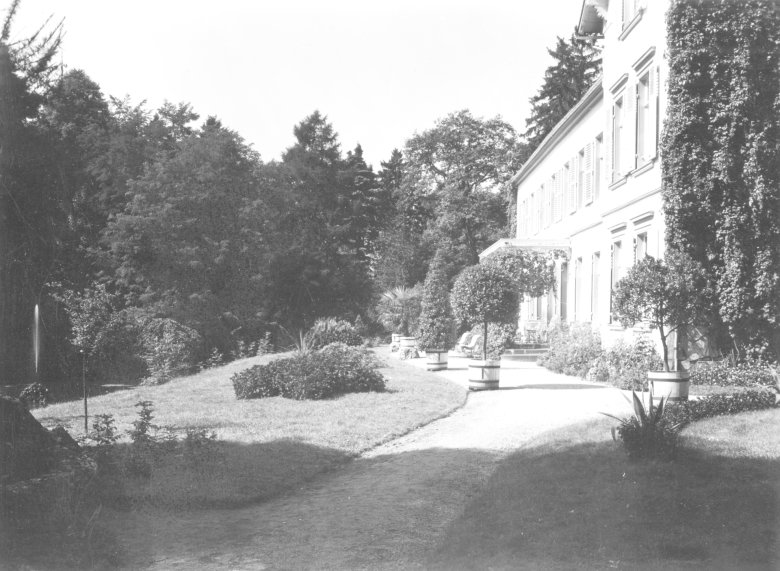
The Protestant parish was also able to rely on her support, so she donated an organ to the Martin Luther Church in 1865 and a bell in 1905, which was given her name and served until 1953. On the occasion of her golden wedding anniversary, she set up a foundation called the Heinrich Maria Foundation, which helped needy families year after year.
Together with Anna Kraemer, née Hauck, who was married to her husband's cousin Oskar Kraemer and lived in Rentrischer Schlösschen, she campaigned for the establishment of a deaconess station. In 1865, the two women were successful in getting the first deaconess to take up her duties in caring for the sick and poor, an important step in the establishment of a regulated support system. Three years later, a house was built in Josefstaler Straße with funds from the Kraemer family, into which an infant care centre for the children of the factory workers moved and the now three deaconesses were given a place to live. From here, the parish nurses were also able to care for patients in the nearby Schmelzer Hospital in Kohlenstraße. In 1909, the Kraemers donated the house to the Protestant Diaconia Association, which had emerged from the women's association founded by the Kraemer ladies.
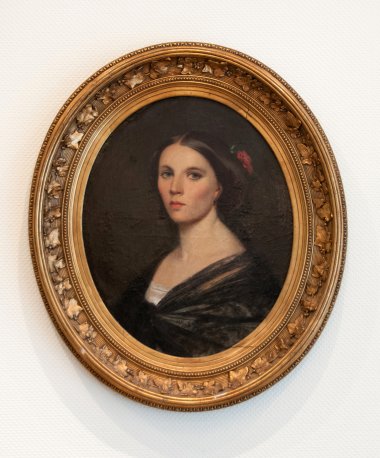
Maria Kraemer also headed the Red Cross Women's Association together with Anna Kraemer and organised a female ambulance service.
In addition to their charitable duties, representation played an important role in the lives of upper-class women. Maria Kraemer ran a stately home, which included a family of four as well as many servants. A guest book of the Elsterstein, which was created in 1869 and lovingly decorated with high-quality details, documents the social activities that were essential for socialising in these circles over the years. Guests often stayed at Elsterstein Castle for several days or even weeks. Every year in October, hunts lasting several days were organised with sumptuous evening soups, during which the mistresses of Elsterstein Castle and Rentrischer Schlösschen took turns in entertaining their often aristocratic guests.
At the beginning of the 20th century, things became quieter at Schloss Elstertein, at the latest in 1912 with the death of the landlord Heinrich Kraemer. What remained was his widow Maria, who in the same year had to cope with the loss of her youngest son, who had put an untimely end to his life in his hunting lodge in Ormesheim.
The entrepreneurial wives Maria and Anna Kraemer can be seen as a vivid example of the bourgeois family ideal of the 19th century, which envisaged a strict division of roles between the sexes: It was the women's task to head the household and to contribute to representation befitting their status and to increase the family's reputation through upscale hospitality. Social engagement was also seen as a female field of activity, which offered women from these circles a welcome opportunity to make a positive impact in their environment and exert their influence.
Written by: Dr Susanne Nimmesgern, historian and women's representative of the Saarpfalz district
Published: 30.10.2025; Last updated: 31.03.2026.
Quotes
The venerable giant trees in Elsterstein Castle Park stand in silent mourning today. Their branches and twigs bow reverently before the bier of their mistress, who is being carried out to the castle today to be laid to rest alongside her husband in the family crypt in the cool bosom of the earth. If these old giant trees could still talk. They would tell of the days when the old woman who is carried out today still walked under their shade as a happy bride and young wife at her husband's side. They could tell of the hospitality and the joyful celebrations at Schloss Elsterstein in the days when the Kraemer family was at the centre of social life on the Saar[...].
At the open grave, town pastor Albrecht took the floor for a profound speech, in which he paid special tribute to the deceased's services to the Protestant religious community. He described Mrs Kraemer as a good, pious, loyal mother and wife, as she was known by the entire Jewish community."
Report in the St. Ingberter Anzeiger of 27 January 1927, reprinted in Scholl, Josef: Schloss Elsterstein und die Leyenschen Güter mit Wald und Kohlengruben, St. Ingbert 1981, p. 76 f.
Footnote
[1] Cf. Orth, Karl: Die Orth und die Krämer. Geschichte zweier Kurpfälzer Familien, Munich/Berlin 1935, p. 159f.
Read more
Nimmesgern, Susanne: The women smelters: Female entrepreneurs, smelter's wives, forced labourers at the St. Ingbert ironworks, published by the Initiative Alte Schmelz St. Ingbert, St. Ingbert 2012, pp. 197-203.
Supported by: