

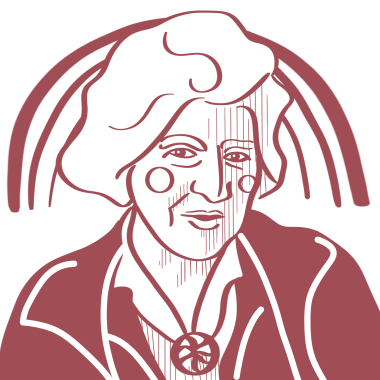
About Maria Bauer
Teacher, mountaineer and travel writer
You feel your way into the future, sometimes pondering past decades. It seems to me that this works best in a garden shed. It can also be an invisible one. Because "the essential is invisible to the eyes". So says the Little Prince to Saint-Exupéry."
Maria Bauer talks about her eventful life in her autobiographical work "The rainbow has seven colours"
From Kusel via Altheim into the world
Maria Bauer was born in Kusel in 1898 as the second eldest child in a family of cloth sellers and spent her childhood and early school years there. When she was four years old, her father died and the family moved into her grandparents' house "An der Landschaft" in Kusel.[1] In 1914, she began her training as a teacher at the Dominican Sisters of St Magdalena in Speyer. There she showed a particular affinity for art, literature and religion - interests that were to characterise her entire life. She also had the opportunity to learn to play various instruments such as the organ and violin. However, she was particularly enthusiastic about the scientific subjects of maths and physics.[2] At the same time, she took on voluntary military hospital duties. The confrontation with war, human suffering and personal loss characterised Maria Bauer in a way that decisively shaped her future life and world view. In 1917, she passed her teacher's examination and began teaching at various schools[3].
Among other things, she taught in Altheim (now Blieskastel), where she experienced the period after the end of the war. She also shed light on this station later in her autobiography[4].
Parallel to her teaching activities, she continued her education. In 1923, she was released from teaching duties and moved to Munich. She studied education, philosophy and German language and literature in Munich and Marburg. She completed her A-levels at the same time. She used her weekends and holidays for hiking trips in Germany, Austria and Switzerland.[5] Inspired by her brother Paul Bauer, she became interested in mountaineering. As he refused to take her on a mountain tour, she began to organise tours in the Alps herself, together with experienced mountain guides. She set herself the goal of climbing various three-thousand metre peaks on her own.[6] In her dissertation in 1927, she dealt with the relationship of man to his time, a core motif of existential philosophy, which she took up and developed further from the thinking of the world-famous philosopher Martin Heidegger. She passed her doctorate with the grade "magna cum laude" - with great praise.[7] She was also involved in the Catholic youth movement in Quickborn and took part in hikes, religious meetings and educational events.[8]
Return to Kusel and the Second World War
[...] the years I spent studying in Munich, and especially the summer semester in Marburg, stimulated and shaped me intellectually far beyond the confines of a specialised course of study."
Maria Bauer on her time as a student in "The rainbow has seven colours"
Due to a lack of funds, Maria Bauer was denied the opportunity to take the state examination and teach at grammar schools. Instead, she returned to Kusel and taught at the adult education centre again. Although the simple, provincial lifestyle weighed on her, her diverse cultural activities helped her to combat boredom. Her musical and writing skills stood her in good stead. She organised numerous singing weeks and music trips to Europe, Asia and Africa.[9] In 1928, she and her brother Paul Bauer undertook an expedition to the Caucasus.[10] She was also active in war graves and sponsored several military cemeteries, including in Sarajevo and Constantinople. For many decades, she was passionately involved in social projects in the region and travelled to various countries. She recorded her impressions in travel diaries, watercolours and drawings. Shortly before the Second World War, she finally realised her dream of climbing her first three-thousand-metre mountain in the Alps single-handedly[11].
However, the Second World War quickly put an end to the carefree years. Once again, Maria Bauer felt called to do her best for the good of others. In 1942, she interrupted her school service to go to war as a "soldier's home nurse" to care for wounded soldiers on the front line. Here, too, she found an opportunity to utilise her academic skills. Thanks to her persistence, she managed to persuade the American camp commander to set up a school for prisoners of war in a simple barrack. She founded a kind of "mini-university" in which she gave lectures and thus distracted the prisoners a little from the suffering they were experiencing. However, all curricula had to be agreed with the camp commandant. She ran the camp school until the prison camp was disbanded in 1946.[12]
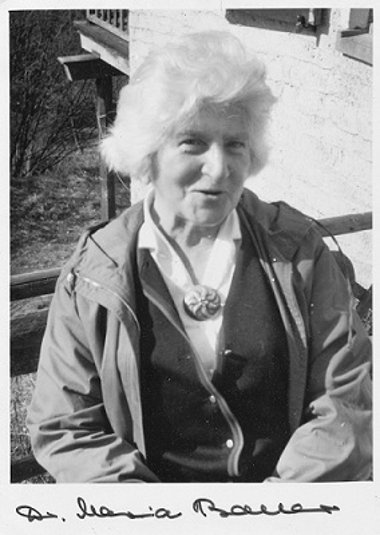
Further life path
After the end of the war, Maria Bauer continued her teaching career. In the following years, she began a further degree in history and German studies in Mainz. At the same time, she was also active in teacher training[13] and later became a civil servant at the Luitpold School in Kusel. She also gave lectures at the adult education centre about her travels and war experiences. She not only taught in Kusel, but also abroad. Between 1961 and 1990, she undertook further study trips, including to Russia. During these decades, she travelled unaccompanied to almost every country in the world[14].
She wrote various books about her travelling experiences in her family's garden shed, including "Unterwegs" (On the Road) and "Späte Wanderungen" (Late Wanderings). In her work "Sieben Farben hat der Regenbogen" (Seven Colours of the Rainbow), published in 1971, she describes her eventful life.[15] Until her death, she lived with her sister Therese in their house in the town centre, which had belonged to the family since 1820 and is now a listed building.[16] She remained in demand as a travel writer and lecturer into old age.[17] Maria Bauer died in Kusel in 1995 at the age of 97. To this day, she is one of the 30 most historically significant women in the Western Palatinate and is regarded as an exceptional example of educational commitment, cultural openness and humanitarian endeavour[18].
Written by: Paulina Gräß, student of historically orientated cultural studies
Published: 09.02.2026; Last updated: 30.03.2026.
Quotes
We make plans too. Secretly, on a hot summer's day, while 'the grown-ups' are in the shop and in the garden, we sneak into grandmother's cool room, snuggle up on the canapé and hold a war council. It is certain that we will emigrate to German South West Africa when we grow up..."
Bauer, Maria: The rainbow has seven colours, Neustadt an der Weinstraße 1971, p.7.
Every generation of people on earth has its own history."
Ibid, p.28.
On 4 June 1927, in my friend's room on Pündterplatz, I was ceremoniously awarded my doctorate. My student days were over. The new attitude to life given to me by the youth movement will stay with me for the rest of my life. Thank you Hochland, you Quickborn, you Wandervogel!"
Ibid, p.52.
Footnotes
[1] Richter, Manfred: Kusel, meine Stadt, 03.01.2008, online at: < https://www.h0-modellbahner.de/kusel-meine-stadt-mainmenu-98.html>[last retrieval: 23/11/2025].
[2] Bauer, Maria: Sieben Farben hat der Regenbogen, Neustadt an der Weinstraße 1971, p.17.
[3] Schnorr, Michael: Dr Maria Bauer, online at: <https://frauenspuren-westpfalz.de/landkreis-kusel/dr-maria-bauer-kusel> [last accessed: 23 Nov. 2025].
[4] Baus, Martin: Maria Bauer, in: literaturland saar online at https://www.literaturland-saar.de/personen/maria-bauer/ [last accessed: 09.01.2026].
[5] Schnorr, Michael: Dr Maria Bauer, online at: <https://frauenspuren-westpfalz.de/landkreis-kusel/dr-maria-bauer-kusel> [last accessed: 23 Nov. 2025].
[6] Richter, Manfred: Kusel, meine Stadt, 03.01.2008, online at: < https://www.h0-modellbahner.de/kusel-meine-stadt-mainmenu-98.html>[last accessed: 23/11/2025].
[7] Schnorr, Michael: Dr Maria Bauer, online at: <https://frauenspuren-westpfalz.de/landkreis-kusel/dr-maria-bauer-kusel> [last accessed: 23 Nov. 2025].
[8] Wedel, Gudrun: Bauer, Maria, in: Autobiografien von Frauen. Ein Lexikon, Cologne and Böhlau 2010, p. 60.
[9] Schnorr, Michael: Dr Maria Bauer, online at: <https://frauenspuren-westpfalz.de/landkreis-kusel/dr-maria-bauer-kusel> [last accessed: 23 Nov. 2025].
[10] Richter, Manfred: Kusel, meine Stadt, 03.01.2008, online at: < https://www.h0-modellbahner.de/kusel-meine-stadt-mainmenu-98.html>[last accessed: 23/11/2025].
[11] Ibid.
[12] Ibid.
[13] Wedel, Gudrun: Bauer, Maria, in: Autobiografien von Frauen. Ein Lexikon, Cologne and Böhlau 2010, p. 60.
[14] Ibid.
[15] Richter, Manfred: Kusel, meine Stadt, 03.01.2008, online at: < https://www.h0-modellbahner.de/kusel-meine-stadt-mainmenu-98.html>[last accessed: 23/11/2025].
[16] Ibid.
[17] Ibid.
[18] Ibid.
Further reading / literature / sources
Bauer, Maria: The rainbow has seven colours, Neustadt an der Weinstraße 1971.
Baus, Martin: Maria Bauer, in: literaturland saar online at https://www.literaturland-saar.de/personen/maria-bauer/ [last accessed: 09.01.2026].
Richter, Manfred: Kusel, meine Stadt, 03.01.2008, online at: <https://h0-modellbahner.de/kusel-meine-stadt-mainmenu-98.html> [last retrieval: 23/11/2025].
Schnorr, Michael: Dr Maria Bauer, online at: <https://frauenspuren-westpfalz.de/landkreis-kusel/dr-maria-bauer-kusel> [last accessed: 23 Nov. 2025].
Wedel, Gudrun: Bauer, Maria, in: Autobiografien von Frauen. Ein Lexikon, Cologne and Böhlau 2010, p.60.
Supported by: