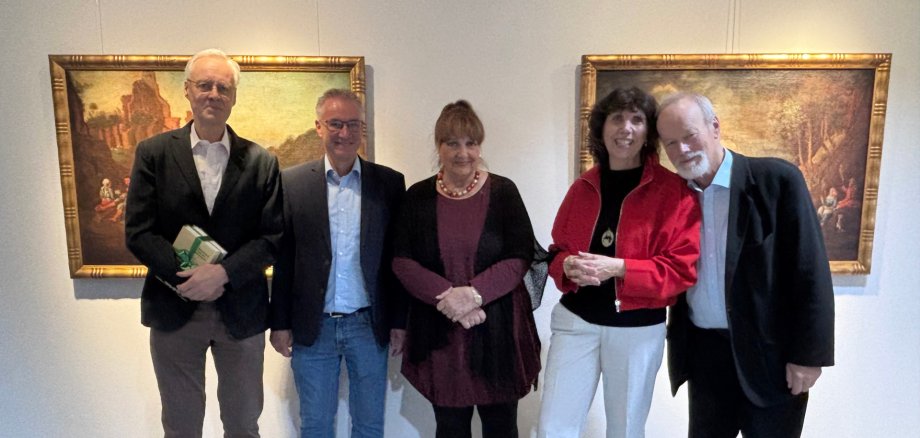
Under the title ‘Sibling Paintings – Two Motifs, One Artist’, two Baroque paintings from the Karlsberg Castle collection were exhibited for the first time in the district administration’s gallery. They are different subjects by the same artist: one on loan and one donated, which illustrate a fascinating shift over time.
The donation depicts a classical idyll – a shepherd couple with their flock in a peaceful landscape. Its companion piece – a painting of the same size, in the same frame and painted by the same artist – depicts an ancient city in a river valley with ships. What also unites the two paintings is their provenance. They come from the collection of Karlsberg Palace. In 1793, French Revolutionary troops destroyed the grounds of the residence of Duke Karl II August of Palatinate-Zweibrücken on the Karlsberg. However, Johann Christian von Mannlich, court painter and Director-General of Public Works, had previously managed to save the extensive collection of paintings, transporting it via Mannheim to Munich. Forester Johann Heinrich Lindemann was one of those who contributed to the success of this feat. In gratitude, he received, amongst other things, the works on display in the exhibition, which have remained in the family’s possession ever since, through all the vicissitudes of time. His descendants include Prof. Dr Max Lindemann, former Head of Surgery and Medical Director at the district hospital in St Ingbert, and Christian Lindemann, a graduate in business administration and former owner of the Lindenfels estate near Alschbach.
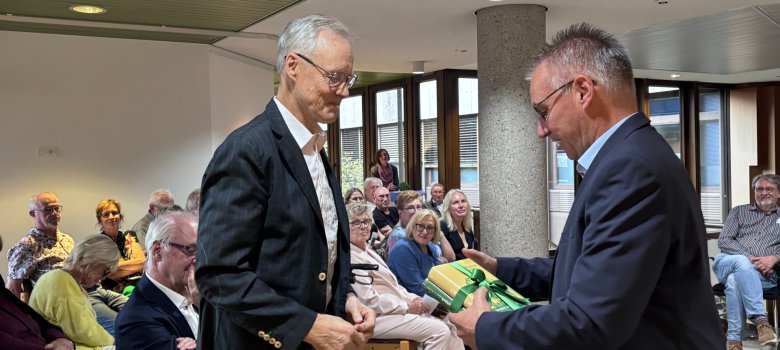
District Administrator Frank John thanked Prof. Max Lindemann for his donation. Photo: Beate Ruffing
It was thanks to a happy coincidence that Prof. Lindemann offered his painting as a gift to the Saarpfalz district, represented by the art historian Dr Jutta Schwan from the cultural management department, and in doing so drew attention to its counterpart. She brought the two works together and, so to speak, united them in a small exhibition. In her introductory remarks, she drew attention from an art-historical perspective to similar paintings by Johann Heinrich Roos – who was born in Otterberg in the Palatinate – and his sons, which can be found in numerous museums across Europe, and explained the historical connections to Karlsberg Castle, which forms a focal point of her work for the district. At the opening and during the ten-minute lunchtime guided tours she had initiated, she invited visitors to take a closer look at seemingly minute details and connections relating to famous painters of this era, who had incorporated elements such as goats and herds of cattle into their visual language as expressions of trade and progress. “I would like to thank the Lindemann families for giving us the opportunity to view the ‘picture siblings’ side by side and, at the same time, for entrusting us with a piece of family history – for this exhibition and, through their donation, beyond,” said District Administrator Frank John at the exhibition opening. Whilst the loaned item has been returned to its original location, the donated piece is set to go on display at the Römermuseum in Schwarzenacker.