Since 1987, 6 October has been the official "German-American Day". At that time, Congress authorised US President Reagan to use the arrival of the first German immigrants in Philadelphia in 1683 as the occasion for this day of remembrance. It is also a reminder of how German immigrants helped to shape America. In the Saarpfalz district, with its diverse German-American connections and friendship with Henrico County in Virginia, the day was the occasion for a German-American search for traces in the form of a dialogue tour through Homburg. This was made possible by the cooperation with the German-American Institute Saarland and the support of the Foreign Office of the Federal Republic of Germany and the Embassy of the United States of America.
"German-American Day is a good opportunity to focus on the shared German-American history. This tour brings people together against the backdrop of the growing German-American relationship in the Saarpfalz. Our partnership with Henrico County has connected people of different generations and interests over the years. Our American partners have always treated us with extraordinary hospitality, openness and appreciation. We are very grateful for the encounters we have had so far. It is very important to us to continue to fill this transatlantic friendship with life. The fact that the German-American Institute exists in Saarland is a valuable support," explained District Administrator Frank John, who accompanied the city walk.
Henrico County Manager John A. Vithoulkas commented, "On the occasion of German-American Day, Henrico County and its Board of Supervisors proudly reaffirm their friendship with the residents and community of Saarpfalz County. Since the beginning of our official partnership in 1997, we have shared a bond based on common values, mutual respect and an unwavering commitment to democratic principles. Even though we are separated by thousands of kilometres, we would like to assure you that the Saarpfalz district will always hold a special place in our hearts. We look forward to continuing our constructive dialogue, participating in student exchanges and exchanging views on local government issues. By cultivating our friendship, we bring our districts closer together and show the world that solidarity, understanding and mutual respect are always within reach."
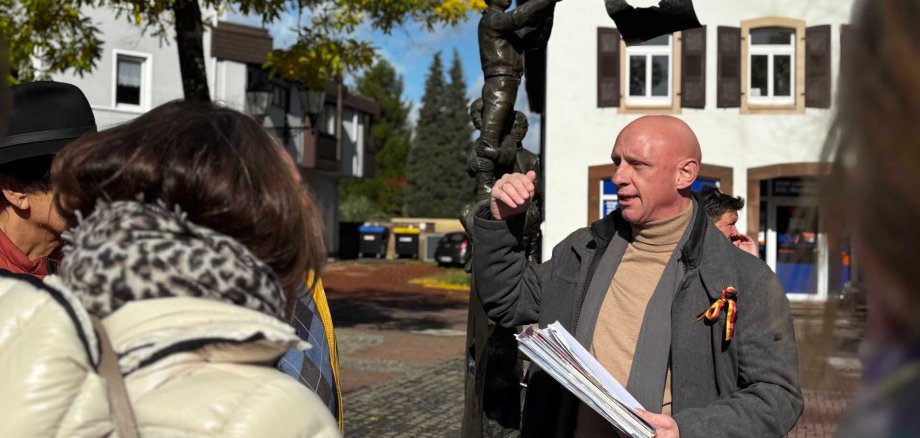
The dialogue tour with Klaus Friedrich began at the Freedom Fountain, which combines various scenes from the history of German democracy and its links to the USA. More than twenty interested people had gathered at the monument, which is unique in Germany. From the fountain to Vauban's old town centre, they learned that there are connections between the large fortress Homburg-la-Forteresse, built according to Vauban's plans, and several US states. Stops included the inn "Homburger Hof, Am Rondell". This former "Peterhof" hotel housed a US Army headquarters after the end of the Second World War. The tour continued near the market square, where it was reported that Carl David Weber, son of Homburg dean Karl Gottfried Weber, emigrated to America and founded the Californian town of Stockton. This town played an important role during the Gold Rush. The Old Town Hall on the market square was the cover of the New York Times Magazine in April 1945. On the way, Klaus Friedrich informed us that the legendary "Forty-Eight" Carl Schurz, who was involved in the revolution of 1848/49 fought in the Saar Palatinate, had also been in Homburg. After the failed revolution, Schurz fled to America. As a member of the Republican Party, he had a major influence on the voting behaviour of German-Americans and on President Lincoln's election victory. Among other things, he fought for the Union Army in the American Civil War. He was appointed Secretary of the Interior under US President Hayes. His wife Margarethe founded the first kindergarten in the United States in 1856. The participants unanimously confirmed that they learnt a lot of new things about Homburg and German-American Day and the perspectives associated with it.