


About Erna Woll
Composer, church musician, music teacher and author
Erna Woll was an important composer of sacred music of the 20th century. Her extensive oeuvre primarily comprises choral and church music. In addition to her artistic work, she was also involved in music education as a university lecturer. Her origins in the Saarpfalz region make her an important woman in the region's cultural history.
Childhood and musical education
Erna Woll was born on 23 March 1917 in St. Ingbert. She developed a strong interest in music as a child. Her father was Karl Woll (1881-1959), a smelter official, and her mother was Anna Illig (1882-1963). The family environment supported her musical abilities, so that she received instrumental lessons at an early age.
Between 1936 and 1950, she completed numerous degree programmes, including Protestant and Catholic church music, composition, school music, musicology and German studies. She also studied organ and piano and focussed on Gregorian chant.
Her most important training centres included Heidelberg, Munich and Cologne. She initially studied Protestant church music in Heidelberg before continuing her studies at the Akademie der Tonkunst in Munich. There she studied composition and school music, among other subjects.
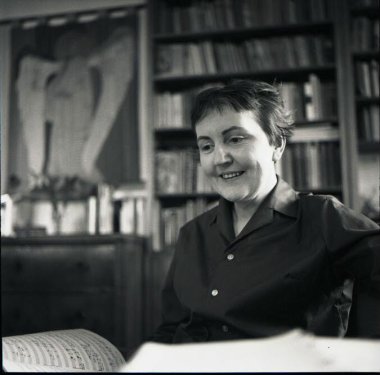
Woll converted from Protestantism to Catholicism in 1941. This decision had a considerable influence on her later work, as a large proportion of her compositions are Catholic in character. After the Second World War, she supplemented her education by studying Catholic church music in Cologne.
Pedagogical activity
After completing her training, Woll initially worked as a cantor and church musician. From 1950, she worked as a school musician at the Catholic teacher training college in Weißenhorn. There she gained extensive teaching experience and increasingly began to compose.
In 1962, she became a lecturer in music education at the Augsburg University of Education. There she played a key role in the training of future music teachers. She also founded the choir at the teacher training college, which later became the university choir.
Woll was awarded the title of honorary professor in 1970. Two years later, she had to retire early for health reasons. She then continued to work as a freelance composer.
In addition to her teaching activities, she has worked intensively on music education issues, in particular new forms of music teaching such as programmed instruction.
Composition
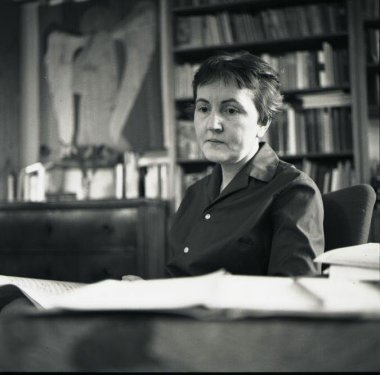
In addition to her teaching activities, Woll devoted herself intensively to composition. Her oeuvre comprises more than two hundred compositions, primarily sacred choral music. These include motets, cantatas and liturgical chants as well as works for organ. A special area of her work was the New Sacred Song.
Her music is characterised by the combination of traditional forms with modern musical language. Woll endeavoured to express religious content in a musically comprehensible way. Her works were performed in many parishes and also attracted attention beyond the region.
Significance and honours
In 1972, she had to retire early for health reasons. She then concentrated entirely on composing. A significant part of her oeuvre was created during this time.
Erna Woll received several honours for her achievements. These included the Papal Cross of Honour "Pro Ecclesia et Pontifice" and the Order of Merit of the Federal Republic of Germany. These honours recognised both her compositional work and her pedagogical activities.
Part of her estate can be found in the Augsburg University Archive and in the Bavarian State Library.
Woll remained artistically active into old age. She died on 7 April 2005 in Friedberg near Augsburg. Even though most of her professional activities took place in Bavaria, her origins in St. Ingbert remained an important part of her biography. As a composer with roots in the Saarpfalz district, Erna Woll is one of the most important musicians in the region's history.
Written by: Olivia Zitzmann, Bachelor student of musicology at Saarland University
Published: 30.03.2026; Last updated: 30.03.2026.
Quotes
The responsibility of organising sounds - according to their various qualities - in such a way that they make a statement for me and do not become a superfluous message for others weighs me down to the point of agony. But this is my form of existence."
Walther, Uta: Women composers and their choral works: Erna Woll, in: inTakt. Magazin für Kirchenmusik im Bistum Augsburg, No. 1, 2024, p. 8.
I prefer to sing vocals. I have more of my own to say in vocals."
Walther, Uta: Women composers and their choral works: Erna Woll, in: inTakt. Magazin für Kirchenmusik im Bistum Augsburg, No. 1, 2024, p. 8.
... Of the many possible functions of music ... I consider the most important to be the one that enables people to transcend their hearing."
Walther, Uta: Women composers and their choral works: Erna Woll, in: inTakt. Magazin für Kirchenmusik im Bistum Augsburg, No. 1, 2024, p. 8.
Further reading / literature / sources
Ames-Reiber, Hildegard:, Ernestine (Erna) Woll. Eine Musikerin aus St. Ingbert, in: Heidemarie Ertle/ Gerhard Sauder (ed.), St. Ingberter Biografien, St. Ingbert 2023, pp. 325-346.
Grünsteudel, Günther: 'Ich vertone am liebsten vokal': Erna Woll zum 100. Geburtstag, in: Musik in Baden-Württemberg: Jahrbuch (2017/18), Vol. 24, Jubiläumsband, Stuttgart 2018, pp. 237-248.
Grünsteudel, Günther: Erna Woll (1917-2005), composer and music teacher, in: Lebensbilder aus Bayerisch-Schwaben Bd. 19, Augsburg 2017, pp. 483-516.
Walther, Uta: Women composers and their choral works: Erna Woll, in: inTakt. Magazine for Church Music in the Diocese of Augsburg, No. 1, 2024, pp. 8-9
Institut für Landeskunde im Saarland (ed.): Erna Woll, in: Saarland-Biografien, Saarbrücken
http://www.saarland-biografien.de/frontend/php/ergebnis_detail.php?id=927 (accessed on 24 February 2026)
Supported by: