
About Helene Trossen
Liturgical vestment embroiderer, mosaic artist and art education consultant
The Art of Embroidery – the Paraments
Helene Trossen – who later called herself ‘Len’ – was born on 27 February 1921 in Illingen, Saarland, the daughter of Josef Trossen (born 1 April 1898) and his wife.[1] She later learnt the artistic craft of parament embroidery, which is almost exclusively in the service of the Church and is practised in specialised master workshops, often in monasteries. This art of embroidering chasubles and textiles used in the church and in the liturgy – that is, the vestments – has a tradition stretching back centuries.
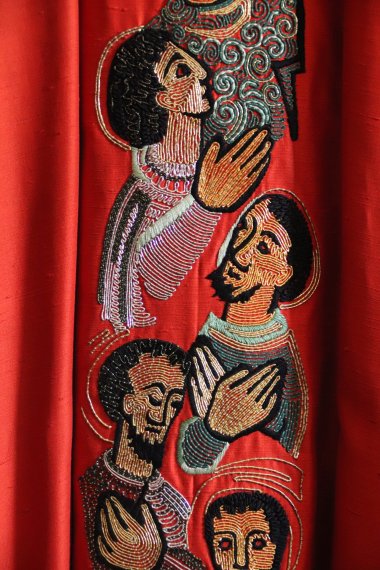
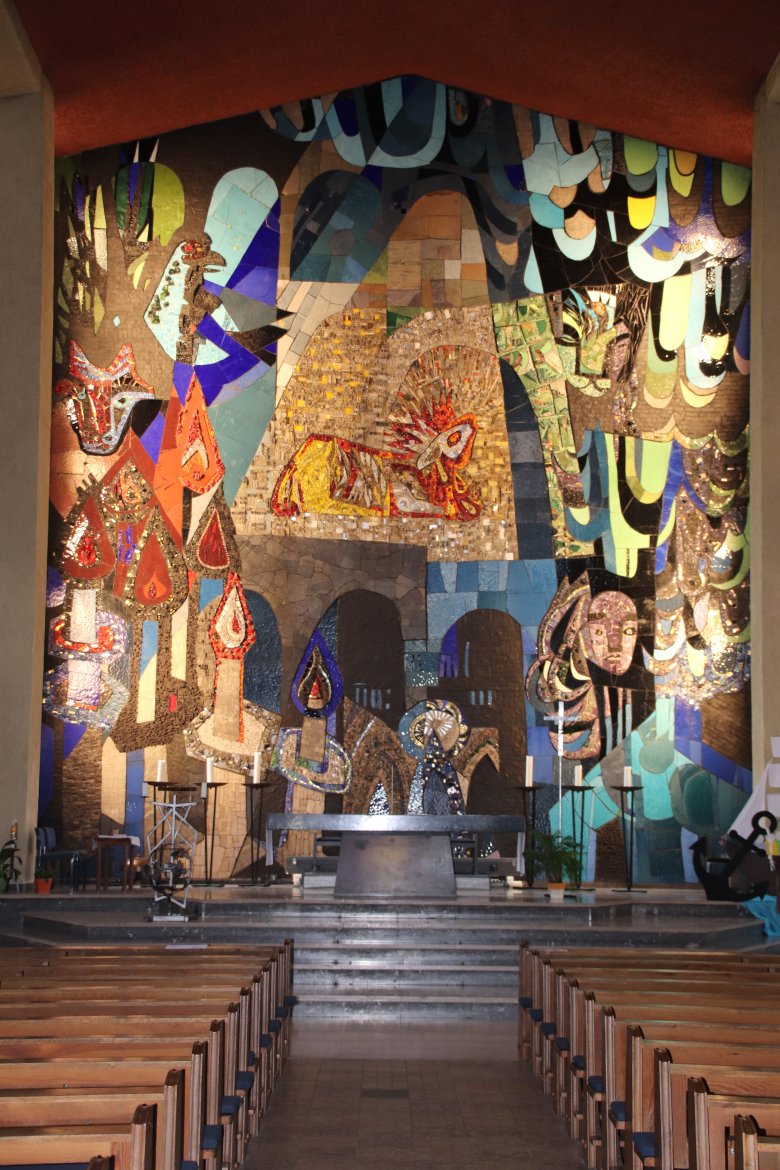
She received her training at, amongst other places, the Folkwang School of Design in Essen, where Erna Hitzberger (1905–2003) was teaching textile design at the time.[2] Helene Trossen created and designed such liturgical vestments, but later turned her hand to three-dimensional art as well, producing designs for several mosaics, including the altar mosaic in the Catholic Church of Mary of Peace in Erbach, which, at 115 square metres , appears downright gigantic. From the 1960s onwards, she served as a consultant for art education for young people in the Diocese of Essen.[3]
From a delicate thread to a mosaic
At some point, Helene Trossen moved from the Saarland to Gelsenkirchen, and in 1947 on to Essen, where her brother lived. From the 1950s onwards, she worked for one of the most prestigious parament and flag embroidery workshops of the time, Adrian Pfadt’s parament workshop in Krefeld. It was there that, in 1955, she designed the liturgical vestments for the Bishop of Tromsø in Norway. “Her designs were used to create embroidery and appliqué work, in lines that were sometimes bold, but always confident […]”.[4] The chasubles of the Parish of Our Lady of Peace in Erbach, including the precious red Apostle’s chasuble and the Marian chasuble, are also based on her designs – each one a unique piece. In the notes of the parish’s then parish priest, Hubert Sedlmair (1927–2014)[5], who had a keen appreciation of art, we read: “It was through the designs for our chasubles that we came across Ms Len Trossen from Essen […].“[6] The parish chronicle for 1957–1969 states, with regard to these commissions, that this artist designed her drawings for the precious chasubles “with extraordinary confidence and with great liturgical thoughtfulness”[7].
However, the artist did not confine herself to church vestments, as she later turned her hand to the art of ceramic design. For the interior of the Pax Christi Church in Essen-Bergerhausen, consecrated in 1959, she designed a cockerel, and shortly afterwards a lily as a brick relief[8].
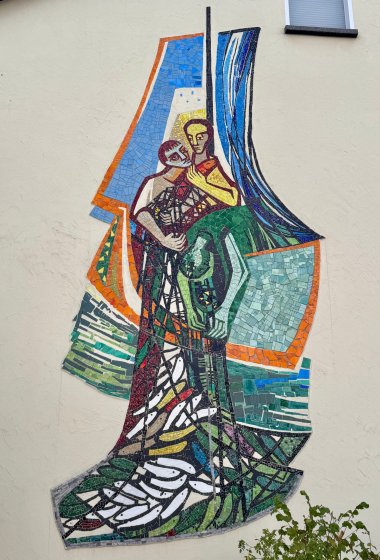
Just two years later, in 1961, the artist travelled to Erbach in person and produced the design for a glass mosaic on the east wall of the Maria vom Frieden rectory in Erbach. She transformed the lower church of the parish church into an artist’s studio and worked together with young people from the parish[9] and the parish priest himself on this piece, which depicts the ‘Great Catch of Fish on the Sea of Galilee’. The project was a sort of trial run, as Father Sedlmair had decided to decorate the church’s altar screen with a mosaic as well. As late as 1956, newspaper reports stated that the creator of the baptismal font and the portals[10], Franz Mörscher from Neunkirchen (1931–2018), was to create a relief in cast aluminium for the choir screen.[11] However, Mörscher’s wall design was never realised. According to his own account, Father Sedlmair had been looking for an “artist […] who was willing to produce a design for a modest fee and, moreover, to leave the execution to us. For the parish could not possibly afford both the design and the execution.”[12] In the end, the contact with Len Trossen proved to be the key.
The church with its new pulpit, a ‘fine piece of work’.
The Church of Our Lady of Peace, the interior of which was to be gradually decorated with works of art, was built in two years to the plans of the Speyer diocesan architect Wilhelm Schulte Jr. (1896–1977)[13] and consecrated in 1956[14]. It was to be built ‘with the utmost economy in mind’[15], yet still be timeless, ‘in the sense that even decades later, one can still “see” the church’[16]. In 1966, a new pulpit was required to improve the acoustics of the large interior. This project, like the parish house mosaic before it, was once again a collaborative effort. Once again, young people from the parish took part, working according to the plans drawn up by “the arts officer of the Diocese of Essen, Ms Trossen.”[17]
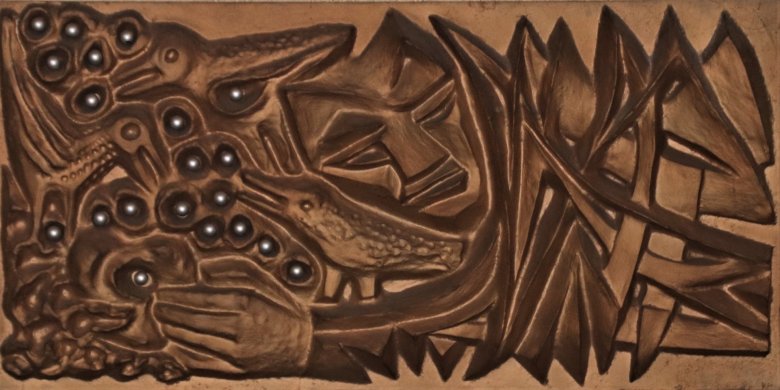
The pulpit on the right-hand side of the chancel is clad with two reliefs made from cast bronze panels, which depict the biblical parable of the Sower. The seeds, representing the ‘Word of God’ – some of which are snatched away by birds in the parable, some fall on stony ground and some bear fruit on good soil – are depicted by 45 rock crystals of varying sizes.[18] On the side panel, ‘Evil’—horned and depicted with angular dynamism—approaches from behind, seeking to snatch the ‘Word’ from people’s hearts. Despite the young people’s great commitment, several Sunday collections were still needed to finance the project. The church, on the other hand, increasingly took on its own distinctive character through the artistic design – not least thanks to Len Trossen.
Art is created together at night
The idea of a large mosaic for the high eastern altar wall had now taken shape. However, due to a lack of funds, work on the artistic decoration of the choir could not begin until years after the consecration. Until then, a huge curtain featuring a pelican in the centre covered the wall for ten years. There is no record of who designed this motif. In the meantime, the Trossen-Sedlmair team had created another mosaic on the outer wall of the Simultankirche at Ramstein Air Base[19]. The artist from Essen was also responsible for this. They were no longer completely inexperienced and were ready for a new adventure, together with the parish. “Ms Trossen sent us the design in a small format […],” writes Sedlmair. With a coloured drawing, she specified the colour scheme for the individual sections.
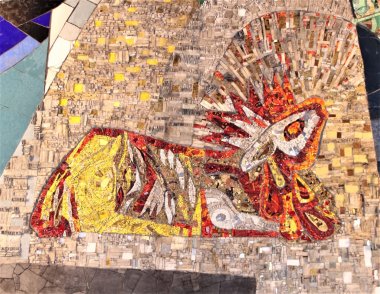
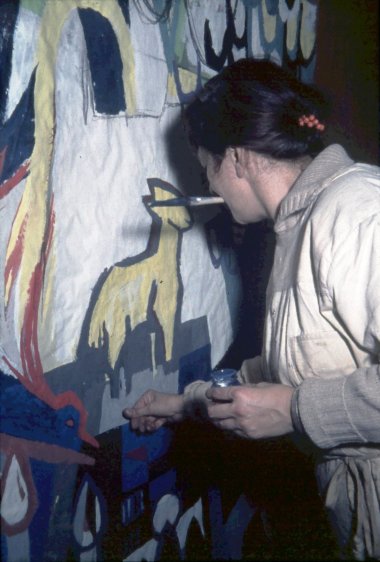
A slide was made of the artist’s design, “which we projected onto the large front wall from the church entrance using the projector. […] And then we set about tracing the lines projected onto the wall with charcoal and transferring them directly onto the wall. As this work could only be carried out at night, we hung from the scaffolding all night long and worked. The following morning, we began incorporating the lines into the overall design, so that one could visualise what was to become of it. The entire mosaic was to be executed using natural stone, cut mosaic glass and chiselled mosaic glass stones, mixed with chunks of fused glass. This was a very interesting technique, as it represented an attempt on a large scale to bring different materials into harmony with one another. […] On 1 August 1968, we were able to begin laying the first section of the mosaic. Work on the large Altarm mosaic was completed on 15 December 1968. So for four months, day after day and – above all, I would like to emphasise – night after night, a small group of helpers worked on this mosaic.”[20] Once again, the work was not carried out entirely without the artist’s assistance, as photographs from that time show Helene Trossen helping with the mosaic.
“You’ll still be able to see the mosaic in a hundred years’ time.”[21]
Through the use of a wide variety of materials and the resulting relief effect, the mosaic takes on a partially three-dimensional form. It depicts the Book of Revelation, featuring the seven churches of God, the four living creatures (bull, eagle, lion, man), the Lamb and the heavenly Jerusalem. On the east wall of the southern transept is another, comparatively smaller mosaic, measuring 2.2 by 10 metres, depicting the burning bush. In the lower section, it also frames the Tabernacle. The design for this more detailed and slightly later motif is also attributed to Len Trossen, but was not documented.
Unfortunately, very little is known to date about the creator of this impressive, symbol-laden work. Contemporary newspapers and reports do, however, refer to the “well-known Essen-based artist Len Trossen”. Years later, in his description of the ‘immense old riverbed mosaic […]’, an author finds it ‘strange that an artist of whom we know of no other works was entrusted here with such an extensive and demanding task, carried it out successfully, and then never appeared on the art scene again.’[22] She has received little attention to date, not even in Essen, where she does not feature in any bibliography. This is all the more surprising given that, as recently as 1974, she adorned the bells of the Church of the Ascension in Essen’s Werden district with reliefs depicting the core tenets of the Christian faith. Be that as it may – she left her literally greatest mark almost 60 years ago in the Erbach district of Homburg and in the Church of Our Lady of Peace. Only time will tell whether it will last the desired 100 years.
Written by: Dr Jutta Schwan, art historian in the cultural management of the Saarpfalz district
Published: 6 July 2026; Last updated: 6 July 2026.
Footnotes
[1] Information kindly provided by Cordula Holtermann of the Essen City Archives.
[2] “Adrian Pfadt considered the hand of the former Folkwang student Miss Drossen (!) from Essen to be particularly suitable”, in: From Amethyst to the Golden Mitre. Krefeld workshop outfits the new Bishop of Tromsø. Krefelder Stadtpost, Saturday 7 May 1955. Kindly brought to our attention by Dr Anke Elisabeth Sommer from the Speyer Diocesan Archives.
[3] Dörner, Helga: ‘A Wall Comes to Life’. Newspaper report in the SZ, probably 1968, from the parish chronicle of Maria v. Frieden 1957–1969, No. 4701-1, unpaginated.
[4] Krefelder Stadtpost, 1955 (as in note 2).
[5] After 17 years in Erbach, Hubert Sedlmair was appointed to the Speyer Cathedral Chapter in 1974. There, amongst other roles, he took on the posts of Head of the Building Department and Diocesan Conservator, and headed the Department of Building and Fine Arts at the Bishop’s Ordinariate in Speyer.
[6] Sedlmair, Hubert: ‘Das große Altarmosaik’, p. 5 in: Maria vom Frieden, Homburg (ed.) 1971, pp. 5–13, here p. 5.
[7] Parish chronicle (as in note 4) of the parish, typewritten entry on chasubles, unpaginated.
[8] Built in 1967 and before 1975. Essen City List of Listed Buildings, An St. Albertus Magnus 45, Dinnendahlstraße, Hallering, Bergerhausen district: Pax Christi Church (Catholic). Built in two phases from 1951 (laying of the foundation stone) to 1959 (consecration). Appendix 1, Upper Church, p. 6, nos. 94 and 97.
[9] ‘Created by skilful amateur hands. Glass mosaic for the Maria vom Frieden rectory’, newspaper clipping, 1961; Maria vom Frieden parish chronicle (as in note 4).
[10] The church portals were installed in December 1962.
[11] Newspaper article in the parish chronicle: “Tabernacle and baptismal font by Franz Mörscher. Modern works of art in the church. The young artist is also designing the bronze doors and the choir screen.”
[12] Sedlmair (as in note 6).
[13] His father, Wilhelm Schulte I (1858–1920), had built the neo-Gothic parish church of St Andrew in Erbach.
[14] Schulte, Wilhelm: ‘On the History, Design and Architects of the New Church’, in: Rembor, Julius (ed.): *Beata Pacis Visio*. Commemorative volume marking the consecration of the Church of Our Lady of Peace in Homburg-Erbach-Saar on 6 May 1956, pp. 22–29, here p. 22.
[15] Schulte (as in note 7), p. 25.
[16] Schulte (as in note 7), p. 25.
[17] “Maria vom Frieden has a new pulpit. The Parable of the Seed depicted as the Word of God”. Newspaper article from 1966 in the parish chronicle (as in note 4), unpaginated.
[18] At some point after 1995, the pulpit was removed. Later, the pulpit panels were reattached to the south wall of the side aisle. The crystals had been replaced by pearlescent hemispheres.
[19] Dörner (as in note 4).
[20] Sedlmair (as in note 5), pp. 27–28.
[21] Quote from Pastor Sedlmair in Dörner (as in note 4).
[22] Bernet, Claus: ‘Masterpieces of the Heavenly Jerusalem’, including, amongst others, Helga Trossen: Mary of Peace in Homburg, (1968). June 2021. https://himmlischesjerusalem.de/2021/06/27/helga-trossen-maria-vom-frieden-in-homburg-1968/. The incorrect first name also appears at the Institute for Contemporary Art in Saarland.
Further reading / literature / sources
Anonymous, “From amethyst to the golden mitre: Krefeld workshop supplies the new Bishop of Tromsø”. *Krefelder Stadtpost*, Saturday 7 May 1955.
Anonymous, “Maria vom Frieden has a new pulpit. The Parable of the Seed depicted as the Word of God”. Newspaper article from 1966, taken from the parish chronicle of Maria vom Frieden 1957–1969, No. 4701-1, unpaginated.
Bernet, Claus: ‘Masterpieces of the Heavenly Jerusalem’, including, amongst others, Helga Trossen: Mary of Peace in Homburg, (1968). June 2021, available online at <https://himmlischesjerusalem.de/2021/06/27/helga-trossen-maria-vom-frieden-in-homburg-1968/>.
Dörner, Helga: ‘A Wall Comes to Life’. Newspaper report from the *SZ*, probably 1968, from the parish chronicle of Maria v. Frieden 1957–1969, No. 4701-1, unpaginated.
Schulte, Wilhelm: ‘On the History, Design and Architects of the New Church’, in: Rembor, Julius (ed.): *Beata Pacis Visio*. Commemorative volume marking the consecration of the Church of Our Lady of Peace in Homburg-Erbach-Saar on 6 May 1956, pp. 22–29.
Sedlmair, Hubert: ‘The Great Old Arm Mosaic’, in: Maria vom Frieden, Homburg (ed.) 1971, pp. 5–13.
Supported by: