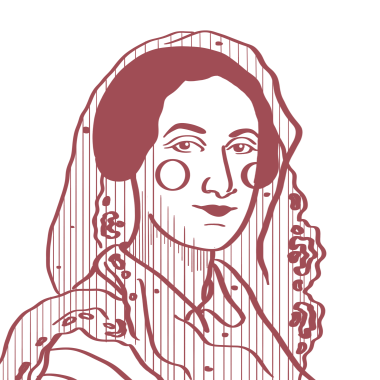
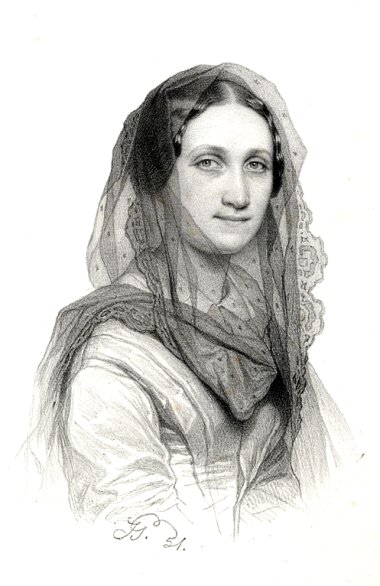
Cornelia Grund
née Siebenpfeiffer
19 July 1826 in Homburg
unknown
About Cornelia Grund
“Alongside these artists, the young pianist, Miss Amalie Grund, certainly did not have an easy time of it. But this makes the success she achieved all the more honourable. She played the last two movements (Romance and Rondo) from Chopin’s E minor Concerto to great acclaim and was met with unmistakable warmth from the audience, who rewarded her with applause and shouts of approval.”
On 31 July 1872, this review appeared in the *Neue Berliner Musikzeitung*. Baden-Baden had previously, on 20 July, been the venue for the concert at which the leading figures of classical music at the time had gathered and given a taste of their skills to a packed house. The young pianist Amalie Grund, mentioned here, had not yet attained the fame of these established virtuosos; the career of this Baden-Baden-born musician was still ahead of her. She was 25 years old at the time. When she was born on 17 March 1848, her far more famous (and no less notorious) grandfather had been dead for nearly three years.
Amalie Grund was the granddaughter of Philipp Jakob Siebenpfeiffer, who served as the first Landcommissar in Homburg from 1818 to 1830. When he subsequently fell out with ‘his boss’, King Ludwig I of Bavaria, he became the figurehead of the liberal-democratic movement, which was to reach its climax at the Hambach Festival in May 1832. During Siebenpfeiffer’s term of office in Homburg, his wife Emilie, née von Weiseneck, had given birth to their daughter: Cornelia Siebenpfeiffer was born on 19 July 1826 at the family’s home at the time, situated between the Catholic and Protestant churches. The family home, where her father carried out his official duties and where the family also lived, was demolished in 1964.
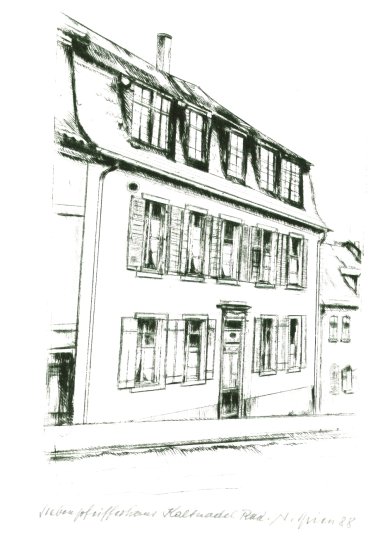
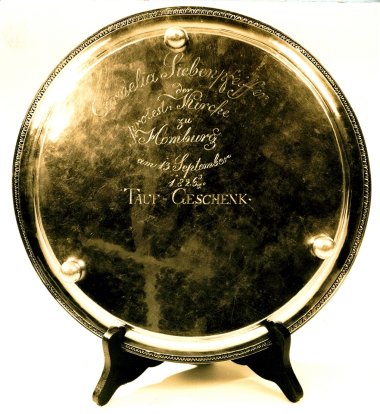
The building that stands on the same site today, known as the ‘Siebenpfeiffer House’, still houses a memento of that era: a silver ‘patene’, a baptismal bowl bearing the inscription: ‘Cornelia Siebenpfeiffer, a baptismal gift from the Protestant Church in Homburg on 13 September 1826 – a christening gift’. The circular tray was crafted by the Zweibrücken goldsmiths and silversmiths Weihinger, as evidenced by the initial ‘W’ left on it. ‘As I have the pleasure of presenting to you, honourable gentlemen, a silver bread plate for the local Protestant church, I ask you to accept it as a small christening gift for my daughter Cornelia, whom you have welcomed into your parish, and as a sign of the mother’s gratitude to the Heavenly Father, who has blessed her, even at this late stage, with this dear child, as well as a bond of unbroken connection between this child and the Protestant Church. Yours respectfully and devotedly, Emilie Siebenpfeiffer’, reads an accompanying letter addressed to the members of the presbytery. The birth entry at the Homburg Registry Office, under the name ‘Corneli Siebenpfeiffer’, was recorded on 21 July 1826. The note is signed by Siebenpfeiffer himself, by Mayor Adam Zott, Justice of the Peace Ludwig Schmidt, and by Friedrich Schmolze, who, as Siebenpfeiffer’s ‘clerk’, was his closest colleague at the Landcommissariat.
Cornelia Siebenpfeiffer spent the first four years of her life in Homburg, where she undoubtedly enjoyed a sheltered upbringing in a middle-class environment in which she wanted for nothing. The lists that have survived, which provide details of the household’s contents in what was then known as ‘Landcommissariatsgasse’, bear witness to this: musical instruments such as ‘a very large and exceptionally fine Viennese grand piano, made of mahogany and featuring three-tiered soundboards throughout’, ‘an ebony flute with eight silver keys’ or an ‘excellent violoncello from 1723’, exquisite furniture, valuable paintings and a well-rounded library all bear witness to the family’s prosperity and their musical interests.
With Siebenpfeiffer’s dismissal from the post of Landcommissär in December 1830, this private, Biedermeier-style phase came to an abrupt end. The family, and their daughter Cornelia in particular, were facing an odyssey that was to be marked by momentous events and strokes of fate. From Homburg, they travelled first to Zweibrücken at the start of 1831, then to Oggersheim, and in the spring of 1832 to Haardt. In the village above Neustadt, Siebenpfeiffer organised the Hambach Festival and was also arrested there in mid-June 1832. After 14 months behind bars, he was acquitted in the spectacular trial in Landau. However, as King Ludwig II of Bavaria was determined to have him locked away at all costs, he was not released – he was charged once again with ‘insulting His Majesty’ and sentenced to two years’ imprisonment as a result. In November of the same year, he ‘escaped’ from the prison in Frankenthal and fled, on an adventurous journey, to Weißenburg in northern Alsace. There, at the ‘Zum Engel’ hotel, his wife Emilie and his ‘little daughter’ were waiting for him.
Once he had recovered from the hand injury he had sustained whilst fleeing, the family’s journey took them through Alsace into Switzerland, with false trails being laid to throw their pursuers off the scent. As a result, the Siebenpfeiffers sometimes travelled separately. A police report notes, for instance, that Siebenpfeiffer was in Basel ‘to collect his wife and child there’. To reach their destination more quickly, his coachman took a shortcut through villages in Baden, which became known. With a lead of a quarter of an hour, he just managed to escape onto Swiss soil ahead of the pursuers sent after him.
As a child, Cornelia Siebenpfeiffer was therefore exposed to all the hardships that life as a refugee entails. When she was nine years old, her mother died. She initially lived with her father in Bern. However, when her father began to suffer from a severe mental illness, she was taken into the care of relatives on her mother’s side in Freiburg im Breisgau. Following the death of Philipp Jakob Siebenpfeiffer in May 1845, a large-scale fundraising campaign was launched to provide for her upkeep. Mannheim and Freiburg, in particular, were the centres of the support campaign organised by her old companions. The liberal politician Johann Adam von Itzstein, for example, was actively involved in the cause. The donations, which came from places such as Bremen, were published in newspapers.
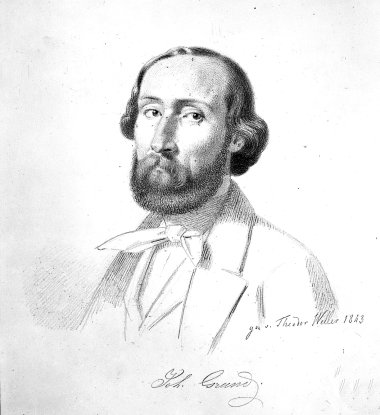
The following year, on 2 April 1846, Cornelia Siebenpfeiffer got married. For her husband Johann Grund, who was 38 years old at the time, this was his second marriage; he was a widower. Grund had been ‘court painter’ to Grand Duke Leopold of Baden since 1839 and, during this period, painted portraits of both the sovereign and his family. Numerous paintings by him have survived to this day in Karlsruhe. Six children were born of this marriage: their eldest daughter, also named Cornelia, was born as early as 12 January 1847. She lived to be only 19 years old.
In 1848, the aforementioned pianist Amalie Grund was born; she is listed as unmarried in the 1888 Baden-Baden address book. The family had moved to the spa town in the Black Forest in the meantime. Their daughter Ernestine Gabriele, born in 1850, died in infancy. She was followed in 1853 by their first son, Franz Friedrich, who became a railway engineer and was appointed ‘Government Architect’. Heinrich Friedrich, born in 1854, died at the age of 23. Elise Grund was the youngest daughter, born in 1856. The date and place of Cornelia Siebenpfeiffer’s death are not yet known. In the 1891 Baden-Baden address book, she is listed as the ‘widow of a court painter’ residing at 4 Hirschstraße, together with her daughter Elise. By 1897, neither of them is listed.
Written by: Martin Baus, Siebenpfeiffer Foundation
Published: 26 October 2026; Last updated: 26 October 2026.
Supported by: