

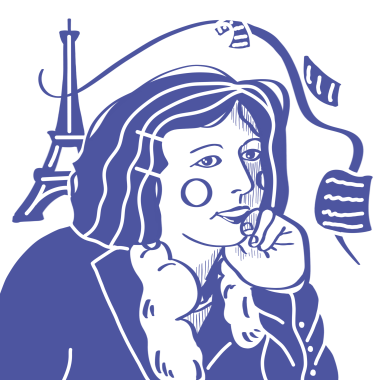
About Charlotte "Lotty" Faber
Foreign language correspondent, dialect poet
But even then you could feel that everything she wrote came from her heart"[1],
This is how Rösel Schüffler, née Faber, characterised her sister Charlotte's passion.
From Blieskastel into the distance (1907-1945)
Isch e `Kaschtler` Kind in weiter Fern`- An sei Heimatort denkt´s oft un gern“[2]
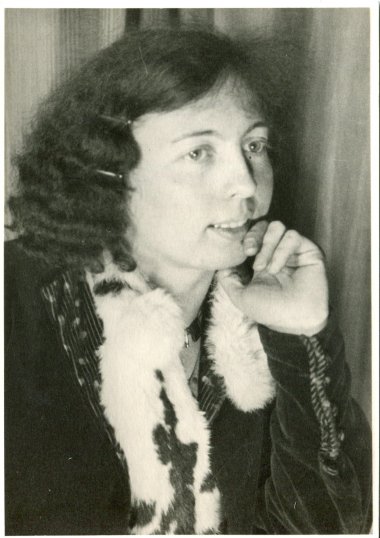
Charlotte Faber was born on 2 March 1907 as the second of five children[3] of Julius Faber and Anna Klementina Faber, née Demuth[4]. Charlotte never met her older brother Johannes Ludwig, who died in 1905. Her younger brother Friedrich Heinrich had been missing in action in Stalingrad since 1944/45. Charlotte and her sister Rösel spent the time during the evacuation between 1939 and 1941 in Bavaria. In later years, she lived with her sister Annelise in her parents' house in Blieskastel. Ten years after Charlotte's death, her sister Rösel wrote the "Lebenslauf von Lotty Faber"[5].
After finishing primary school in Blieskastel, Charlotte attended the Höhere Töchterschule in Homburg. At this time, she harboured the desire to train as a teacher after finishing school, "but she was needed at home as the eldest daughter when our brother Fritz-Heinz was born."[6] Charlotte wrote her first poems for family and friends in her youth.[7] "Barometer" was her first work, which was published under the pseudonym Charlotte in the Saarbrücker Landeszeitung on 10 October 1928.
Charlotte Faber began her professional career as a correspondent for the Adt company[9], which had production facilities in Germany and abroad (including in France). During her stay in Paris[10], she learnt the French language fluently and worked there temporarily as a foreign language correspondent. When the Red Zone was evacuated at the beginning of September 1939, the Faber family was evacuated to Bavaria and lived separately until 1941: "Father travelled with my brother[11] on bicycles to Munich to visit his sister who lived there. Mother and my sister Annelise came to Bad Steben and Lotty and I to Naila [...] In autumn 1941, the family was reunited, our relatives had found us a vacant flat in Munich."[12] During this time, Charlotte and Rösel first found office work in an electricity plant and then, from autumn 1941, employment at the Reichsbahndirektion in Munich.
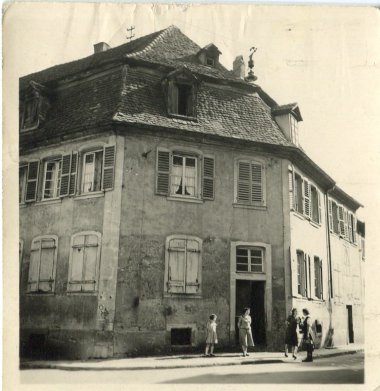
Charlotte spent her free time writing poems about her school days, "about the old house, a lot about her homeland, to which she was particularly attached"[13] as well as on anniversaries or birthdays. When Charlotte returned to Blieskastel, the second evacuation of the town (1944/45) was imminent. She spent her renewed absence from home due to the war in Iphofen, this time without her sister Rösel, who had remained in Munich. After the end of the Second World War, Charlotte continued her career as a correspondent for French at the Jansen company in St. Ingbert-Rohrbach.
Homeland and dialect poet (1960-1985)
Then why do so many people think that only speaking 'High German' would be clever?
'High German'! Well, it's quite right, it's not a bad way to communicate;
It's the official language - and applies to the whole German-speaking country.
That's true. But our German-speaking country has many tribes with their own customs and ways.
With their own dialect and dialect; it's not that we hide it!"[14]
After the death of her parents (1954/1959) and the move to her parents' house in Maitälchen, Charlotte once again devoted herself more intensively to poetry. In order to be able to record her lines at all times, she "alwayshada pen and a sheet of paper lying on her bedside table"[15].
Her first volume of poetry was published in 1970 under the title: Ein Mundartstrauß für jedes Haus. Saarpfalz dialect poems by Lotty Faber[16]. In addition to a tribute to the dialect, to which she remained true in all her poems, verses about the Blieskasteler homeland and its customs, the annual cycle or special occasions as well as stories from her school days were published.
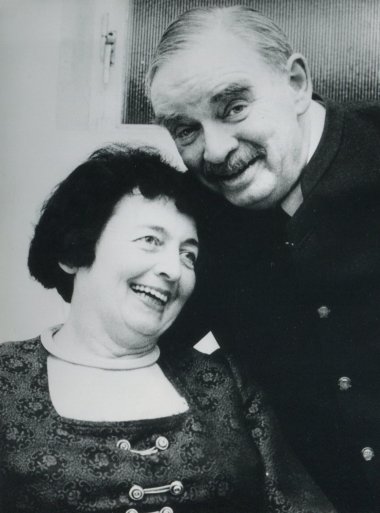
Her second volume: De Kaschtler in Wort und Bild. Mundartliches aus Alt- und Neu-Blieskastel der Barock-Stadt im Bliesgau[17], was written at the suggestion of Dr Peller-Séguy[18] (Saarländischer Rundfunk) after the filming of the series: Sprache der Heimat - Besuch im Bliesgau. In it, Charlotte Faber reported on her home town of Blieskastel in June 1971.[19] The focus of her second work was on the sights of the town, current issues in local politics and events from people's everyday lives, combined with personal memories. In contrast to earlier publications, prose and verse alternate in "Kaschtler".
Charlotte Faber remained unmarried and died on 15 July 1985 at the age of 78. She was devoted to poetry throughout her life: "She wrote her last poem in Saarbrücken hospital. It was a "thank you" to the doctors and nursing staff."[20] Charlotte Faber found her final resting place in the cemetery in Blieskastel.
Written by: Raffaela Berger, Head of the Blieskastel City Archive
Published: 03.09.2025; Last updated: 30.03.2026.
Quotes
Her performance opened the hearts of the audience to the Kaschtler dialect."
A good spirit of the town. Report on the occasion of the 10th anniversary of Lotty Faber's death, Saarbrücker Zeitung No. 162 of 15/16 July 1995, Stadtarchiv Blieskastel, Handapparat Biografien, Band II - Lotty Faber.
She was part of the cityscape, like a favourite little street. Everyone knew her, the lady in the hat, pushing her shopping bag on wheels up and down the castle hill."
Ibid. Hans Cappel, long-time friend and member of the Literatenstammtisch, on Lotty Faber.
"Ambassador of her home town"
Annemarie Neumar: Blieskastel. Pictures of the town and its people, Blieskastel, 1997, p. 289.
Footnotes
[1] Stadtarchiv Blieskastel (StaB), Bestand 3 Nr. 380, curriculum vitae of Lotty Faber, written by Rösel Schüffler, née Faber, July 1995.
[2] Extract from the poem "De Kaschtler", in: De Kaschtler in Wort und Bild. Mundartliches aus Alt- und Neu-Blieskastel der Barock-Stadt im Bliesgau, Merkur Druck, Bartz KG, Zweibrücken, 1975, p. 7.
[3] Johannes Ludwig Faber (*1905, †1905); Annelise Faber, married name Wagner (*1911, †1987); Rösel Faber, married name Schüffler (her vital statistics are not available in Blieskastel, †after July 1995) and Friedrich Heinrich Faber (*1921, †1945). In 1961, the registry office I Berlin transmitted the death of Friedrich Heinrich Faber on 31 December 1945 to the Blieskastel registry office. He was declared dead in February 1961. See also: Blieskastel registry office, Blieskastel alphabetical register and Blieskastel town archive (StaB), fonds 58-1-G-45 to 58-1-G-51, Blieskastel birth register 1905-1911.
[4] Julius Faber (*1874, †1954); Anna Klementina Demuth, married name Faber (*1878, †1959), StaB, fonds 58-2-H-43, marriage register Blieskastel 1904.
[5] StaB, fonds 3 no. 380, curriculum vitae of Lotty Faber, 1995.
[6] Ibid. This refers to the birth of Friedrich Heinrich Faber in 1921.
[7] Ibid. "You couldn't imagine a birthday table without a small or large poem from her on it."
[8] StaB, Bestand 8 Nr. 284; Blieskasteler Nachrichten, 22. Jahrgang/35, Heft 14, p. 9 and Stadtarchiv Blieskastel, Handapparat Biographien, Band II - Lotty Faber, In Erinnerung an Lotty Faber von Hans Cappel, 1995.
[9] Gerhild Krebs: Die Adt-Betriebe an der Saar und in Lothringen (1739-1969), from: Rainer Hudemann in collaboration with Marcus Hahn, Gerhild Krebs and Johannes Großmann (eds.), Stätten grenzüberschreitender Erinnerung - Spuren der Vernetzung des Saar-Lor-Lux-Raumes im 19. und 20. Jahrhundert. Lieux de la mémoire transfrontalière - Traces et réseaux dans l'espace Sarre-Lor-Lux aux 19e et 20e siècles, Saarbrücken 2002, 3rd, technically revised edition 2009. Published on the Internet at www.memotransfront.uni-saarland.de. [viewed on 16/07/2025]. According to the descriptions in Lotty Faber's curriculum vitae, she must have been employed after 1921. More precise details are not available.
[10] Before 1939, details of her time in Paris are not known.
[11] Friedrich Heinrich Faber.
[12] StaB, fonds 3 no. 380, curriculum vitae of Lotty Faber, 1995.
[13] Ibid.
[14] Excerpt from the poem "Mundart", in: Ein Mundartstrauß für jedes Haus. Saarpfälzische Mundartgedichte von Lotty Faber, Zweibrücken, 1975, p. 7.
[15] StaB, fonds 3 no. 380, curriculum vitae of Lotty Faber, 1995.
[16] Faber: Mundartstrauß, Zweibrücken 1970.
[17] This: De Kaschtler in words and pictures. Mundartliches aus Alt- und Neu-Blieskastel der Barock-Stadt im Bliesgau, Merkur Druck, Bartz KG, Zweibrücken, 1975.
[18] Dr Irmengard Peller-Séguy (*1919, †2019).
[19] "Sprache der Heimat - Besuch im Bliesgau", a broadcast by SR with Lotty Faber from 5 June 1971.
[20] StaB, fonds 3 no. 380, curriculum vitae of Lotty Faber, 1995.
Your works / literature / sources
Your works
In addition to a large number of unpublished poems that she wrote in the course of her life:
Lotty Faber: A dialect bouquet for every home. Saarpfalz dialect poems by Lotty Faber, Zweibrücker Druckerei und Verlagsgesellschaft m.b.H., 1970.
"Sprache der Heimat - Besuch im Bliesgau", a SR programme with Lotty Faber from 5 June 1971.
Lotty Faber: De Kaschtler in words and pictures. Mundartliches aus Alt- und Neu-Blieskastel der Barock-Stadt im Bliesgau, Merkur Druck, Bartz KG, Zweibrücken, 1975.
Literature
Reiner Marx, Die Zeit bringt Frucht. Saarländisches Autorenlexikon, Homburg 2008, pp. 40-41. http://www.saarland-biografien.de/frontend/php/ergebnis_detail.php?id=5374 [viewed on 18 July 2025]
Katja Leonhardt: Weibliches Schreiben in regionalen Strukturen (Diss.), Herbert Utz Verlag, Munich 2007, pp. 251-253.
Gerhild Krebs: Die Adt-Betriebe an der Saar und in Lothringen (1739-1969), from: Rainer Hudemann in collaboration with Marcus Hahn, Gerhild Krebs and Johannes Großmann (eds.), Stätten grenzüberschreitender Erinnerung - Spuren der Vernetzung des Saar-Lor-Lux-Raumes im 19. und 20. Jahrhundert. Lieux de la mémoire transfrontalière - Traces et réseaux dans l'espace Sarre-Lor-Lux aux 19e et 20e siècles, Saarbrücken 2002, 3rd, technically revised edition 2009.
Annemarie Neumar: Blieskastel. Pictures of the town and its people, Blieskastel, 1997.
Sources
Blieskastel town archive (StaB):
- Fonds 3 No. 380, CV of Lotty Faber, 1995
- Fonds 8 No. 284, Lotty Faber 1971-1982
- Handapparat Biographien, Band II - Lotty Faber - (without signature)
- Bestand 58 Nr. 1-G-45 bis 51
- Bestand 58 Nr. 1-H-43
Blieskastel registry office: Alphabetical register Blieskastel A-Z.
Supported by: