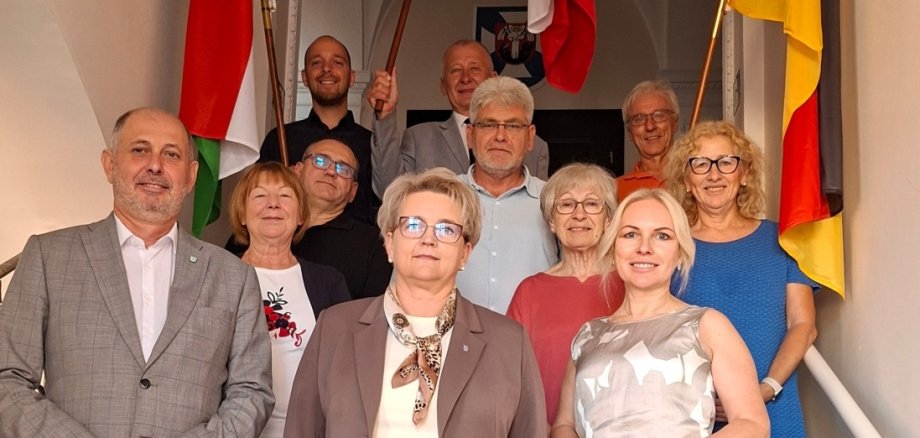
The visit combined an exploration of local cultural traditions with in-depth professional discussions on current challenges facing local government – in particular the consequences of climate change, the protection of emergency services personnel, and the modernisation of education and care infrastructure.
A key event to kick off the programme was the participation of the delegation from the Saarpfalz district in the district and local harvest festival in Medynia Głogowska (Czarna municipality). Together with the local community and a delegation from Hungary, the focus was on celebrating the tradition of the harvest festival, which is still observed in Poland. Dr Violetta Frys, the Saarpfalz District’s European Affairs Officer, welcomed the hosts and the audience on behalf of the delegates and conveyed greetings from District Administrator Frank John.
In his welcoming address, District Administrator John emphasised the importance of rural areas and cross-border dialogue: “The harvest festival reminds us just how important it is to manage our natural resources sustainably. In light of noticeable climate changes, adapting agriculture requires action from all of us. Events such as this offer the ideal opportunity to exchange views in a friendly atmosphere, to take joint responsibility and to raise awareness of the challenges facing our region.”
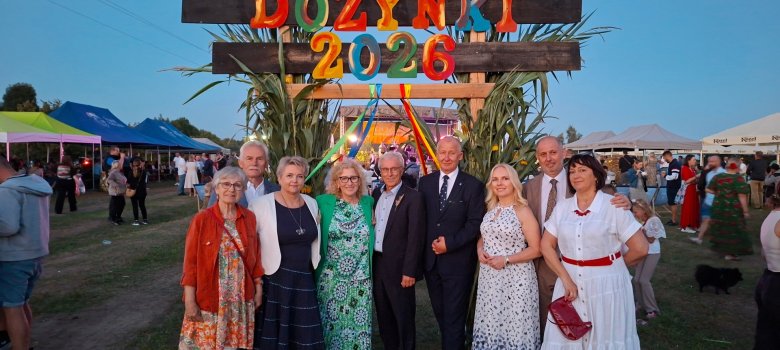
At the harvest festival (from left): Monika Hauck, Krzysztof Kraus, Barbara Pilawa-Kraus, Maria Vermeulen, Albrecht Hauck, Adam Krzysztoń, Dr Violetta Frys, Aleksander Cwynar and Beata Cwynar. Photo: Anna Duda-Świerk
The dialogue then focused on working meetings concerning the exchange of expertise in agriculture and regional administration. The main focus was on strategies for adapting to climate change and environmental changes, which are increasingly affecting both regions.
As part of the visit, the Saarpfalz delegation undertook a wide-ranging programme of visits to see local council operations in action. A key focus was on safety and emergency services. At the Białobrzegi Volunteer Fire Brigade, the delegates discussed the operational readiness and role of local emergency services in the face of new environmental and climate risks with local politicians and the fire brigade command.
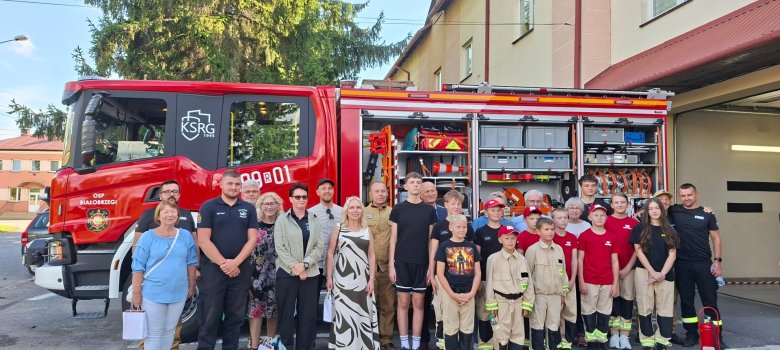
Delegates from the Saarpfalz district with the local young firefighters at the Białobrzegi Volunteer Fire Brigade. Photo: Anna Duda-Świerk
The focus was also on education and youth development. At the ‘Janusz Korczak’ School Centre No. 1 in Łańcut, the delegation visited a newly built sports hall. In discussions with the school management, they explored ways of making efficient use of modern sports facilities for the benefit of both the school and the local community.
Social policy and care formed another key component. The delegation’s programme included visits to a local care home and a day centre for people requiring support. During professional discussions with senior management, the delegation gained insights into the Polish care and support systems for older people and people with disabilities.
The discussions were rounded off with a focus on culture and infrastructure. During a visit to the Łańcut Castle Museum, discussions centred on the protection of Europe’s shared cultural heritage, whilst the tour of the Community Centre for Sport and Leisure in Białobrzegi provided an opportunity to discuss improvements to social infrastructure to promote civic engagement and regional development.
The working visit also provided significant impetus for further networking at the level of towns and local authorities. For instance, Maria Vermeulen, Mayor of Mandelbachtal, used the partnership with the Polish municipality of Markowa – established at the start of the year – to engage in direct dialogue with her counterpart Aleksander Cwynar, as well as to hold technical discussions with other mayors and the heads of the institutions visited. In addition, Deputy Mayor Albrecht Hauck, who is responsible for town twinning in the town of St. Ingbert, played an active role in the delegation’s work. He expressed his hope that St. Ingbert, too, should establish contacts with a Polish local authority in accordance with the principles of the Weimar Triangle. The Saarpfalz District’s European Affairs Officer actively supports such local authority links: “Any local authority in our district seeking a partnership in Poland or Ukraine is welcome to contact me. Through our European partner districts, we have networks with towns and municipalities that are specifically seeking exchanges with German local authorities,” emphasises Dr Frys.
The delegation gave a very positive assessment of the exchange. The Saarpfalz district would like to thank Adam Krzysztoń, District Administrator of Łańcut, as well as all the institutions involved, for their hospitality and professional openness. The insights gained will now be incorporated into specific follow-up projects within the cross-border partnership.
Information on the Saarpfalz District’s district partnerships and its work on European affairs is available from the European Affairs Officer and Head of the European Affairs Unit, Dr Violetta Frys, on tel. (06841) 104-8273 or by email at [email protected] and [email protected].