

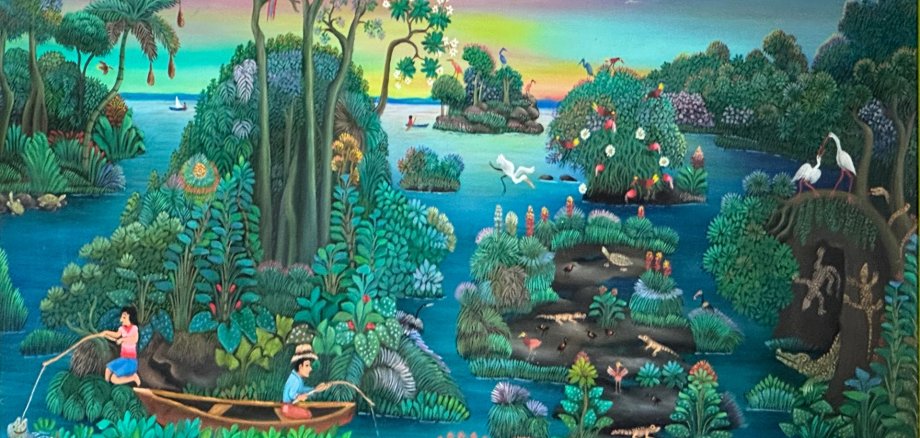
The Fairtrade Town of Homburg and the Fairtrade Saarpfalz District are organising a dual exhibition on Nicaragua in collaboration with the Fairtrade Initiative Saarland (FIS). The Homburg Forum is hosting an exhibition of works by artists from the Solentiname archipelago – an archipelago in Lake Nicaragua – alongside the roll-up exhibition ‘With Power into the Future – The Struggle of the Women of Nicaragua’. At the exhibition opening, art historian Dr Jutta Schwan from the Saarpfalz District’s cultural management department presented the works and their connection to the poet, liberation theologian and Minister of Culture Ernesto Cardenal (1925–2020) and the actor and presenter Dietmar Schönherr (1926–2014). Schönherr’s deep friendship with Cardenal and his commitment to the country and the people of Nicaragua were largely unknown to the interested visitors at the exhibition opening. It was Cardenal who encouraged the people to take up painting and to found an artists’ colony. The people lived in extreme poverty. Alongside their meagre income from farming, this offered them a further means of earning a living. They painted scenes from their everyday lives on the islands of Lake Nicaragua in the style of naïve art. The exhibition features colourful and powerful paintings by Elba Jimenez and Rudolfo Arellano from the original group. Also on display are works by artists who have since become famous, such as Adán Gonzales, Johnny Garcia, Ligia Sandino and Paul Morales. The painting by Marvin Campos depicts a clock tower, the landmark of Diriamba, a town in western Nicaragua, which is the focus of the Fairtrade Initiative Saarbrücken’s partnership.
“Over the course of the last six decades, this art – which at first glance appears so naïve – has come to symbolise both Nicaragua’s struggle against oppression and the hope for a better world. In my view, this means it deserves special attention,” emphasised Schwan.
District Administrator Frank John used the song “Todo Cambia – Everything Changes” by Mercedes Sosa to set the mood for the double exhibition. She sang it in April 1983 as a symbol of peace and justice in the Plaza de la Revolución in Managua, the capital of Nicaragua.
“This dual exhibition invites visitors to explore Nicaragua and its culture, as well as the challenges faced by women. It combines art with socio-political issues and demonstrates how solidarity across national borders is possible through fair trade, which acts as a bridge to the global market.”
The second part of the exhibition is dedicated to the women of Nicaragua and their efforts to improve their living conditions, which is why Anke Michalsky, Women’s Representative for the district town of Homburg and an advocate for fair trade, is supporting the campaign as part of the organising team. Ingrid von Osterhausen from the Fairtrade Initiative Saarbrücken introduced the women’s movement, the Diriamba Association – founded over 30 years ago – and the Fundación Entre Mujeres (FEM): “FEM was founded in 1995 in northern Nicaragua. It advocates for women to lead self-determined lives free from violence and empowers them through education, healthcare services, counselling and political awareness-raising. A key focus is on networking among women and their commitment to equality and social change.” Eight co-operatives, comprising a total of 362 women who have come together under the name Las Diosas (“The Goddesses”), are working to achieve economic independence. Among other things, they produce coffee, honey, hibiscus tea, vegetables and jam. Las Diosas’ coffee is also sold internationally. Together, FEM and Las Diosas campaign for women’s rights, solidarity and a self-determined life.
The Fairtrade representative for the municipality of Kirkel, the head of the Fair Trade nursery in Alschbach and the ‘One World’ working group of the Holy Family parish in Lautzkirchen all highlighted the importance of raising awareness of fair trade. The Homburg ‘One World’ shop also made a statement at the exhibition opening by selling coffee from Nicaragua. This allowed visitors to experience the link between the exhibition themes and their own consumer behaviour. The Saarpfalz District Fairtrade Working Group provides information on where to source various coffee varieties, such as SaarKaff and Las Diosas – as well as facilitating the sale of the pictures through the Diriamba Association in support of women’s projects.
The exhibitions can be viewed until 15 November during the district administration’s opening hours. Due to restricted access, the district administration asks that you register with Eleonora Lupp, District Administrator’s Office, email: [email protected], tel.: 06841 104-8266.