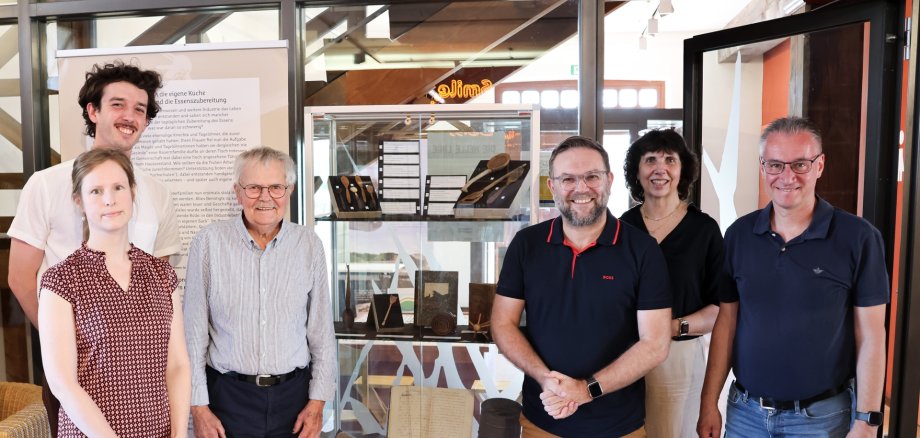
A display case featuring items from the collection of folklorist and customs researcher Gunter Altenkirch is currently on show in the tavern at the Bliesbruck-Reinheim European Cultural Park. The exhibits provide an insight into 19th-century kitchens in the region. At that time, mining, metallurgy and other branches of industry were transforming people’s lives. Working-class families emerged and faced a number of challenges – such as the day-to-day task of preparing meals. The women in these working-class families, having previously worked as maids and day labourers, had never learnt to cook; this was traditionally the sole responsibility of the farmer’s wife. Many industrial firms offered cookery courses for the workers’ wives, usually referred to as ‘cooking schools’. Countless handwritten recipe collections were produced during these courses. Many kitchen utensils were made by the workers themselves or sold by travelling traders from the Hochwald-Hunsrück region. Examples of these, along with the recipes, can be found in the museum’s collection.
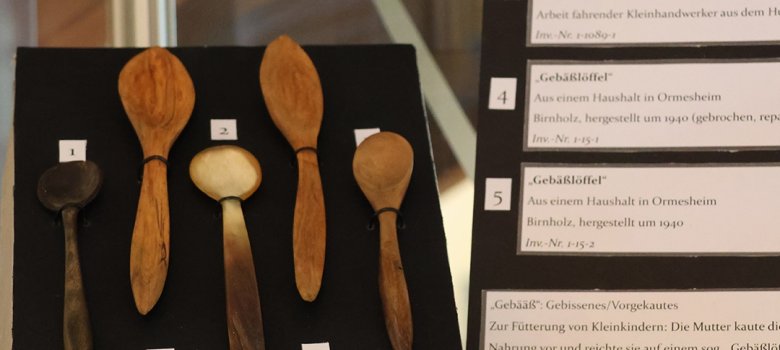
Various ‘soup spoons’ from Gunter Altenkirch’s collection. Photo: Max Grummel
The display case was officially opened by District Administrator Frank John and Mayor Michael Clivot, who, in their speeches, paid tribute to Gunter Altenkirch’s dedication and emphasised the significance of his collection. It offers a profound insight into the everyday culture of the region.
“Gunter Altenkirch’s work is so significant because it helps us understand where we come from and what our history is. The history of mining and metallurgy in our local area is still largely unknown. The exhibits provide an insight into how people used to live,” said Mayor Michael Clivot in his welcoming address.
District Administrator Frank John highlighted the district’s commitment to the future preservation and display of the collection: “It is a shared concern of ours that the exhibits are not only preserved, but that they are also shown to the public time and again. This ensures that these everyday objects – some of which I still remember from my own childhood – do not fade into oblivion.”
The exhibits on display were selected by the art historian Anika Meyer, editor of ‘Sonah’ magazine, in collaboration with Gunter Altenkirch. Within the district administration, the project is being overseen by Jutta Schwan and Andreas Stinsky from the cultural management department. There are plans to present objects from the collection relating to further thematic areas.
The display case, which contains information in German and French, is open to the public free of charge during the tavern’s opening hours.