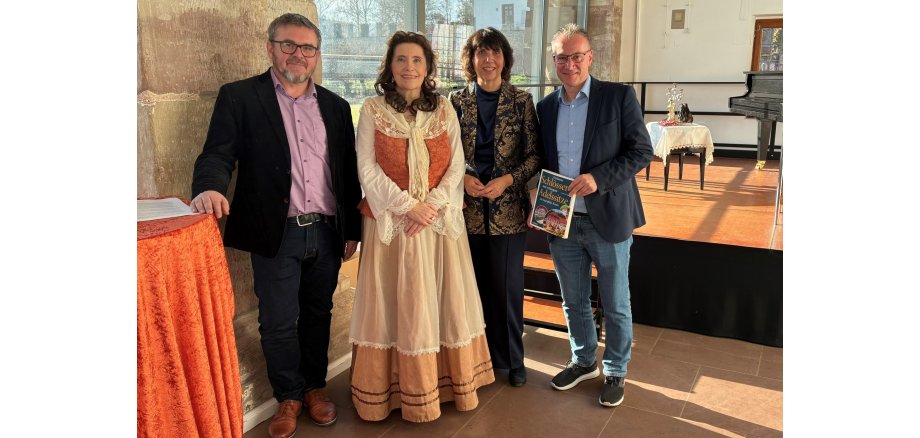
"Lost castles and hidden aristocratic residences" is the title of a newly published book that focuses on the castle landscape in what is now the Saarpfalz district. The publisher is Dr Jutta Schwan from the Saarpfalz district's cultural management department, who recently invited guests to the Orangerie Blieskastel for the presentation of the book.
A stroll through the historic centre of Blieskastel or around the Würzbacher or Jägersburger Weiher ponds gives you an idea of how dense and varied the local palace landscape once was. However, many of the once magnificent buildings and aristocratic residences - such as the castles in Blieskastel and Wecklingen or the legendary Karlsberg Castle near Homburg - have either not survived or have only survived in the form of isolated, sometimes impressive ruins. These remains can hardly convey the impression of former grandeur and splendour.
French revolutionary troops, who plundered and pillaged the region in 1793, marked an abrupt end to the era of residences, hunting lodges and summer palaces, urban palaces and magnificent gardens with exotic plants. As a result, the significance of the region as a "palace landscape" can no longer be experienced in its entirety - not even with a travel guide in hand.
What helps the imagination are traditional written descriptions and pictorial representations. Dr Jutta Schwan and her co-authors, who had conducted intensive research on individual objects, went on a new search for this book. They returned from the libraries and archives with rich pickings and many a surprising discovery.
District Administrator Frank John, who welcomed numerous guests to the Orangery, merely anticipated the event:
"This book brings together the results of an intensive search for clues. Photographs, drawings, historical maps and scientifically based visual reconstructions provide an in-depth look at the history of the lost castles and hidden aristocratic residences in our region. A real enrichment."
Stefan Wirtz from the publishing house Conte-Verlag was also impressed: "The collaboration with Jutta Schwan and the other authors was very pleasant. I am delighted to be able to publish a work of this calibre about our homeland. Stories about our region, written by people from the region and printed and bound here - you can't get more regional than that," said a delighted Stefan Wirtz.
The 246-page print edition is intended to close the gap between concise travel guides and overly comprehensive, scientific works with vivid descriptions. The results and the range of variations will certainly surprise many readers and perhaps even encourage some to look around today's Saarpfalz with different eyes. Hidden gems can also find new meaning for supra-regional tourism. Those who are particularly interested will find more detailed literature references in the appendix.
Dr Jutta Schwan and the chambermaid Henrietta, alias Monika Link, who released herself from her duty of confidentiality for the book presentation, delighted the audience with a kind of staged reading that made them want to delve deeper into the subject matter.
The book was produced with the support of the Saarpfalz district, the BarockStraße SaarPfalz and the Ike and Berthold Roland Foundation and is available in bookshops.