


About Catharina Loth
Successful entrepreneur and leaseholder of several ironworks
In the 18th century, a very special personality was active in St. Ingbert, who has left her mark on the townscape and the memory of those born after her to this day. She was the entrepreneur Catharina Loth, who managed the St. Ingbert ironworks, the Alte Schmelz, on her own responsibility for many years after the death of her husband and set up further production facilities in Illingen and Rentrisch.
Childhood and youth
Catharina Loth, née Gottbill, came from "one of the most important families in the iron and steel industry in the Hochwald-Saar region in the 18th century". Her father and her male relatives had been hammer smiths and iron smelters for generations and as such moved from smelter to smelter with their families. Entries of this name can be found in the parish registers of Neunkirchen, Dillingen, Züsch and Jägerthal in Alsace. In 1715, their father Jean Baptist and his family settled in Nunkirchen in the Saarland to set up a hammer mill there with his brother Carl, i.e. they changed their status from skilled labourers to independent entrepreneurs.
Catharina grew up with her four siblings in rather modest circumstances. Due to her initially unsettled lifestyle, she - like many people at the time - did not receive an education and remained illiterate throughout her life. However, she was a clever person with a technical mind and a good grasp of things. This is the only way to understand her later development into a commercially calculating and strategically thinking entrepreneur. In 1729, Catharina married Joseph Loth, a widowed armourer from Blieskastel. It was no coincidence that he also worked in the ironworking industry like the Gottbills, as the iron smelters and hammersmiths only ever married among their own kind. With this measure, they protected their exclusive knowledge of iron smelting and processing, which was ultimately their only asset. Four years later, Catharina and Joseph Loth moved to St. Ingbert to set up another ironworks there together with Catharina's brother, effectively as a second branch of the Nunkirch hammer mill.
Widow Loth - single mother and company boss
In 1943, ten years after founding the Schmelz in St. Ingbert, Joseph Loth died. Catharina was left with her five biological children and three nieces and nephews, for whom she had taken over care after the early death of her sister. The ironworks also needed management and, according to the logic of the early modern economic system of the "whole house", it was up to the widow to continue the business of her deceased husband, at least until one of the sons had grown up and was able to take over the sceptre. The widow Loth was confronted with a wide variety of problems, such as the supply of wood (the blast furnaces were still fuelled with charcoal at the time) and iron ore to her factory, which was a major challenge that required a great deal of diplomatic skill and necessitated numerous negotiations with neighbouring lords. The outbreak of a devastating fire also caused great losses. Disputes over taxes to be paid to the church and the amount of rent to be paid to the Counts von der Leyen as sovereigns also dragged on for years.
However, Catharina Loth proved to be very skilful and was in negotiations to take over further ironworks. In 1759, she founded a hammer mill in neighbouring Rentrisch, which belonged to the Principality of Nassau-Saarbrücken. In the same year, it also laid the foundation stone for the construction of an iron smelter in Illingen. The sovereign Franz von Kerpens, who had also supplied Lothin with iron ore for years, leased her a suitable plot of land for this purpose. Even when her two sons came of age and took over the management of correspondence for their mother, Lothin did not relinquish control, but reserved the right to make the final decision in all business matters.
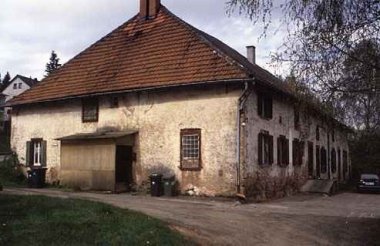
At home in St. Ingbert, meanwhile, the situation came to a head: due to ongoing disputes with Count von der Leyen, she was finally expelled from the factory she and her husband had founded and moved into the management building of the newly built Rentrischer Hammer, the so-called "Höfchen", which still bears witness to her work today. She died there three years later and her body was laid to rest in front of the altar of Engelbert Church in St. Ingbert, which was a great honour and documents that she was a highly respected personality during her lifetime. She was both feared by her competitors and valued as a business partner of the various noble houses. She socialised with the most respected business families of her time and even received personal audiences with Chamber Councillor Dern at the princely court of Nassau-Saarbrücken. Even generations later, she was not forgotten and two streets in St. Ingbert and Rentrisch were named after her: Katharina-Loth-Straße and Lottenhammer
Written by: Dr Susanne Nimmesgern, historian and women's representative of the Saarpfalz district
Published: 29.04.2026; Last updated: 29.04.2026.
Quote
The St Ingbert plant is known far and wide, especially as it is run by me in such a way and is considered by everyone to be a quiet plant."
Letter from Lothin to the administration of Count von der Leyen dated 12 September 1758 in the course of disputes over a higher lease fee, cited in Wolfgang Krämer, Geschichte der Stadt St. Ingbert von den Anfängen bis zum Ende des Zweiten Weltkrieges. A local history based on archival sources, vol. 2, p. 12.
Further reading / literature / sources
Nimmesgern Susanne: The women smelters: Unternehmerinnen, Hüttenfrauen, Zwangsarbeiterinnen auf dem St. Ingberter Eisenwerk, ed. by the Initiative Alte Schmelz St. Ingbert e.V., St. Ingbert 2012.
Catharina Loth (1705-1762): Entrepreneur, illiterate and excellent merchant, in: St. Ingberter Biografien Bd 2, ed. by Heidemarie Ertle and Gerhard Sauder, St. Ingbert 2025, pp. 11-23.
Labouvie, Eva: In female hands - women as company founders and entrepreneurs (1600-1850), in: Frauenleben - Frauen leben. Zur Geschichte und Gegenwart weiblicher Lebenswelten im Saarraum, edited by Eva Labouvie, St. Ingbert 1993, pp. 88-131.
This: Early modern female entrepreneurs. Frauen im Bergbau, in der Eisen- und Glasindustrie, in: Ökonomien der Geschlechter in Geschichte und Gegenwart, ed. by Eva Labouvie and Katharina Bunzmann, Münster 2004, pp. 135-162.
Supported by: