

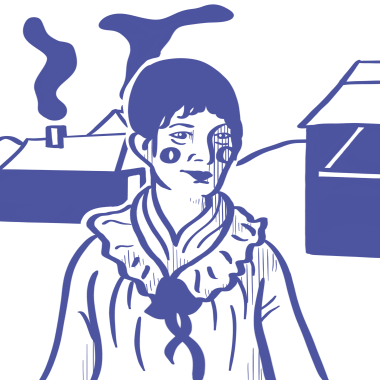
About Sophie Krämer
Entrepreneur - owner of an ironworks and lady of the manor
Sophie Krämer was undoubtedly one of the most influential women of the early 19th century in the Saar region. After the early death of her husband, she followed in his footsteps as the widow, managing and owning an ironworks that prospered and expanded under her leadership.
Childhood and youth
She was born in 1763 in St. Johann (Saarbrücken) as the daughter of the wealthy innkeeper and merchant Georg Ludwig II. Firmond and Catharina Magdalena Schmidtborn. Both parents came from influential and wealthy merchant families and the father was a founding member of the Saarbrücken Krahnen Society, which was privileged by the prince and belonged to the city's elite. The Firmond family, who ran the "Zum Ochsen" inn at the beginning of St. Johann's Fröschengasse, lived in a prestigious house on the Stadtgraben near the Untertor, whose extensive garden stretched towards the Saar and was equipped with several garden sheds[1].
Sophie Firmond found a suitable husband in the businessman Philipp Heinrich Krämer from Alsenborn in the Electoral Palatinate, nine years her senior, who was also the son of a wealthy innkeeper and merchant and related to the leading merchant families in Saarbrücken.
Married life and widowhood
The marriage, which took place in 1782, produced 11 children, 6 of whom died at an early age. After Philipp Heinrich Krämer finally succeeded in taking over the management of the St. Ingbert ironworks after several attempts, the young family moved to the Alte Schmelz in 1794, having previously had a new manor house built there. After eventful and politically turbulent years as a result of the French Revolution, which nevertheless brought the ironworks lucrative armaments contracts, Philipp Heinrich died in 1803 at the age of just 49.
His wife Sophie remained behind, whose task as a widow was not only to run the household, but also to take over the management of the ironworks in place of her sons, who were still minors. Sophie Krämer showed great skill as a businesswoman and was the first company director in the region to acquire the ironworks, which had previously been run on a leasehold basis. She was responsible not only for the expansion of the ironworks, including the renovation of the Möllerhalle, which is still standing today, but also for the expansion of the factory estate and the expansion of the company. She bought several ore fields and ironworks in the southern Eifel region, including Quinter Hütte with its rococo castle, which served as a manor house for the factory owners.
After her sons took over the management of the ironworks at the beginning of the 1820s, Sophie Krämer was still nominally in charge, but withdrew from the operational side of the business and ran the family estate, where she successfully campaigned for the cultivation of potatoes and the production of starch flour to better supply the population. She died in 1833 at the age of 70 and left a prosperous business to her sons. Her grave with a cast-iron genius can still be found today in the old cemetery in St. Ingbert.
Written by: Dr Susanne Nimmesgern, historian and women's representative of the Saarpfalz district
Published: 05.09.2025; Last updated: 31.03.2026.
Quotes
In addition to her services in managing the ironworks in difficult times, Sophie Krämer earned a reputation as a charitable and compassionate woman who helped the poor, sick and needy. In the time of great need after the Napoleonic Wars, there was ample opportunity to do so. The widow Krämer did not stop at helping individual cases, but also endeavoured to improve the nutritional basis of the population by testing the production of potato flour (starch)."
Glaser, Harald: The Alte Schmelz St. Ingbert. Industrial history circular route, St. Ingbert 2001, p. 70f. Glaser refers here to a publication by Werner Weidemann (Schul-, Wirtschaft- und Sozialgeschichte der Pfalz, Otterbach 1999).
On a high mountain ridge
Leaning against an old tree
A warrior leans pondering
Immersed in a deep dream.
He dreams of his fatherland,
Of France's glory and power,
Of freedom, brotherly love,
Offered to the nations.
And as he muses and dreams
A flash, a bang, O pain,
The enemy's bullet
Has struck him in the heart
Far away are his comrades,
Who hears his last prayer,
When by the old beech
His spirit of life is blown away?
He entrusted it to him,
To the tree green and strong,
He cut it into the bark,
Deep into the marrow.
The "Vive la République".
So died the son of liberty.
The beech tree has fallen,
Napoleon proudly reigns!"
This poem is attributed to Sophie Krämer and refers to her liberal political views.
Krämer, Wolfgang: Geschichte der Stadt St. Ingbert von den Anfängen bis zum Ende des Zweiten Weltkrieges. Eine Heimatkunde aufgrund archivalischer Quellen, St. Ingbert 1989 [reprint] vol.2, footnote 264, p. 287f.
[...] true mother of the poor, not only for her sick labourers, but also for the poor and sick in St. Ingbert, whom she always supports in every possible way, in the good spirit of her late husband, who was just as devoted to the poor, who rejoices and still asks the pastor of the village to report the needy to her in order to be able to prove her charity."
The acting pastor Wilhelm Torsch about Sophie Krämer.
Quoted from Müller, Friedrich: St. Ingbert unter der Herrschaft Napoleons nach der "Pfarrchronik" von Wilhelm Torsch (1802-1813), in: Saarheimat 2006, pp. 22-45, here: p. 44, note 23.
Footnotes
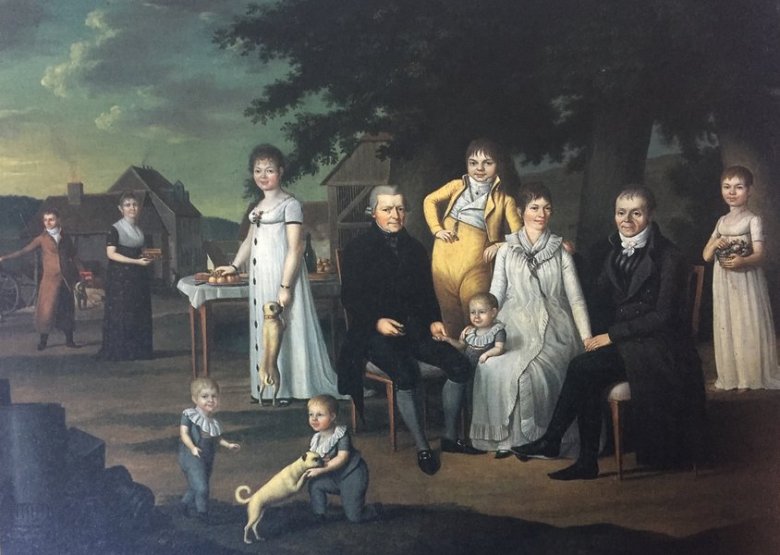
[1] Firmond'sche Chronik 1790-1801, in: Mitteilungen des Historischen Vereins für die Saargegend, Heft 7, Saarbrücken 1900, pp. 28-123, here p. 113. The author of the chronicle, which provides important impressions of the Napoleonic period, was Sophie's father Georg Ludwig II. Firmond, 5th person from the right in the painting.
Read more / Literature
Nimmesgern, Susanne: The women smelters. Women entrepreneurs, smelter wives, forced labourers at the St. Ingbert ironworks. St. Ingbert 2012, pp. 75-135 (published by the Initiative Alte Schmelz St. Ingbert e.V.).
This: The Krämer family. Founders and representatives of a new era in St. Ingbert, in: Ertle, Heidemarie; Sauder, Gerhard (ed.): St. Ingbert biographies, St. Ingbert 2023, pp. 26-46.
Supported by: