

About the "Princess" of Reinheim
Outstanding woman at the time of the Celts
After the death of one of its members, a community decides to place extremely valuable artefacts in his burial chamber and then to go to great lengths to erect a mound above it that can be seen from afar. Meanwhile, those who were responsible for making the elaborate grave goods and building the tomb are buried without any such effort.
Even without knowing the exact motives, it can be concluded from such circumstances that the person in the richly decorated burial chamber must have had a prominent position in the community during his or her lifetime. The situation described can be found at various times in world history and also fits the grave of the so-called "Princess" of Reinheim.
A look inside the Reinheim elite tomb
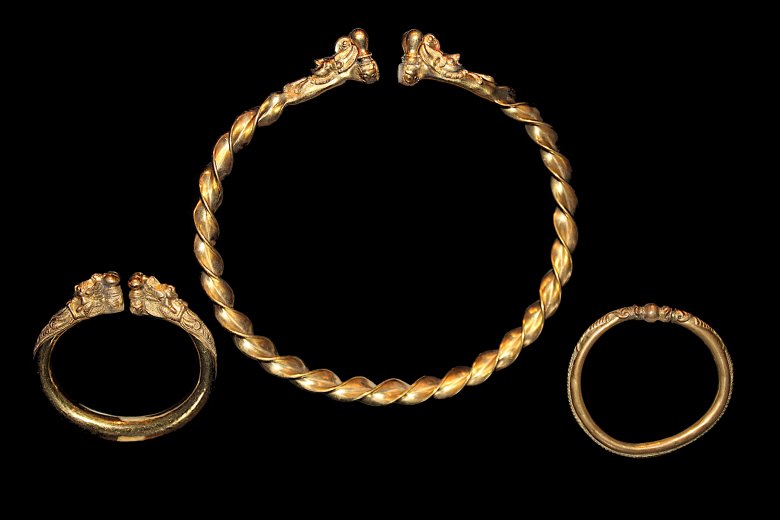
After it was discovered in 1954, it became clear during the three-day excavation that this was an elite grave due to the special finds.[1] Although all the bones had already been lost,[2] the gender of the person buried was also quickly established: the neck ring and the arm rings worn on both sides archaeologically indicate that the grave was worn by women at the time.
The find became world-famous as the "Princess of Reinheim" [3]. The grave was erected in the 4th century BC and belongs to the Frühlatène culture,[4] which is categorised as "the Celts". They lived in many parts of Europe and have also left many traces in Saarland.
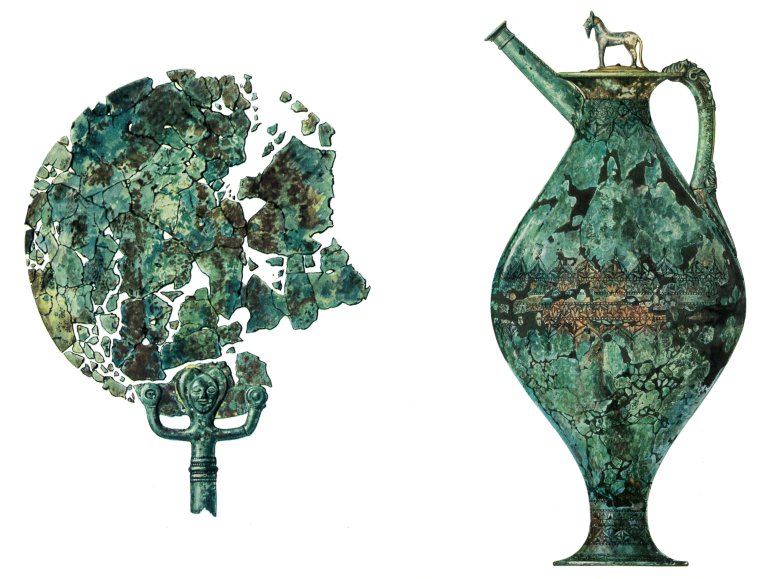
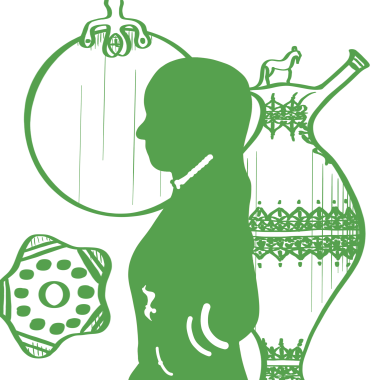
These also include the jewellery, the drinking set and the other objects from the special Reinheim women's grave.[5] The woman in the grave wore a twisted necklace made of gold - a symbol of power among the Celts. Her arms and fingers were adorned with rings made of gold, glass and oil shale. Her garment, which is no longer preserved, was held together by elaborate fibulae, or garment clasps. Next to her - possibly in a container made of fabric or wood - was other jewellery, such as a belt chain and an impressive necklace made of over 100 amber and glass beads. Two bronze bowls, golden fittings from drinking horns and a gilded bronze tube jug half a metre high represent a sumptuous drinking service. The grave also contained a mirror, a knife, an amber stick and various pendants and stones.
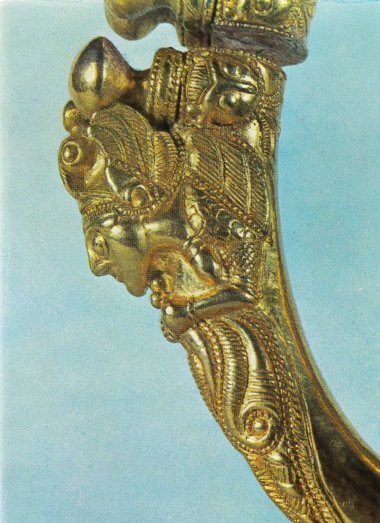
In addition to the pure material value and the number of high-quality objects, their decoration is also interesting. Both the jewellery objects, such as necklaces and bracelets or brooches, and the drinking service are artistically designed. They feature finely crafted floral and geometric ornaments as well as human faces in some cases. The heads on the end pieces of one of the gold bangles can be interpreted as a depiction of a female deity. She combines aspects of the Greek goddess Athena or the Etruscan Minerva with characteristics of the goddess Artemis as the mistress of the animals.[6] Beardless faces, which perhaps also embody female figures, can also be found on the necklace and mirror.[7]
Ruler? Priestess? Princess?
So who was the buried woman? The grave goods reveal, among other things, trade relations and long-distance contacts.[8] Gold, amber, coral, copper, pewter and glass - many of the materials used did not originate from the region around Reinheim.[9] The design of some objects, such as the decorative elements mentioned, which refer to the Mediterranean region, also point to contacts with other cultures. Perhaps the woman belonged to a group that controlled trade in her community or region.
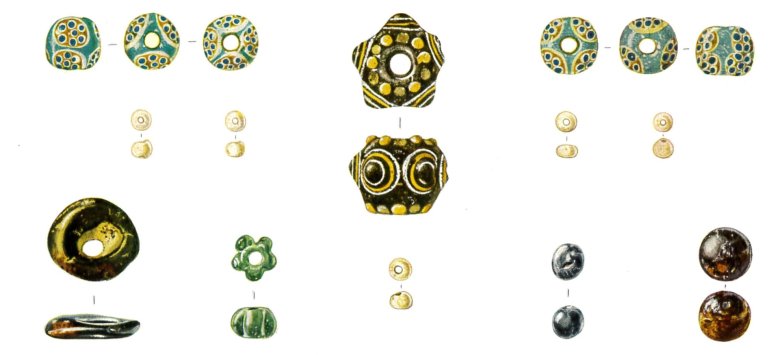
A number of objects were also found in the grave which - in contrast to jewellery or drinking vessels - can hardly be attributed to a profane, i.e. everyday secular, use. For example, a staff with a rattling handle can be reconstructed from a handle-like object made of amber and some beads with the help of comparisons.[10] Like this, a collection of smaller pendants and stones, including two pendants depicting naked men (possibly dancing), a Stone Age arrowhead or a fragment of an ammonite have no clear function.[11] Researchers are therefore considering whether the objects were perhaps used as amulets or in religious rites and whether they identified the buried woman as part of a cultic elite, e.g. as a kind of priestess.[12] However, it is difficult to reconstruct what the community at the Blies actually believed in and which practices were part of their possible beliefs.
A powerful woman
Although it remains to be seen what role the woman played in her community, it is clear that she had a prominent position and the means to access exclusive objects. Even after her death, she received recognition from her fellow human beings. As a woman in prehistory and early history, and also among the Celts, she is therefore not an isolated case. Examples include the "princess" of Vix or the "princess" of Schengen.
It is therefore a misconception to assume that women were unable to achieve such social positions over 2,000 years ago. A comprehensive examination of female elites in early history reveals that women often achieved high positions in religious areas[13], but this does not rule out a position of political or economic power - especially in societies in which cult and rule were not necessarily strictly separated.
Written by: Helen Tepper M.A., Project Coordination Women's Traces in the Saarpfalz District
Published: 15 September 2025; Last updated: 11 August 2026.
Film
The following short film from 2018, commissioned by the Bliesbruck-Reinheim European Cultural Park, shows one version of what the life of the "Princess" might have looked like.
Courtesy of the European Cultural Park Bliesbruck-Reinheim | A film by Friedrich van Schoor & Tarek Mawad
Footnotes
[1] Cf. Keller, Das keltische Fürstengrab von Reinheim, Mainz 1965, p. 14.
[2] Ibid, p. 17.
[3] Since the term "princess" is certainly associated with more modern forms of rule or society, attempts are now often made to describe the prominent position of such graves and the buried in a more neutral way.
[4] For the dating see: Stinsky/Matzerath, Die sogenannte Fürstin von Reinheim, in: Saarpfalz, H. 149, 2023, p. 11.
[5] On this and the following, cf. the list of finds in: Keller 1965, pp. 17-19.
[6] Echt, Das Fürstinnengrab von Reinheim, Bonn 1999, pp. 42-50; Haffner, Alfred: Wer war die Dame von Reinheim?, in: Petit, Jean-Paul (ed.): Europäischer Kulturpark Bliesbruck-Reinheim - 2500 Jahre Geschichte, Dijon 2013, p. 24.
[7] Echt 1999, p. 39; Haffner 2013, p. 25.
[8] Stinsky/Matzerath 2023, p. 19.
[9] Ibid, p. 12.
[10] Cf. Haffner 2013, pp. 26-27.
[11] Echt 1999, pp. 84-89; p. 106.
[12] Ibid., p. 111; Haffner 2013, p. 33.
[13] Quast, Weibliche Eliten - eine Einführung, in: Ders. (ed.): Weibliche Eliten in der Frühgeschichte, Mainz 2011, p. 1.
Read more / Literature
Echt, Rudolf: The tomb of the princesses of Reinheim. Studien zur Kulturgeschichte der Früh-La-Tène-Zeit, Bonn 1999 (Saarbrücker Beiträge zur Altertumskunde Vol. 69).
Haffner, Alfred: Who was the Lady of Reinheim?, in: Petit, Jean-Paul (ed.): European Cultural Park Bliesbruck-Reinheim - 2500 years of history. Celts, Romans and Franks in Lorraine and the Saarland, Dijon 2013 (Les dossiers d'archéologie Sonderh. 24), pp. 20-33.
Keller, Josef: The Celtic princely tomb of Reinheim. Volume 1, Mainz 1965.
Quast, Dieter: Weibliche Eliten - eine Einführung, in: Ders. (ed.): Weibliche Eliten in der Frühgeschichte. International conference from 13 to 14 June 2008 at the RGZM as part of the research focus "Elites", Mainz 2011 (RGZM - Tagungen 10), pp. 1-4.
Stinsky, Andreas/Matzerath, Simon: The so-called Princess of Reinheim. Assessment of the long-distance contacts in the inventory of the Early Latène Period ceremonial burial, in: Saarpfalz. Zeitschrift für Geschichte und Regionalkultur, H. 149, 2023, pp. 8-25.
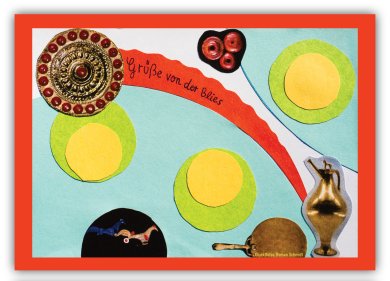
Mail from the Princess
You have mail! Follow the link to a postcard directly from the Princess.
Supported by: