

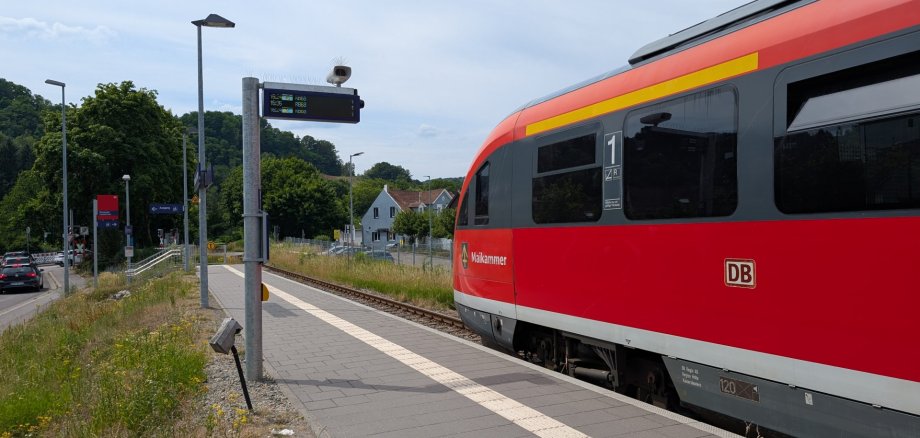
Cycle safely along the new cycle route to the station, catch your connecting train easily via the app from the rural Bickenalbtal valley, and store your high-quality e-bike securely in a locked box to prevent theft: The Saarpfalz district and the town of Blieskastel have significantly improved the routes to and from Lautzkirchen station. For this, the project ‘Upgrading Lautzkirchen station as a hub for the rural area’ was awarded a prize in the national competition ‘Designing Connections: Mobility in Rural Areas’.
The project specifically addresses gaps in the regional transport network, as the hamlets in the Bickenalbtal valley previously lacked a direct rail link, whilst commuters at the station lacked modern, theft-proof cycle parking facilities. The Saarpfalz district has therefore implemented a package of coordinated measures in collaboration with the town of Blieskastel and with support from Deutsche Bahn. Thanks to the innovative on-demand transport service ‘Bliesgau Flitsaar’ , even remote districts now have a reliable and flexible connection to rail transport; the option to book a preferred arrival time and scheduled services during peak hours ensure punctual connections to trains on the Saarbrücken–Pirmasens route. In addition, cycling infrastructure has been enhanced by converting part of Florianstraße into a safe access route to the cycle route, as well as installing modern cycle lockers and covered parking facilities. Thanks to the barrier-free development, optimised timetables for bus routes such as the RegioBus R14 and the Dolmusch city bus service, as well as the connection to the Biosphere Bus 501, the ‘Bliessteig’ long-distance hiking trail and local amenities, the station now serves as a central ‘gateway to the biosphere’.
District Administrator Frank John emphasises the importance of the project for the region: “This award confirms that we are on the right track in approaching local public transport in rural areas not in isolation, but as a seamless travel network. By combining the flexible ‘Flitsaar’ service, safe cycling infrastructure and coordinated bus timetables, we have turned Lautzkirchen station into a modern transport hub that makes our residents’ daily lives significantly easier and makes switching to eco-friendly transport an attractive option.”
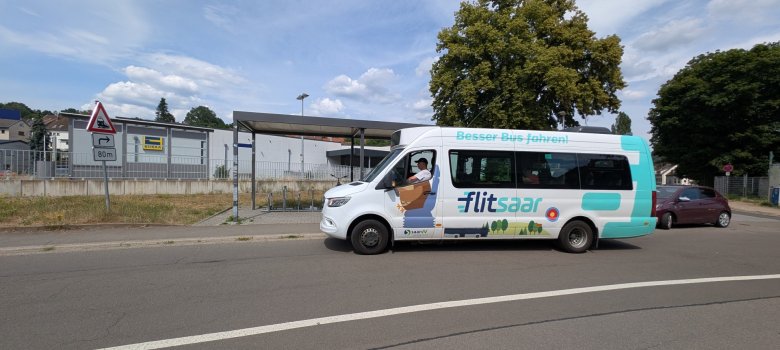
The “Bliesgau Flitsaar” connects even remote districts to the rail network via Lautzkirchen station, operating on an on-demand basis. Photo: Maurice Eickhoff
The project is one of the 20 winning projects in the nationwide competition and will receive prize money of 5,000 euros. Sabine Poschmann, Parliamentary State Secretary to the Federal Minister for Housing, Urban Development and Construction, emphasised that people in rural areas must not be left behind if they do not own a car, as good mobility means inclusion and makes communities more attractive places to live and work. Dr Peter Jakubowski, Director of the Federal Institute for Research on Building, Urban Affairs and Spatial Development, added that a good rail connection is of little use if you cannot travel the last few kilometres. The award-winning projects address precisely this issue, coordinating buses with trains and ensuring safe and short journeys when changing transport.
All the award-winning projects are featured on Mobilikon, the online reference portal for local authority mobility run by the Federal Institute for Research on Building, Urban Affairs and Spatial Development. The portal brings together practical examples and information on mobility solutions and helps local authorities find approaches suited to their local circumstances. The competition was organised as part of the federal programme ‘Region gestalten’, through which the Federal Ministry for Housing, Urban Development and Construction supports projects with a particular focus on rural areas, with the aim of testing new approaches to spatial development and making the findings available to other regions. The Federal Institute for Research on Building, Urban Affairs and Spatial Development provides scientific support for the projects and adapts the findings for use in local government practice.