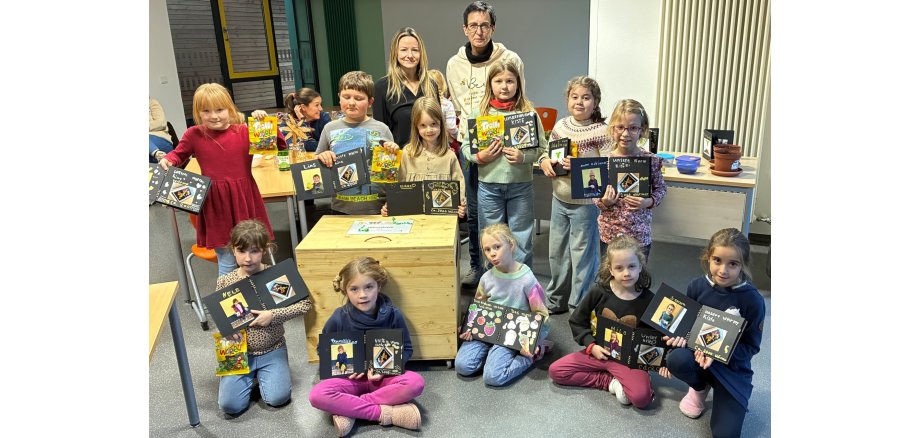
The children from the voluntary all-day school (FGTS) at Kirkel-Neuhäusel primary school recently presented their worm box - a large wooden box specially built for the project - with visible enthusiasm. What do the children learn? How worms can produce fertile humus from leftover food in their lunch boxes.
The project was initiated by the Saarpfalz district's staff unit for shaping social change, education and demography and shows what modern STEM education (mathematics, information technology, natural sciences and technology) can look like.
In addition to the parents, Mark Herzog, head of the staff unit, and Anne Speicher, staff member and project coordinator, did not miss the opportunity to see the children in action.
They proudly showed their parents and other visitors what they were learning in their worm farmer project: how worms can produce fertile humus from leftover food in their lunch boxes.
Using an endoscope camera, the children can even shine a light inside the box and observe the worms closely. And they then document their observations in their "worm brochures", which they proudly showed off.
The project gives the children their first insights into biological cycles and sustainability - without any theoretical hurdles, just by doing. "I am particularly pleased that we are arousing interest at an early age and breaking down fears of STEM subjects - especially because it is practical, sustainable and accessible to all children," says District Administrator Frank John.
The worm box found its way into the FGTS through a cooperation between the staff unit and the company Vermi Biotech, which transferred its concept to the FGTS together with the FGTS staff, in particular the head of the working group, Tanja Rupp, in a child-friendly way. This was done with the help of a train-the-trainer approach so that the teaching staff can continue the project independently and anchor it in the FGTS in the long term.
"Girls in particular have signed up for this project," emphasised Tanja Rupp, FGTS supervisor, who is in charge of the group and runs it with the children. Fear of contact with STEM subjects (maths, IT, science and technology), for which girls often show less interest, does not even arise here.
Background
As part of the BMBFSFJ's MINT Cluster III funding programme, in which the Saarpfalz district is one of five partners in the funded SaarMINT network, MINT courses for children between the ages of six and sixteen are being rolled out.