


About Maria Amalie
Duchess of Palatinate-Zweibrücken
The Little Princess
Princess Maria Amalie Anna Josephina Antonia Justina Augusta Xaveria Aloysia Johanna Nepomucena Magdalena Walpurgis Katharina of Saxony[1] was born on 26 September 1757 at the Taschenberg Palace in Dresden. She was the eldest daughter – following four older brothers – of the Saxon Elector Friedrich Christian (1722–1763) and his wife Maria Antonia (1724–1780) of the House of Wittelsbach, who was a great lover of the arts. Maria Amalie was thus a young princess with a very distinguished family tree: On her father’s side, she was the great-granddaughter of Augustus the Strong from the Albertine line of the House of Wettin; on her mother’s side, she was the granddaughter of the Holy Roman Emperor Charles VII, and the cousin of King Louis XVI of France and King Charles IV of Spain.
During the Seven Years’ War (1756–1763) became the main theatre of war for the major European powers, which is why the ‘young court’ of the Crown Prince and Princess, by then with six children, initially fled into exile in Prague from 1759 onwards and found refuge in Munich from 1760. It was not until the summer of 1762 that the young family, now with seven children, returned to the partially destroyed city of Dresden. Maria Amalie was by then almost five years old. Whilst the family had managed to escape major misfortunes during the war, misfortune caught up with them in Dresden in the form of a smallpox epidemic. Smallpox, a highly dangerous infectious disease – also known at the time as ‘blattern’ – had been greatly feared for centuries, not only because of its high mortality rate but also because of the disfiguring smallpox scars, from which those affected often suffered for the rest of their lives. Within a short space of time, her older brother Joseph and her father, who had become Elector only a few months earlier, died. Desperate in the face of these losses, Maria Amalie’s mother had her children treated for smallpox using a highly controversial and as yet rarely tested method. The disease was induced via ‘inoculation’, that is, the introduction of infectious material into the skin.[2] The less dangerous cowpox vaccination, introduced by the country doctor Edward Jenner, did not come until later.
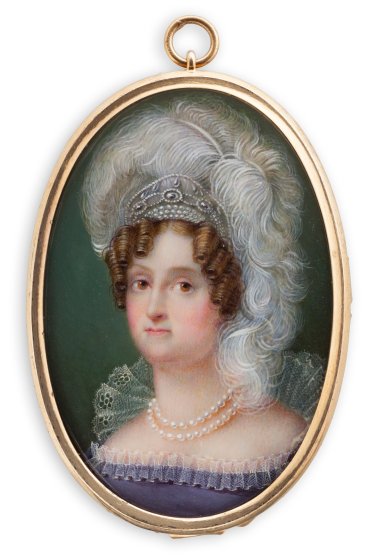
A Wedding Full of Obstacles
In 1769, Maria Amalie’s eldest brother, Friedrich August, married Princess Auguste Amalie of Palatinate-Zweibrücken. At that time, no one could have imagined that, five years later, another marriage might take place between the Saxon House of Wettin and the House of Palatinate-Zweibrücken. In the years prior to this, a marriage had been envisaged between Prince Karl August of Palatinate-Zweibrücken (1746–1795) and a daughter of Maria Theresa of Austria – ironically, also named Maria Amalia – but this fell through, much to the young couple’s dismay. Prince Karl August – or rather, his family’s income – did not meet the Austrians’ demands, and the negotiations were broken off. Meanwhile, in Buchsweiler in Lower Alsace, at the country estate of his aunt, Landgravine Karoline of Hesse-Darmstadt, Karl August met and fell in love with the daughter of the French cavalry captain Friedrich Jacob Gayling von Altheim. In this instance, it was the family and background of the young woman, Carolina Augusta, that the House of Palatinate-Zweibrücken deemed beneath their station. Duke Christian IV opposed the proposed marriage, and swift arrangements were made for Carolina Augusta to marry the ducal Master of the Hunt, Ludwig Friedrich Baron von Esebeck. It was believed that this romantic crisis had thus been resolved.
As early as 1773, the newspapers were rumouring that there might once again be a marriage alliance between the Houses of Saxony and Zweibrücken; indeed, in letters to her brother, the Saxon Electress Auguste praised the virtues of her sister-in-law Maria Amalie, describing her as charming and gentle, with a good heart and many talents.[3] The esteemed Karoline of Hesse-Darmstadt, known as the Grand Landgravine, also supported the idea. Her brother, however – Duke Christian IV and uncle of the future groom – assumed that the latter had been ‘[…] forced into this union at knifepoint […]’[4] and opposed the marriage contract. Consequently, he did not take part in the wedding celebrations either.
Against this difficult backdrop, and following extensive negotiations, the wedding finally took place on Saturday, 12 February 1774, in the chapel of Dresden Palace, in the chapel of Dresden Palace, the official wedding of the Saxon Princess Maria Amalie to the 27-year-old Count Palatine Karl August (1746–1795), who was eleven years her senior and later became Duke of Palatinate-Zweibrücken. The meticulously planned celebrations, featuring balls, operas, excursions into the Dresden countryside and other festivities, continued well into March; however, on 7 March, the young Countess Palatine was finally forced to leave her Saxon homeland.
She was just 16 years old, so saying goodbye to her family was all the more difficult and tearful, especially as Karl August had initially refused, prior to his young wife’s wedding, to allow her chambermaid, her trusted dressmaker and a lady-in-waiting to remain part of her household. Maria Amalie later donated some of the ceremonial garments from those days, including a wedding dress made of white-ground silk brocade with pastel-coloured flowers, to the Catholic parish in Homburg. The remnants of the wedding dress – altered into a priest’s vestment – can still be viewed today in St Michael’s Church.[5] The remaining fabrics, which had long been in the parish’s possession, fell victim to the wars of the 20th century and disintegrated.

The Era of Marriage in Homburg
After the wedding, the newlyweds first travelled to Sulzbach in the Upper Palatinate[6] to visit Karl August’s mother, who had been unable to attend the ceremony[7]. They then travelled on to Mannheim, where the couple stayed at the local royal residence for four weeks. They subsequently took up residence in their first shared home in Neuburg an der Donau, where they had at their disposal a wing of Neuburg Castle, the hunting lodge in Grünau for their hunting pursuits, and the Rohrenfeld estate with its stud farm. However, it is said that the Duke never felt at home there. In the autumn of 1774, the couple travelled to Zweibrücken for the first time, where festivities, balls and theatre performances were held in honour of the princess.[8]
On 5 November, Duke Christian IV of Palatinate-Zweibrücken died – completely unexpectedly. As Duke Christian had no children of his own who were entitled to the succession, his nephew Karl August was therefore designated to rule the Duchy of Palatinate-Zweibrücken. The court in Neuburg was dissolved, and Maria Amalie, who was by then six months pregnant, set off once again with her husband for a new home. The young couple moved into the capital city in early January, to the cheers of the people of Zweibrücken. However, as indicated in the French legation reports[9] and much to the annoyance of the people of Zweibrücken, the couple took up residence from November 1775 onwards at Christian IV’s hunting lodge in Jägersburg near Homburg. On 2 March 1776, the couple’s first son, Karl August Friedrich, was born. The joy at what was believed to be a secure succession was correspondingly great. In the period before and after the birth, Maria Antonia of Saxony stayed in Zweibrücken to support her daughter. However, she was unable to prevent her son-in-law from once again turning passionately towards his childhood sweetheart whilst in Zweibrücken. What is more, Carolina Augusta, who had been married to Baron von Esebeck ten years earlier, was now elevated by Karl II August not only to the status of his mistress, but also to that of his wife’s chief lady-in-waiting. As a result, Carolina von Esebeck immediately became part of the Duchess’s court and gained more and more influence there.
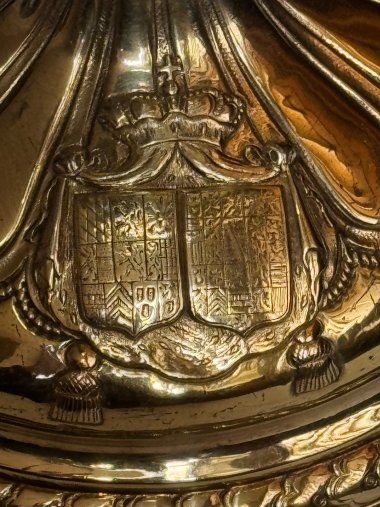
Power – and living conditions at court in the Palatinate-Zweibrücken region
Maria Amalie thus soon found herself in a situation which, two centuries later, Diana, Princess of Wales (1961–1997), described in her own marriage to Prince Charles with regard to Camilla Parker Bowles as: “Well, there were three of us in this marriage, so it was a bit crowded”.[10] Maria Amalie, who is described by many contemporaries as very gentle-natured, also had Baroness von Esebeck constantly in her immediate vicinity. At the Duke’s new favourite residence, the ‘Louisenhof’ estate on the Buchenberg in Homburg – later known as Karlsberg Castle – the Duke allocated two rooms to his young wife Maria Amalie – a study and a dressing room – whilst Carolina Augusta occupied two rooms and a cloakroom on the ground floor. At Karl August’s request, the ground floor and first floor were connected by an additional secret staircase, accessible via a filing cabinet with a sliding door and a built-in cupboard.[11] The estate soon proved to be too small, and several new wings were added. Although a palace wing, in which an apartment on the bel étage befitting her status could have been accommodated, was begun in 1782, work on it was temporarily halted in favour of a collection wing for the Duke. It was therefore never completed to the extent that the Duchess could have moved into these rooms. Consequently, she had to live on the ground floor of the North Wing on the Karlsberg, in a suite of rooms situated beneath her husband’s apartments.[12]
As early as 1778, extensive renovation work began on a pheasantry building dating from the time of Duke Christian IV, which had stood there since at least 1760 and was situated on the road from Karlsberg to Jägersburg. The roof was re-tiled, the interior underwent a thorough renovation, and both the house and the garden were given a ‘makeover’. From 1779 at the latest, the young Duchess spent more and more of her time at this estate – albeit mostly only during the day. The 14 rooms of the two-storey house were furnished with a dining room, stately marble fireplaces, tall mirrors, Bohemian glass chandeliers and precious furniture, including card and embroidery tables and a billiard table. Furthermore, there is evidence of a copper bath and a lightning conductor on the roof.[13] The garden featured such attractions as a small carousel, a pavilion with a pond, a grotto and a shaded arbour, as well as goldfish ponds and countless gilded earthenware flower pots.
The politician Maximilian von Montgelas, who was familiar with the circumstances from his stays in the Palatinate-Zweibrücken region, described the Duchess as a “charming princess” who loved music, theatre and dance – no doubt a trait she had inherited from her mother. He also noted that she was probably glad “whenever she managed to escape from that dreary prison of luxury on the Karlsberg”[14]. The court painter Mannlich characterised her in his memoirs as gentle, pious and virtuous.[15]
The ducal couple’s only son, whom nature had endowed with great intelligence and a noble character,[16] died on 21 August 1784 at the age of just eight and was buried in St Alexander’s Church in Zweibrücken. No further children were to follow. The grieving Duchess increasingly took refuge in her own small country house near the town of Homburg. Owing to the invasion of French Revolutionary troops, she was forced to flee with her husband to Mannheim by carriage one night in February 1793, after they had been warned by a postilion from St. Ingbert. The couple spent the following months in the vacant Mannheim Palace and at Rohrbach Castle near Heidelberg. Duke Karl II August did not wish to return to Neuburg. There was also no going back to Karlsberg, which had been destroyed and plundered in July 1793. Instead, in December 1793, he purchased the Palais Castell in Mannheim, with its stately interiors, as a city residence. The couple moved there in the course of 1795. This palace, located at Quadrat L2 No. 9, was also the place where Karl II August died unexpectedly of a stroke that same year, aged just 48.
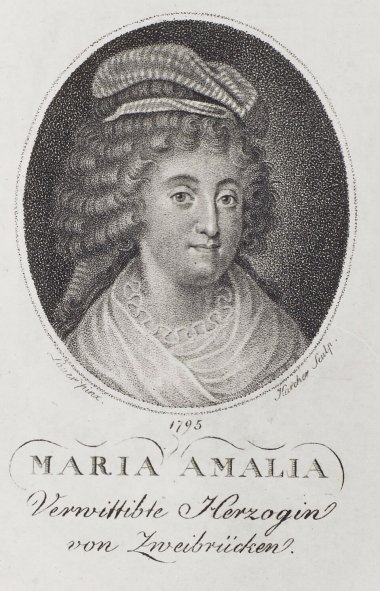
The Escape from Mannheim
As late as 1794, Maria Amalie had been appointed Grand Mistress of the Wittelsbach Order of St Elizabeth, the third-oldest order for women in the world (founded in 1766), ; however, the order was losing its significance, particularly as the early death of her husband meant she could not become Electress, as had originally been expected. In 1795, she retired to her new widow’s residence in Neuburg an der Donau. But even there she was initially unable to find a permanent home, as the First Coalition War forced her to flee once more in 1796, this time to her relatives in Dresden.[17] In the winter of that same year, she returned once more to Neuburg, only to be forced to leave her home again during the Second Coalition War. It was not until eight years and three flights from her home following her time in Karlsberg that she was finally able to find peace in Neuburg. Despite all these upheavals, she had managed to save a personal treasure in the form of a wooden casket bearing the portrait of her beloved son, who had died far too young, in which she had kept his baby shoes, little stockings and a child’s bonnet. Today, this writing box is housed in the Bavarian National Museum in Munich.[18] Wherever she was, the Dowager Duchess was regarded as amiable, friendly and magnanimous, and maintained close contact with her relatives in Munich, who held her in high esteem. Her brother-in-law Max Joseph (1756–1825) had by then become Maximilian I Joseph, the first King of Bavaria.
Maria Amalie, who had to bury her only, much-loved child and who outlived not only her husband but also his former mistress, died in 1831 and was buried in the princely crypt of the Catholic Court Church of ‘Our Lady’ in Neuburg. By that time, not a trace remained of her pheasantry in Homburg, which had been set alight and ravaged in August 1793.
Written by: Dr Jutta Schwan, art historian in the cultural management of the Saarpfalz district
Published: 3 September 2025; Last updated: 16 July 2026.
Footnotes
[1] The spelling varies in the literature – Maria Amalie or Maria Amalia. In her letters to her brother Friedrich August, held in the Saxon Main State Archives, she signs her name as ‘Amelie’.
[2] Vonhof-Habermayr, Margit: Dangerous virus: 200 years ago, the Neuburg vaccination centre was located in the Marstall, *Neuburger Rundschau*, 12 February 2021. https://www.augsburger-allgemeine.de/neuburg/Neuburg-Dangerous-Virus-200-Years-Ago-the-Neuburg-Vaccination-Centre-was-in-the-Marstall-id59102226.html, accessed on 25 June 2026.
[3] Vonhof-Habermayr, Margit: ‘Neuburg’s Fortune’. Duchess Maria Amalie of Palatinate-Zweibrücken (1757–1831), in: *Neuburger Kollektaneenblatt* 2013, Neuburg an der Donau, pp. 79–119; here pp. 89–90 with note 20.
[4] Weber, Wilhelm: Schloss Karlsberg, Homburg 1987, p. 133. Ibid.: ‘The Friendship between the Palatines and the Saxons’, in: Die Saarpfalz, Part 4, Homburg 1991, no page numbers.
[5] Derksen, Maximilian: ‘The Pluviale at St Michael’s in Homburg. On the dating and purpose of a ducal endowment’, in: *Saarpfalz. Journal of History and Regional Culture* 2/2026, No. 156.
[6] Now known as Sulzbach-Rosenberg, situated approximately 50 km east of Nuremberg.
[7] Vonhof-Habermayr 2013, p. 94.
[8] Weber 1987, p. 134.
[9] Roland, Berthold: ‘The Events at the Court of Zweibrücken from late October 1775 to early March 1776’, in: *Pfälzer Heimat* 9 (1958), pp. 179–183, here p. 181
[10] Diana in an interview with BBC1 on 20 November 1995 as part of the BBC documentary series “Panorama”.
[11] Mannlich, Johann Christian von: Rococo and Revolution, Stuttgart 1966, p. 209.
[12] Schwan, Jutta: Studies on the Architectural History of Carlsberg Castle, Neustadt a.d. Weinstraße 2010, p. 100ff.
[13] Schwan, Jutta: ‘The Duchess’s Little Castle in Homburg’, in: Lost Castles and Hidden Aristocratic Residences in the Saarpfalz District, St. Ingbert 2025, pp. 149–161, here p. 153.
[14] Weis, Eberhard: Montgelas: A Biography. 1759–1838. Vol. 1, Between Revolution and Reform 1759–1799, Munich 1971/1988, p. 178.
[15] Mannlich, Johann Christian von: Rococo and Revolution, Berlin 1913, p. 321.
[16] Vonhof-Habermayr: Duchess Amalie’s Family Album. The Portrait Collection at Neuburg an der Donau Town Hall. Neuburg 2017, p. 21.
[17] Vonhof-Habermayr 2013, p. 101.
[18] Vonhof-Habermayr, Margit: ‘A Little Treasure Chest Full of Memories’, in: *Die Pfalz* 2017/1. Journal of Politics, Culture and Economy, pp. 6–7. Bavarian National Museum, Inv. No. 7716.
Read more / Literature
Derksen, Maximilian: The Pluviale at St Michael’s in Homburg. On the dating and purpose of a ducal endowment, in: Saarpfalz. Journal of History and Regional Culture 2/2026, No. 156.
Mannlich, Johann Christian von: Rococo and Revolution, Berlin 1913, p. 321.
Roland, Berthold: ‘The Events at the Court of Zweibrücken from late October 1775 to early March 1776’, in: *Pfälzer Heimat* 9 (1958), pp. 179–183.
Schwan, Jutta: A brief insight into the secluded realm of Duchess Maria Amalie, in: Becker, Bernhard (ed.): "... die Mutter Erde schmüket". Gardens, parks and natural monuments in the Saar Palatinate, Merzig 2010, pp. 71-85.
Schwan, Jutta: Studies on the Architectural History of Carlsberg Castle, Neustadt an der Weinstraße, 2010.
Schwan, Jutta: ‘The Duchess’s Little Castle in Homburg’, in: Lost Castles and Hidden Aristocratic Residences in the Saarpfalz District, St. Ingbert 2025, pp. 149–161.
Vonhof-Habermayr, Margit: Das "Familienalbum" der Herzogin Maria Amalie von Pfalz-Zweibrücken - Die Fürstenbildnisse im Rathaus zu Neuburg an der Donau, in: Neuburger Kollektaneenblatt 2015, Neuburg an der Donau 2015, pp. 202-265.
Vonhof-Habermayr, Margit: “Neuburg’s Fortune”. Duchess Maria Amalie of Palatinate-Zweibrücken (1757–1831), in: Neuburger Kollektaneenblatt 2013, Neuburg an der Donau, pp. 79–119.
Vonhof-Habermayr, Margit: “This is my last will and testament…”. The will of Duchess Maria Amalie of Palatinate-Zweibrücken dated 7 June 1829, in: Neuburger Kollektaneenblatt 2014, Neuburg an der Donau 2014, pp. 5–44.
Vonhof-Habermayr: Duchess Amalie’s Family Album. The portrait collection at Neuburg an der Donau Town Hall. Neuburg 2017.
Vonhof-Habermayr, Margit: ‘A little treasure chest full of memories’, in: *Die Pfalz* 2017/1. Journal of Politics, Culture and Economy, pp. 6–7.
Weis, Eberhard: Montgelas: A Biography. 1759–1838. Vol. 1, Between Revolution and Reform 1759–1799, Munich 1971/1988.
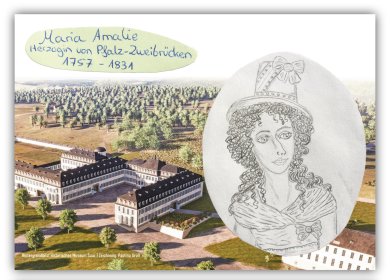
Mail from the Duchess
You have mail! Follow the link to a postcard directly from the Duchess.
Supported by: