

About Elisabeth von Blieskastel
Countess and founder of Gräfinthal Monastery
As the first-born of Count Henry of Blieskastel (†1238), who came from the House of Metz-Lunéville, and his wife, Countess Agnes of Sayn (†1255), Countess Elisabeth was her father's heiress daughter. She herself remained childless during her two marriages.
She is known as the founder of Gräfinthal Abbey. When and for what reason she founded the monastery can no longer be fully traced today. Looting and a fire destroyed all the documents that could have proven this. However, the oldest literature on the monastery dates the foundation to 1243 or immediately afterwards.
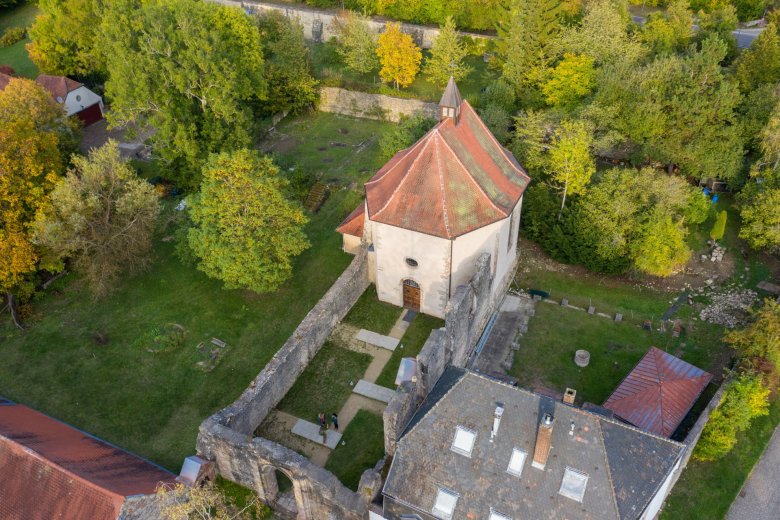
The countess's tomb can be found in the pilgrimage chapel of the Gräfinthals monastery, which can still be visited today, and the name of the valley on the Letschenbach still commemorates Countess Elisabeth von Blieskastel, a formative personality of the medieval Bliesgau.
Family and heritage
Countess Elisabeth was the eldest of seven daughters born from the marriage of Count Heinrich von Blieskastel and Countess Agnes von Sayn. The parents also had a son, Johannes, who died in 1235 and was buried in Wörschweiler. [1]
The countess's sisters were: Imagina, who married Mr Gerlach von Limbach; Adelheit, the wife of Gottfried von Arensberg; Kunigunde, the wife of Count von der Mark and the wife of Ulrich Rappoltstein, whose name has not survived. The other two sisters, Loretta and Mathilde, were not married during Count Heinrich's lifetime, which is why he transferred half of Hunolstein Castle to each of them. Loretta later married the Count of Salm and Mathilde the Count of Blankenheim. In 1237, Elisabeth married Count Berthold von Sulz.
After the death of the father in 1238, the widowed mother and sisters had to settle the inheritance among themselves. Obviously, they ruled out joint administration, which led to disputes[2].
Shortly after the death of her father, Elisabeth made efforts to obtain the enfeoffment of Blieskastel from the Bishop of Metz and issued a feudal charter on 26 March 1238. In it, she not only regulated her own claims, but also the succession in the event of her childless death:
I, Elisabeth, Countess of Castel, make it known to all that with the consent of my husband, Berthold, Count of Sulz, I have become a feudatory of my Venerable Lord John, by the grace of God Bishop of Metz, after the Venerable Lords, the Archbishop of Trier and the Bishop of Verdun, the fiefs which my father received from them have been restored to me by them . . . But if it should happen to me to die without any heirs of my own, one of my sisters shall receive and retain the said fief in the prescribed manner."[3]
The fact that the executor of the estate, Count Heinrich von Zweibrücken, agreed to this was shown by the fact that Elisabeth used his seal:
And since I have no seal for myself, I have had the seal of the noble man, the Count of Zweibrücken, my relative, affixed to these letters in testimony of the truth."[4]
The feudal verse also makes clear her claim to other fiefs that her father had received from Trier and Verdun, in particular Hunolstein and Schaumburg. She wanted to claim these later.
After her return from Metz, Countess Elisabeth saw a problem in her mother's presence at Blieskastel Castle. She feared both that Agnes might interfere with her rule and that her sisters would often appear at the castle under the pretence of visiting their mother.[5] In the end, she was able to get the dowager countess away from Blieskastel on the grounds that the unmarried daughters at Hunolstein needed their mother.
Marriages
Shortly after Countess Elisabeth's return from Metz, she also learnt that her first husband, Count Berthold von Sulz, had already been ordained a subdeacon before entering into the marriage. This meant that he had married without permission. Initially, the marriage remained binding, which is why Elisabeth was considered an adulteress when she could not live with the count's great deception and immediately separated from him.
After the expulsion of her mother and the separation from Count Berthold von Sulz, she now stood alone. She also did not have enough power at the time to defend her possessions, which is why she needed the help of a man. In the same year, 1238, she is said to have married Count Rainald von Bitsch (†1274), the brother of the Duke of Lorraine and son of Duke Frederick II.[6] Both sides entered into the marriage more out of self-interest than love. Countess Elisabeth was in urgent need of help and Count Rainald thus secured a claim to the County of Blieskastel. He later called himself Count of Blieskastel. However, Elisabeth's second marriage was not recognised by the church until 1253[7], as her first marriage first had to be declared null and void by the Pope. In 1258, she is mentioned for the first time as the wife of the Count of Bitsch[8].
Around 1243, battles broke out over the rule of Blieskastel because Agnes, the countess's widow, instructed her son-in-law Henry of Salm to recapture the castle and the Schaumburg region[9]. While Countess Elisabeth's husband was in the field, she took over the effective management of the county.
Foundation of a monastery
This year, 1243, also saw the foundation of the Wilhelmite monastery of Gräfinthal, in which Count Rainald was not involved. When it was founded, Countess Elisabeth donated church rights, revenue and other property to the monastery. Her relatives, the Lords of Mengen, also supported it with further church rights and income. The monastery developed undisturbed over the next 130 years.
Elisabeth handed over the monastery to the order of the Wilhelmites, a young Benedictine reform order. They lived according to the rule of St Benedict, but led a particularly pious life. Their everyday life was characterised by prayer, meditation, worship, penance, but also pastoral care and nursing. They permanently took over pastoral care in Blickweiler-Blieskastel and also looked after Bliesmengen, which meant that the monastery played an important religious role in the region.
In 1376, the monastery suffered great damage for the first time. On his way to Alsace, the Duke of Guise ordered his troops to plunder the monastery and set it on fire, burning all the documents in the process. For this reason, we now have to rely on a legend from the 15th century to find out something about the foundation of the monastery. It reports:
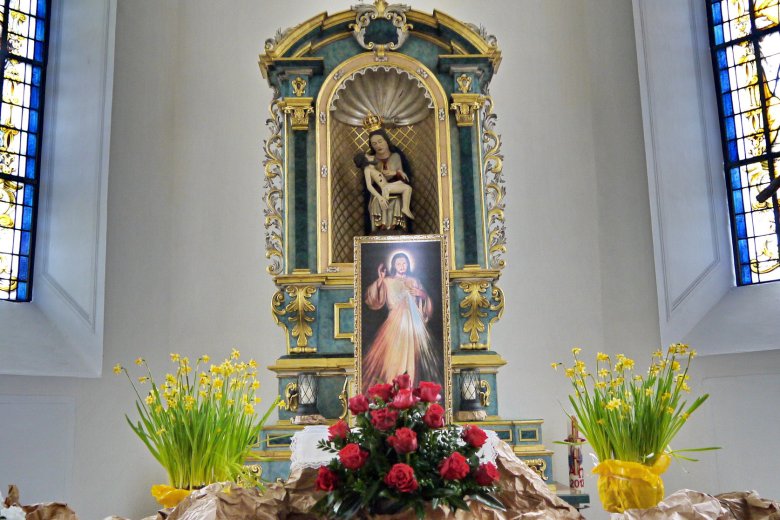
"Not far from today's Gräfinthal, there used to be an image of the Virgin Mary in a niche in an oak tree. Desperate fellows who passed by the place shot at it with arrows, which stuck in the image. Blood flowed from the wounds.
A blind man who rubbed it into his eyes regained his sight.
Countess Elisabeth, the heiress daughter of Count Heinrich von Blieskastel and his wife Agnes, Countess of Sayn, also suffered from dripping eyes. When the countess heard of the incident, she travelled there and is said to have been cured of her ailments by this blood. In gratitude, she had a monastery built in the immediate vicinity of the oak, which was named Vallis Comitissae - Valley of the Countess. This took place in 1243."[10]
It is not known whether Elisabeth actually suffered from dripping eyes as a child, but the so-called Arrow Madonna was a regionally recognised image of grace.
Death
Countess Elisabeth von Blieskastel died in 1273, probably shortly after 22 April[11]. The exact circumstances of her death are unknown. Shortly after her death, a sandstone tomb was erected for her in the octagonal chapel of the monastery. It bears the inscription "Elisabeth Comitissa a Bliescastel"[12].
The monastery lives on
Even in the 16th century and during the Thirty Years' War, the monastery was not spared from plundering. It was destroyed several times and had to be rebuilt, which was mainly due to the fact that the monastery was located directly on the Lorraine border and was therefore always directly exposed to the disputes between the princes. The failed harvests around 1780 led to the emigration of many of the inhabitants and thus to the economic decline of the monastery, which then had to sell part of its property. In 1782, the monks of Gräfinthal asked the Pope to dissolve the convent and move it to Blieskastel. Pope Pius VI then converted it into a secular foundation in 1785 with its seat in Blieskastel, the then residence of Imperial Countess Marianne von der Leyen.
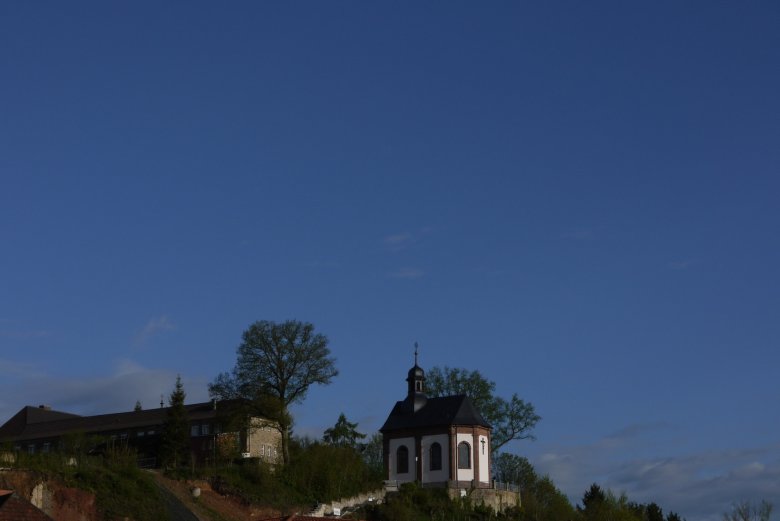
However, the miraculous image of Our Lady of the Arrow survived the repeated looting and was brought to Blieskastel after the dissolution of the monastery in 1786. Today it can be seen there in the Chapel of the Holy Cross. The countess's tomb has also remained intact within the monastery.
It is a miracle that despite all these fates, the tomb of the founder, Countess Elisabeth von Blieskastel, has been preserved almost intact to this day!"[13]
Written by: Laura Czech, Federal Volunteer in the Women's Office of the Saarpfalz District
Published: 09.02.2026; Last updated: 31.03.2026.
Quotes
Countess Elisabeth von Blieskastel († 1273), who gave her name to the lovely valley on the Letschenbach, is one of the most important medieval noblewomen in the Bliesgau."
Lauer, Nikolaus [revised by E. Himbert, C. Jöckle, E. Rubeck]: Wallfahrt Gräfinthal. 3rd revised edition (Munich 1984), p. 2.
It seems strange to us that Elisabeth did not organise an anniversarium, i.e. a mass in her memory, for her salvation. It was customary to make a larger endowment in the form of a plot of land or a large sum of money for the recurring memorial. But history tells us nothing of this."
Mayer, Alfred: Gräfinthal. Ein Wilhelmitenkloster im Bliesgau (Homburg 1990), p. 36.
Footnotes
[1] Mayer, Alfred: Gräfinthal. Ein Wilhelmitenkloster im Bliesgau (Homburg 1990), p. 26.
[2] Ibid., p. 28; cf. Lauer, Nikolaus [revised by E. Himbert, C. Jöckle, E. Rubeck]: Wallfahrt Gräfinthal. 3rd revised edition (Munich 1984), p. 2.
[3] Quoted from Mayer 1990, p. 26.
[4] Ibid.
[5] Ibid, p. 29.
Read more / Literature
Barth, Hermann Peter: The pilgrimage chapel in Gräfinthal (St. Ingbert 1954).
Barth, Hermann Peter: Das Wilhelmitenkloster Gräfinthal (Saarbrücken 1956).
Becker, Hermann Josoph/Touba, Jacques: The Wilhelmites in Gräfinthal (Saareguemines 1930).
Hiebl, Manfred: Family of the Counts of Blieskastel, online at<https://www.manfred-hiebl.de/genealogie-mittelalter/blieskastel_grafen_von/familie_der_grafen_von_blieskastel.html>[last accessed: 23 January 2026].
Lauer, Nikolaus [revised by E. Himbert, C. Jöckle, E. Rubeck]: Wallfahrt Gräfinthal. 3rd revised edition (Munich 1984).
Mayer, Alfred: Gräfinthal. A Wilhelmite monastery in the Bliesgau (Homburg 1990).
Pöhlmann, Carl: Regesten des Wilhehlmitenklosters Gräfinthal bis 1599 (Speyer am Rhein 1930).
n.d.: Chronicle. Gräfinthaler Hof, online at<https://www.graefinthaler-hof.de/chronik>[last accessed: 23 January 2026].
Supported by: