Enthusiastic children, creative tinkering and a clear goal in mind: as part of a cooperative event organised by the Saarpfalz district with its staff unit for shaping social change, the Saarlouis Student Research Centre and the CJD Homburg/Saar, pupils from the voluntary all-day school at Leibniz-Gymnasium, the Albertus Magnus Schools and the Albert Schweitzer School tested selected STEM tasks as part of this year's Summer Holiday Care 2025.
The aim was to transfer the "Science Rallye" tasks developed by the Saarlouis Pupil Research Centre to voluntary all-day schools. In the future, hands-on kits with these STEM-related tinkering tasks will be made available to selected local voluntary all-day schools and made available for loan to other locations in the Saarpfalz district via the Saarpfalz district media centre.
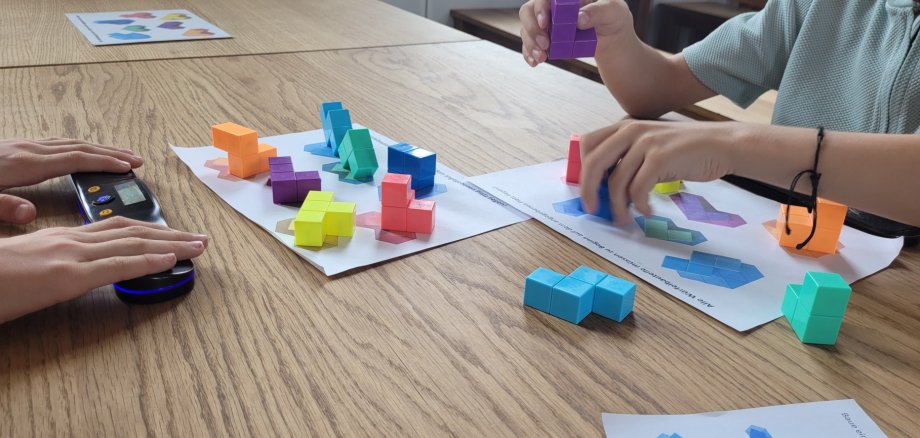
The children tried out tasks from different areas: for example, they trained their sensitivity and problem-solving skills by constructing towers from ice cream sticks and clothes pegs or challenged their memory and concentration skills with the electronic game "Simon Says". Assembling a cube under time pressure - a task that requires spatial thinking, perseverance and strategy - was particularly popular. In this way, important STEM skills are promoted in a fun and motivating way. The children's feedback will be incorporated into the selection of tasks for the hands-on kits.
The event took place as part of the SaarMINT project, funded by the MINT Cluster III programme of the Federal Ministry of Research, Technology and Space. The Saarland network SaarMINT is committed to STEM education in order to get children and young people between the ages of six and sixteen interested in maths, computer science, natural sciences and technology. The network places particular emphasis on reaching girls and educationally disadvantaged children and young people. Such hands-on programmes in particular offer the best opportunities for this, as they motivate through a playful approach, lead to a sense of achievement and appeal equally to a wide range of talents.
The beaming faces of the children as they tinkered around showed that STEM is fun. Especially when you can try things out and puzzle things out freely and uninhibitedly.