About Rosa Salmon
Owner of a shop specialising in handmade and ready-to-wear clothing
Rosa Salmon’s life vividly illustrates the opportunities she had as a Jewish woman in Homburg around 1900: she owned a shop and flats, and could afford domestic staff. However, her fate also makes it clear how quickly social recognition and economic success could be destroyed by exclusion, anti-Semitism and Nazi violence.
The Jewish community in Homburg – their living environment
The history of the Jewish community in Homburg dates back to the 17th century.[1] Although Jewish families had been living in the town from an early stage, they were legally and socially disadvantaged for a long time.
It was not until the early 19th century that living conditions improved, thanks to the ideas of the Enlightenment and the reforms of the Napoleonic era. The community grew to 281 members by 1841[2] and, following a protracted struggle, acquired a religious centre in 1860 in the form of the former Franciscan church, which was converted into a synagogue.[3] Numerous Jewish businesses and associations also shaped social life in Homburg, including an Israelite women’s association, which had been in existence since 1919.[4]
Little is known today about the everyday lives of Jewish women. Like many women in the 19th century, they were often dependent on their fathers or husbands. Religious obligations such as ritual ablutions shaped their daily lives and could have health implications, particularly for pregnant women, as there was no public bathhouse until 1838.[5]
Rosa Salmon – entrepreneur and distinguished citizen of Homburg
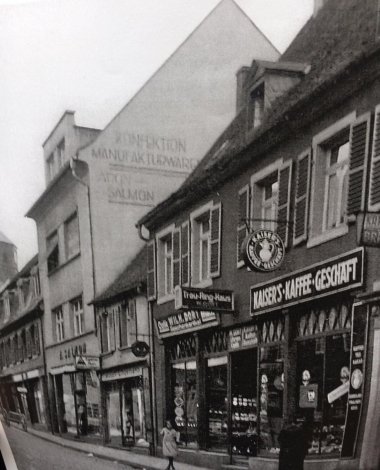
Rosa Salmon was born on 10 August 1867 as Rosa Herz in Ruchheim, in the Palatinate.[6] After her marriage to Aron Salmon, she moved to Homburg and became part of the local Jewish community. Together they had two children, Karl and Paula. Around 1900, the family opened a shop specialising in handmade goods and ready-to-wear clothing at 6 Eisenbahnstraße, which enjoyed great popularity amongst the people of Homburg for many years. This was partly because her husband Aron offered customers who were short of cash the option of buying on credit, telling them: ‘When you’ve got money again, you can pay the rest’.[7]
Following the death of her husband in 1932, Rosa Salmon officially took over the running of the business and became the owner of the family home. Together with her daughter Paula and her daughter-in-law Alice, she worked in sales, whilst her son Karl was responsible for purchasing and bookkeeping, which made him the unofficial owner of the business. The whole family worked in the business and were so financially successful that they were able to employ domestic staff and nannies. This illustrates that, around 1900, women were taking on responsibilities in economic life, even though their activities have often received little attention in historical accounts.
From the early 1930s onwards, anti-Semitic sentiment became increasingly evident in society, particularly after 1933. Consequently, the *Homburger Zeitung* banned advertisements from Jewish businesses, of which there were a large number in the town at that time.[8] Jewish players were also expelled from the Homburg football club as early as 1933.[9] With the annexation of the Saar region to the German Reich on 1 March 1935, the situation changed fundamentally once again. More and more Jewish families left Homburg to escape the growing discrimination. The Salmon family initially remained in their home town.
Persecution, Deportation and Remembrance
In early 1938, the Nazis put up a sign reading ‘Jewish shop’ outside the Salmons’ shop.[10] At the same time, customers were photographed in order to intimidate them. As a result, many people avoided the shop for fear of the consequences, leading to a significant drop in takings. At the time of Kristallnacht, it was still the only Jewish-owned shop in the town; all the others had already closed down and emigrated.
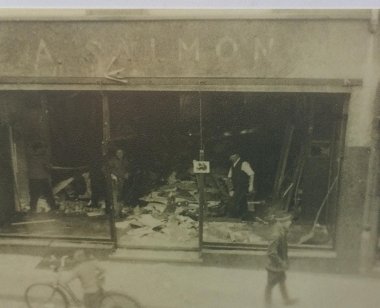
In the early hours of 10 November 1938, hordes of SS men smashed in doors and shop windows. The shop fittings were then demolished, bales of fabric were torn apart and cut up, and subsequently thrown onto the street, where a crowd of applauding onlookers had gathered.”[11]
Meanwhile, Rosa Salmon and her family were in their flat on the first floor of the house, which was also searched by the rioters. In the process, they confiscated documents and 20,000 Reichsmarks. In tears, Rosa’s daughter-in-law, holding her little daughter – who was only two months old at the time – in her arms, pleaded with them to leave them some money to live on, whereupon she was given back 100 Reichsmark.[12] At the same time, the synagogue in Homburg was also set alight and the Star of David torn down in front of a cheering crowd. The fire brigade intervened only to prevent the fire from spreading to neighbouring buildings.
On 22 October 1940, Rosa Salmon, her children Karl and Paula, her daughter-in-law Alice and her two grandchildren were deported to the Gurs internment camp in the south of France as part of the so-called Wagner-Bürckel Aktion.[13] Like some 6,500 other Jewish men and women from Baden, the Palatinate and the Saar region, they were forced to leave their homes within a matter of hours. For the elderly in particular, this mass transport usually meant certain death. For Rosa Salmon, then aged 73, the hardships of the deportation were almost insurmountable. After a two-day journey in cattle trucks and the subsequent transport, she suffered from hunger, illness and appalling hygienic conditions. She died in the Gurs camp as early as 4 December.
The fate of her family, too, illustrates the brutality of Nazi persecution. Her daughter Paula initially survived Gurs, but was later deported via the Drancy internment camp to the Auschwitz concentration and extermination camp, where she was murdered. Her son Karl, however, together with his wife Alice and their two children, managed to flee to the USA in 1942, where they survived the Holocaust.
Today, in Homburg, the ‘Gegen das Vergessen’ (Against Forgetting) memorial, inaugurated in 2019, commemorates the town’s Jewish men and women who were murdered during the Nazi era. This memorial site is complemented by Stolpersteine, which commemorate the victims at their former places of residence.
Written by:
Laura Czech, a volunteer with the Federal Voluntary Service at the Saarpfalz District Women’s Office
Dr Susanne Nimmesgern, historian and women’s representative for the Saarpfalz district
Helen Tepper, MA, Project Co-ordinator for ‘Frauen Spuren’ in the Saarpfalz district
Published: 26 October 2026; Last updated: 26 October 2026.
Quotes
I was unable to fulfil your request to describe our deportation, as my nerves could not bear it. It was too terrible what we went through with two children in such dire straits, driven from our home and livelihood and everything that was dear to us, only to end up in the most appalling conditions at the Gurs camp in the south of France.
Cold, hunger, wretched wooden barracks, filth, no water. I comforted other people, elderly folk, and told them thatthe world would find out where we were and would send help… We knew we were being sent to an extermination camp. How much can a mother with two children bear?
What’s the point of writing about this now? We need to create a better world, prevent a second Holocaust and respect every religion. Today, my dear friend, I do not wish to weep too much before you; I am relying on the decency of today’s educated young people to help create a better world. May the good Lord grant that we succeed.”
Rosa Salmon’s daughter-in-law, Alice Salmon (née Vicktor), wrote to a friend in St. Ingbert in 1987; quoted in Nimsgern/Zutter: *Jews in St. Ingbert*, p. 77.
“The Jewish community has all but disappeared from Homburg. In particular, the Jewish business community, which once accounted for a significant proportion of the town’s merchants, has been reduced to a single shop.”
Newspaper clipping dated 28 February 1936 (reproduced in Blinn 1993, p. 147).
The fate of the Salmon family [...] serves as a reminder to us in Homburg that we must continue to commemorate the victims of the persecution and deportation of the Jews. Rosa Salmon was deported to Gurs as part of the Wagner-Bürckel operation and lost her life in the process. It is not only her name that has been immortalised on the ‘Memorial Against Forgetting’ [...] at the Alter Markt in Homburg.
It is intended to promote remembrance of the victims of Nazi terror and thus prevent them from being forgotten. Through the names engraved on the stelae, the victims regain part of their identity and are given a dignified place of remembrance in their former home town and in the immediate vicinity of where they once lived.”
The elective subjects at the Saarpfalz-Gymnasium Homburg (2020/21), available online at <https://orte-der-erinnerung.entdeckerwelten.eu/homburg/> [last accessed: 26 October 2026].)
Footnotes
[1] Dieter Blinn, *Jews in Homburg: A History of Jewish Life 1330–1945* (Homburg-Saarpfalz 1993), p. 13.
[2] Ibid., p. 69.
[3] Ibid., pp. 106–109.
[4] Alemannia Judaica – Working Group for Research into the History of the Jews in Southern Germany and Neighbouring Regions: Homburg (district town, Saarpfalz district). Jewish History / Synagogue (as at 2 April 2026), available online at <https://www.alemannia-judaica.de/homburg_saar_synagoge.htm> [Last accessed: 26 October 2026].
[5] Blinn 1993, pp. 116–118
[6] On this and the following points: Ibid., pp. 183–186.
[7] Quoted in Hans-Joseph Britz: ‘The Expulsion and Murder of Jewish Citizens in Homburg’, in: Saarpfalz 2016/2, pp. 28–30, here p. 28.
[8] Blinn 1993, p. 130.
[9] Ibid., p. 130 ff.
[10] Ibid.
[11] ‘Kristallnacht’: Nazi henchmen on a rampage, in: Suppressed History – Nazi Rule, Persecution, Resistance. A Guide to the Saarpfalz District, published by the Saarpfalz District Office for Local History and Heritage Conservation, Blieskastel 1995, p. 78.
[12] Ibid.
[13] On this and the following points: Blinn 1993, pp. 183–186.
Further reading / literature / sources
Dieter Blinn: Jews in Homburg. A History of Jewish Life 1330–1945 (Homburg-Saarpfalz 1993).
Hans-Joseph Britz: ‘The Expulsion and Murder of Jewish Citizens in Homburg’, in: Saarpfalz 2016/2, pp. 28–30
Saarpfalz District Office for Local History and Heritage Conservation (ed.): Suppressed History. Nazi Rule, Persecution, Resistance; a Guide to the Saarpfalz District (Blieskastel 1995).
Alemannia Judaica – Working Group for Research into the History of the Jews in Southern Germany and Neighbouring Regions: Homburg (district town, Saarpfalz district). Jewish History / Synagogue (as at 2 April 2026), available online at <https://www.alemannia-judaica.de/homburg_saar_synagoge.htm> [Last accessed: 26 October 2026].
Baden-Württemberg State Archives: Entry on Salmon, Paula (undated), available online at <https://www.leo-bw.de/detail/-/Detail/details/PERSON/gurs_biogramme/7122/Salmon%20Paula> [Last accessed: 26 October 2026].
Saarland State Agency for Political Education: Entry on Salmon, Rosalia/Rosa, née Herz (no date), available online at < https://gurs.saarland/index.php?id=44&uid=96&name=Salmon-Rosalia/Rosa-geb.-Herz> [last accessed: 26 October 2026].
Supported by: