

About Anna Leszczynska
Polish princess
Childhood in Poland and flight
Anna Leszczynska was born on 25 May 1699 in Poland under the baptismal name Maria Anna and was thus named after her two grandmothers. There is speculation about her exact place of birth, but it cannot be proven. Her parents were Stanislaus Leszczynski, who went down in history as a Polish king in exile, and Katharina von Bnin, Countess of Opalince-Opalinska, who had married the previous year. Anna's sister Maria Charlotte was born in 1703.
Stanislaus was elected King of Poland on 12 July 1704, and he and his wife were crowned on 4 October 1705.
Exile in Zweibrücken
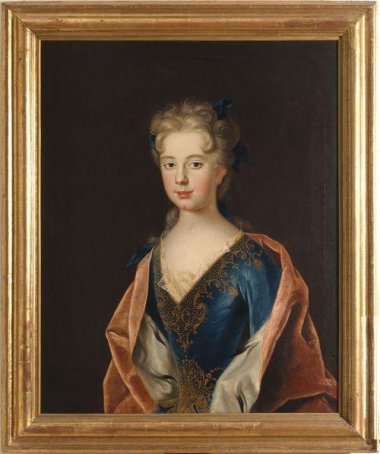
In 1709, at the age of 10, Anna fled Poland as part of the royal family. She never returned there for the rest of her life. The family initially lived in Stettin in Sweden. In 1711, they moved on to Stralsund in Swedish Pomerania. In September of the same year, they moved on to Kristianstad in Skåne (southern Sweden) to the court of the Swedish royal family.
From 16 November 1714, Anna and her family, consisting of her parents, her sister and her grandmother, lived in exile in Zweibrücken. As the smallest province of Sweden, far away from the threatened areas where they had previously been, Zweibrücken offered a place of refuge for the Polish royal family.
Zweibrücken was initially somewhat overwhelmed by the arrival of the Polish king, who "wanted to live and hold court in Zweibrücken like a prince"[1]. Initially, the family lived in two town houses in the town, which were lavishly renovated and furnished - at the expense of the state treasury. Stanislaus' court in Zweibrücken comprised around 150 people and was both internationally and religiously diverse.
The Catholic religion played a major role in the life of the family, and therefore also in Anna's life. The women of the family "[...] prayed for two hours a day, read pious books and made embroideries to pass the time."[2] Stanislaus was also very devout. His strong devotion to the Virgin Mary is particularly important. As a result, he became the most important patron of the Wilhelmite monastery in Gräfinthal. The Pieta "Our Lady with the Arrows" or "Arrow Madonna" was exhibited and venerated there.
Anna Lescyzsnska was much loved by her parents and was considered the family's favourite child. Her everyday life in Zweibrücken was quiet. She enjoyed going hiking with her younger sister.
Early death
Anna fell ill at the age of 18. Around 6 June 1717, she developed a severe fever, which could not be cured despite medical treatment. Anna Leszczynska died on the morning of 20 June 1717 between 05:00 and 06:00 in Tschifflick, a pleasure palace in Zweibrücken. She was buried the next day in Gräfinthal Monastery.
There was speculation at the time as to whether Anna was the victim of a poison attack intended for her father.
Since the French Revolution, Anna Leszczynka's grave was thought to have been lost. In 2006, the archaeologist Emanuel Roth found the grave, which was attributed to the deceased princess, during an excavation at Gräfinthal Monastery.
Written by: Elena Germann, student of historically orientated cultural studies at Saarland University
Published: 09.02.2026; Last updated: 09.02.2026.
Further reading / literature / sources
Ministry for the Environment, Energy and Transport - State Monument Office (ed.): Denkmalpflege im Saarland, Jahresbericht 2009. Saarbrücken 2010.
Voltmer, Manfred: "Anna, die wiederentdeckte Königstochter" in: Saarbrücker Zeitung, 10 October 2016, available online at: https://www.saarbruecker-zeitung.de/saarland/saar-pfalz-kreis/mandelbachtal/anna-die-wiederentdeckte-koenigstochter_aid-777249
Schneider, Angelika: Anna Leszczynska - polnische Exil-Prinzessin in Zweibrücken und in der Saargegend, in: Zeitschrift für die Geschichte der Saargegend, Freiburg im Breisgau 2008/2009.
Zweibrücken City Museum (ed.): Stanislaus Leszczynski. A king in exile. [Special exhibition Stanislaus Leszczcynski - A King in Exile, 21 March to 2 July 2006] Blieskastel, 2006.
Supported by: