

Ticks - TBE and Lyme disease
What are ticks?
 © Marcel / Adobe Stock
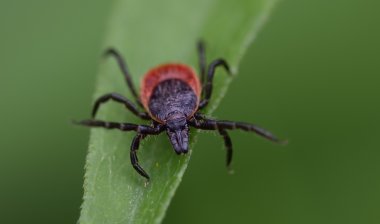
Ticks are arachnids that prefer to live outdoors in tall grass, bushes, hedges and undergrowth. There are many different types of ticks in Germany, with the common wood tick (Ixodes ricinus) being the most common. Due to milder winters and rising temperatures earlier in the year, increased tick activity can now be observed in Germany in spring. Native tick species are therefore active over a longer period of the year and the risk of coming into contact with ticks also increases in the winter months. In addition to the native tick species, tick species introduced from warmer regions of Europe (e.g. ticks of the genus Hyalomma) are finding increasingly better survival conditions here.
Are ticks dangerous?
Ticks can transmit various pathogens to humans. In Germany, Lyme disease and tick-borne encephalitis (TBE) are among the best-known diseases caused by tick-borne pathogens. While TBE is caused by transmitted viruses, transmitted bacteria are responsible for Lyme disease.
TBE - What is it and are there any special features in the Saarpfalz district?
Tick-borne encephalitis (T BE) is a disease caused by viruses transmitted by ticks.
Based on the frequency of the disease, the Robert Koch Institute (RKI) publishes an annual map of TBE risk areas (pdf) in which the Saarpfalz district has also been designated as a risk area since 2012. While the frequency of TBE cases is low in regions not defined as risk areas, TBE cases are significantly more frequent in many risk areas in Bavaria and Baden-Württemberg in particular. Despite being classified as a risk area, only isolated infections are detected in the Saarpfalz district each year.
Not every tick bite leads to an infection or illness. However, there is a risk that after flu-like symptoms, a second phase of the disease may occur in which the central nervous system is affected, among other things. The inflammation of the brain (encephalitis) and the meninges (meningitis) that gives the disease its name can occur, which can lead to permanent and sometimes life-threatening damage.
Even if severe courses of the disease are rare and only isolated infections have been detected in the Saarpfalz district despite its classification as a risk area, caution is still required, as targeted treatment against the cause of the disease is not yet possible.
What is Lyme disease?
Lyme disease is a disease caused by bacteria (borrelia) transmitted by ticks. These pathogens are not transmitted with every tick bite, as not every tick carries the bacteria or the tick is removed in time. Even if the exact number of Lyme disease cases in Germany is not known, the disease occurs much more frequently than TBE. A total of 36 cases of Lyme disease were reported in the Saarpfalz district in 2024.
A typical characteristic of an infection with borrelia is the ring-shaped reddening known as "travelling redness", which usually forms around the bite site several days after the tick bite and increases in size as the infection progresses. In addition, flu-like symptoms and, depending on the course of the infection, (recurring) joint pain or, due to the infection of the nervous system (neuroborreliosis), facial paralysis and meningitis are also possible.
In contrast to TBE, Lyme disease can be treated against the cause of the disease. This means that timely treatment with suitable antibiotics can usually prevent severe courses of the disease and achieve a full recovery. You should therefore contact your GP practice if you experience symptoms after a tick bite. A preventive vaccination against Lyme disease is not possible.
How can I protect myself against TBE and Lyme disease?
Naturally, avoiding tick bites offers the best protection against infection or disease. The following therefore applies:
- Wear long, closed clothing when outdoors (especially in tall grass, undergrowth, bushes)
- Use insect-repellent protective agents if necessary
- Check your body for ticks after spending time outdoors
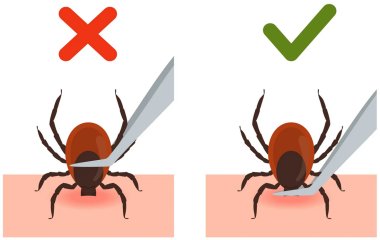
- In the event of tick bites, remove ticks as quickly as possible close to the skin, slowly and without twisting, e.g. with a tick card or tweezers, and then disinfect the puncture site
 © sabelskaya / Adobe Stock
If you would like to prevent TBE, you can also do so by getting vaccinated against TBE. The TBE vaccination is recommended by the Standing Committee on Vaccination (STIKO) in particular for people who live in TBE risk areas and may come into contact with ticks due to frequent outdoor activities. This also applies to people who are exposed to ticks at work or when travelling to risk areas. However, no vaccination is available against Lyme disease.
Further information