

Asian tiger mosquito
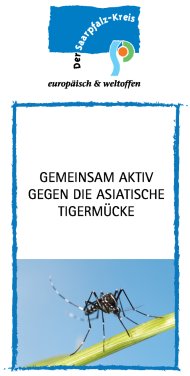
Originally from Southeast Asia, the Asian tiger mosquito has also spread to Europe as a result of global trade and travel, where it has now established itself due to climatic changes, especially in southern European countries. After the Asian tiger mosquito was first detected in Baden-Württemberg in 2007, the first specimens were also documented in Saarland in 2023. It is a potential vector of pathogens such as dengue, chikungunya and Zika viruses, although the risk of transmission in Saarland is (still) classified as low. In view of the ongoing climatic changes and the aggressive biting behaviour of the mosquito during the day, it is nevertheless worthwhile counteracting the permanent colonisation of the Asian tiger mosquito in our region at an early stage.
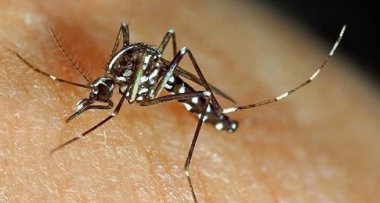
What does the Asian tiger mosquito look like?
Features:
 Marco Uliana / Adobe Stock
- 3-10mm (smaller than a 1 cent coin)
- 5 white rings on hind legs (the rearmost pair of legs ends in white)
- White line from the back of the head to the base of the wings
- Push-button with silver-white tips
- Day active
Is a sting dangerous?
The Asian tiger mosquito can only transmit pathogens if it has previously bitten an infected person and then bites a healthy person. As diseases such as dengue fever have only rarely occurred in Saarland and only in travellers returning home, the risk of transmission has so far been classified as low. There is therefore no cause for concern in the event of a bite. However, if you experience symptoms of illness such as fever, headaches and aching limbs a few days after a mosquito bite, you should consult your GP for clarification. This applies in particular after travelling to countries where the Asian tiger mosquito is more widespread.
How do I protect myself from a sting?
As with other mosquito species, wearing long, closed clothing and using repellents (e.g. anti-mosquito sprays) outdoors can protect against tiger mosquito bites. Fly screens on windows and doors also help to prevent mosquitoes from entering the home. Due to the short flight radius of the Asian tiger mosquito, avoiding breeding sites on your own property and in the immediate vicinity can reduce the number of mosquitoes. This is one of the best ways to protect against the Asian tiger mosquito.
How can I help reduce the spread of the tiger mosquito?
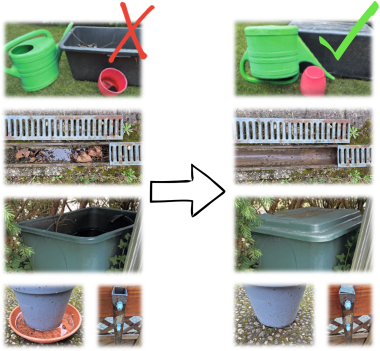
The most effective protection against the reproduction and spread of the Asian tiger mosquito is to avoid small, stagnant pools of water, which are used by the mosquitoes as breeding grounds:
- Cover rainwater collection containers with suitable nets or lids
- Clean buckets, vases, ashtrays, tarpaulins, old tyres etc. in which small amounts of water can collect when it rains and store/dispose of them upside down in a dry place.
- Empty flowerpot saucers, paddling pools and birdbaths at least once a week
- Clean rain gutters regularly to prevent water accumulation
- Permanently seal open fence tubes or holes in the masonry
- Establish natural predators of mosquitoes in garden ponds (e.g. dragonfly larvae)
- Do not dispose of stagnant water down the drain, but pour it into the garden to prevent the possible spread of mosquito eggs and larvae
 Health department
Winter measures: Cleaning and storage
Before winter, the tiger mosquito lays so-called diapause eggs, which can survive cold temperatures and dryness. Therefore, objects that are to be stored or disposed of must be thoroughly cleaned beforehand:
- Scrub objects thoroughly with water and a brush and/or clean with a high-pressure cleaner
- Store cleaned items upside down, closed and/or in a dry place to prevent water from collecting again
- Cover rainwater collection containers with suitable nets or lids
Have there already been proven finds in the Saarpfalz district?
No. So far there have been no confirmed findings of the Asian tiger mosquito in the Saarpfalz district.
What can I do if I find an Asian tiger mosquito?
As the Asian tiger mosquito can be confused with other mosquito species, the public health department asks you to send a meaningful photo of the mosquito with exact details of where it was found to the Saarpfalz district health department by e-mail.
Captured mosquitoes can also be sent to the Mosquito Atlas (Leibniz Centre for Agricultural Landscape Research). Please note the dispatch information given there.
Further information