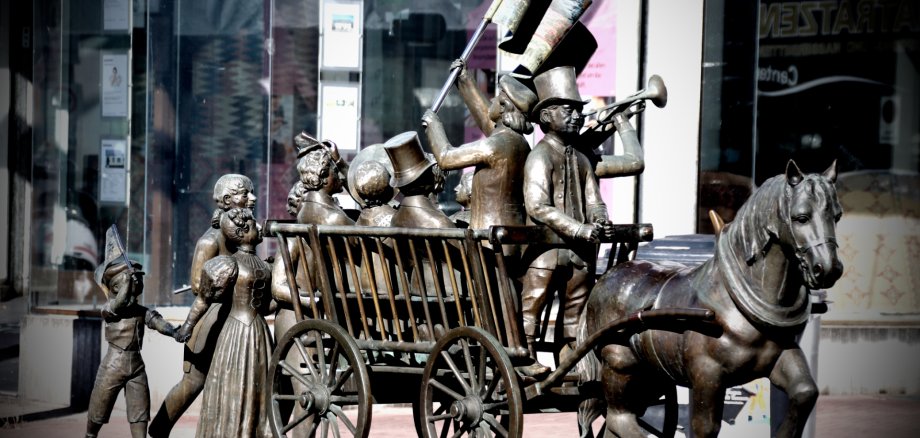
Where, exactly 200 years ago, Cornelia Siebenpfeiffer was born, the daughter of the then ‘Landcommissär’ (district administrator) of Homburg, but also where Philipp Jakob Siebenpfeiffer, in chains, spent his last night in Homburg; where his comrade-in-arms Johann Georg August Wirth, in his nightshirt, with his nightcap on his head and the law book in his hand, stood up to the mayor of Homburg and his police; where the combative Protestant dean Gottfried Weber stored his wine supplies, and where the citizens of Homburg gathered together with their like-minded comrades from Zweibrücken to set off in horse-drawn carts for the Hambach Festival on 26 May 1832: Such historical events form part of the walking tour through Homburg town centre, to which the Siebenpfeiffer Foundation invites you on Thursday, 17 September. The tour focuses on those sites where, in the run-up to the Hambach Festival between 1830 and 1832, a chapter in the history of German democracy was written. This time, Frank John, Chairman of the Siebenpfeiffer Foundation and the 15th successor to Siebenpfeiffer as District Administrator of Homburg, will also be joining the tour.
“The people of Homburg are extremely liberal,” wrote Georg Fein in 1832 in a letter to his mother in Wolfenbüttel. Fein was an editor at the *Deutsche Tribüne*, the most influential and highest-circulation liberal newspaper of the time. His observation also serves as the theme of this guided tour. The tour of the key locations associated with the events surrounding Siebenpfeiffer and Wirth is no ordinary stroll through the town centre. Rather, participants can look forward to a dramatised, costumed tour: Monika Link from Zweibrücken will take on the role of ‘Regina Wirth’ – that is, the wife and widow of Johann Georg August Wirth, in period costume, recount what she ‘experienced’ during the turbulent years in Homburg between 1832 and 1834, whilst her combative husband was imprisoned for most of that time. Stops on the historical tour include the site where Philipp Jakob Siebenpfeiffer’s house and garden once stood, as well as the former ‘Landcommissariat’ (district office), the building of the former Cappel inn, where the series of numerous political ‘banquets’ began, and finally the Freedom Fountain, which was created by the artist Bonifatius Stirnberg (Aachen), who passed away last October at the age of 92, and which was unveiled at the roundabout in 1992. Participation is free of charge; the tour begins at ‘six o’clock in the afternoon’, i.e. at 6 pm, in the grounds of the Siebenpfeiffer-Haus, Kirchenstraße 8 (opposite the Protestant town church). The tour lasts about an hour and a half, and participation is free of charge.