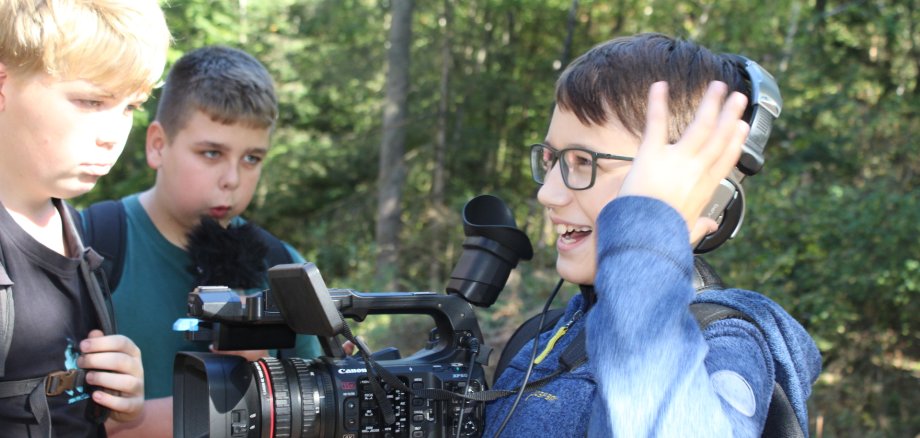
Sunshine, a camera and plenty of exciting nature experiences: during the autumn half-term, eleven young people took part in the ‘GreenCut-JUMP’ nature film workshop, where they explored the Bliesgau Biosphere in depth. Together with a team of media and nature experts, they developed their own film ideas, learnt professional camera and sound techniques, and explored key issues relating to biodiversity, climate change and the protection of valuable habitats. The project week was organised by the Co-ordination Office for Sustainable Youth Work in the Saarpfalz district as part of the ‘Young Biosphere’ initiative.
The weather was perfect during the filming days, with plenty of sunshine providing ideal conditions and impressive shots of nature. At the start of the week, the group explored the area around Kirkel together with biosphere ranger Patric Heintz. The programme began with some practical camera exercises on the rocky trail. The young people were particularly fascinated by an anthill, which was filmed from various angles and set to suitable sound recordings. Macro shots provided a very special insight into these tiny creatures and their activities.
As the week progressed, the focus shifted to the creative work and the preparation of the participants’ own films. The participants developed scripts and split into two film teams, which were guided by the Greencut-JUMP media experts Tim Gontrum and Maggie Slowinska. One group explored the biosphere reserve and its zoning. They focused in particular on the importance of the core zones, where natural processes can take place largely without human intervention, and on their value for the protection of biodiversity. The second group delved into the fascinating world of fungi. Together with mushroom expert Susanne Ratering, the young people explored the forest and learnt about the important role mushrooms play in the ecosystem. As decomposers of organic material, they contribute significantly to natural material cycles and thus create important conditions for functioning forest ecosystems. At the same time, the impact of climate change on nature became clear: following a long, hot summer, very few fungi could be found. The search thus also provided an opportunity to discuss drought and its consequences for biodiversity.
As well as developing their own stories, the young people learnt about different types of camera and shooting angles. They practised sound recording, lighting and conducting interviews, and gained an insight into the planning and subsequent editing of a film. In the process, they were able to contribute their own creative ideas and discover how individual shots come together to form a coherent story.
A special highlight on Thursday was a joint environmental initiative at the floodplains in Reinheim. Under the guidance of ranger Michael Kessler, the young people got stuck in: using loppers and saws, they cut back bushes and removed trees and shrubs to clear the habitat. Despite the occasional rain shower, the participants tackled the task with great enthusiasm and vigour. The initiative highlighted that nature conservation requires not only knowledge and awareness, but also hands-on commitment.
The group spent the last two days of the project at the Spohns Haus ecological school camp in Gersheim. There, the young people reviewed the footage they had shot, drew up editing plans and used editing software to assemble their footage into finished films. This gave them an insight into all the key stages of film production – from the initial idea, through research and filming, to post-production.
The results of the project week are impressive: two short nature films have been produced, as well as a ‘making-of’ video documenting the environmental campaign and the experiences during the project week. “The ‘GreenCut-JUMP’ project impressively demonstrates how young people can be inspired to care for their local area and its natural environment. When they pick up a camera themselves, explore ecological interrelationships and communicate their findings creatively, they develop a unique perspective on the issues of sustainability and nature conservation. I am particularly pleased that the young people have not only gained knowledge about our biosphere, but have also taken practical action to preserve valuable habitats. Projects like this strengthen young people’s sense of initiative and show that they can play an active role in shaping the future of our region,” emphasises District Administrator Frank John.
Thanks to the support of the Saarpfalz District Savings Bank’s Foundation for Culture and the Environment, participation in the media project was free of charge for the young people. GreenCut-JUMP is a project run by the Gespa e. V. association and is funded under the federal ‘Biodiversity’ programme by the Federal Ministry for the Environment, Climate Action, Nature Conservation and Nuclear Safety. Other sponsors include the Heinz Sielmann Foundation and the Lower Saxony Bingo Environmental Foundation. The films and further insights into the project will be available on the website once completed at www.GreenCut-JUMP.de.