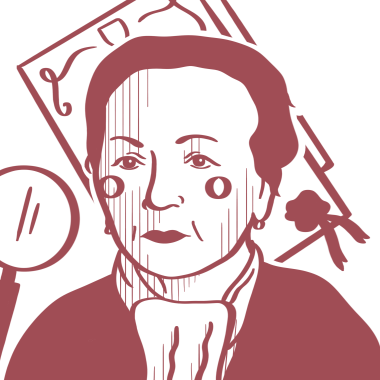
About Dora Dimel
Teacher, local historian, author
As a local historian, Dora Dimel researched and published works on the regional history of various towns in the Saarland, including those in what is now the Saarpfalz district, thereby contributing to a better understanding of the past.
Early life
Dora Dimel was born on 1 November 1898 in the Beaumarais district of Saarlouis.[1] After attending the local primary school, she moved on to the girls’ grammar school in Saarlouis, where she took her A-levels around 1916.[2] In the midst of the First World War, she began her studies in Trier, which she completed in 1919 by obtaining a teaching qualification for primary, secondary and higher girls’ schools.
Her first professional experience was a position as a private tutor with the Fabvier family in Wallerfangen between 1919 and 1922. She then taught for five years at the Domanial School run by the French mining authority[3] and subsequently spent three years as a primary school teacher.[4] Eager to learn and ambitious, Dora Dimel continued her education: from 1930 to 1933, she studied economics in the French cities of Nancy, Lille and Dijon, as well as business studies and French and English linguistics at Goethe University in Frankfurt.[5] In addition, she obtained a teaching qualification in religious education[6] and, in November 1933, passed the examination to become a teacher of commercial studies, submitting a dissertation on ‘The Use of Hydropower in France’.[7]
The Saar referendum and the Second World War
Between 1934 and 1935, Dimel taught at the primary school in Hüttersdorf,[8] which today forms part of the municipality of Schmelz. However, the political upheaval following the re-annexation of the Saar region to the German Reich hit her hard: Because, during the referendum campaign leading up to 13 January 1935, she had campaigned – amongst other things – through political lectures for the retention of the Saar region and the ‘status quo’,[9] she was dismissed from the teaching profession on political grounds from March to September of that year.[10] During this half-year, she worked as a private tutor for the Villeroy de Galhau family in Wallerfangen[11] and had already made arrangements to flee to England, as well as distributing her belongings amongst relatives, as she feared expropriation.[12] Although she was reinstated at the end of 1935, this was on condition that her previous years of service and pension entitlements were forfeited.[13]
Alongside her teaching career, Dora Dimel became a committed local historian. She was often seen in the archives of Blieskastel, Zweibrücken and St. Ingbert.[14] In 1936, she published her book on the village of Alschbach, which appeared as the first volume in the series ‘Village Books of the St. Ingbert-Gau-Saarpfalz District’.[15] At that time, she was also teaching at the local primary school. Shortly afterwards, she returned to the Saarlouis district and, from 1936 to 1945, worked as a business studies teacher at the Commercial Vocational School in Lebach, where she taught war-wounded students who were undergoing retraining.[16] During this period, she produced further works, including studies on the ironworks in Schmelz and on the mining village of Hüttersdorf. [17]
post-war years
In the immediate post-war years, Dora Dimel taught German to the French nuns from Peltre at the Saarlouis hospital, as well as to the children of the Villeroy de Galhau family. Several historical and economic articles published in the media of the time also date from this period. In 1947, her book *Marshal Ney and his Homeland* was published. From 1945 until her retirement in 1963, Dora Dimel taught at the commercial school and the vocational school for commerce in Saarlouis. In addition, she also ran French courses for adults.[18]
In 1955, she once again voted against the Saarland’s reintegration into the Federal Republic of Germany.[19] In 1977, she was awarded the title of ‘Chevalier dans l’ordre des Palmes Académiques’ by the French Ministry of Education in recognition of her commitment to Franco-German cooperation,[20] one of the most important In 1980, to mark the 300th anniversary of the town of Saarlouis, she published the book *Die Geschichte des Stadtteils Beaumarais* (*The History of the Beaumarais District*), a comprehensive account of her home town.[21] In the foreword, she writes that with this book, on which she had worked for forty years,[22] she wished to ‘bring joy to the older generation’[23] and to ‘make it easier for newcomers to settle into village life’[24]. Dora Dimel died in Beaumarais in 1985. As a mark of recognition, ‘Dora-Dimel-Straße’ was named after her there in 2012.[25]
Written by: Jeanne Blaes, student of historically orientated cultural studies at Saarland University
Published: 26 October 2026; Last updated: 26 October 2026.
Quotes
Mrs Dimel is an excellent storyteller. With her vivid, rich language – which is perfectly suited to the subject matter and reveals an extraordinary power of observation in every line – she captivates the reader and allows them to share in village life from its founding right up to the present day. […] The folklore-related facts that Mrs Dimel herself contributes – whether drawn from family tradition or her own experience – are astonishing and deserve the highest praise.”
Dr Manfred Henrich on Dora Dimel in his welcoming address (Dimel, Dora: The History of the Beaumarais District. (History of the District Town of Saarlouis. Vol. 2). Saarlouis 1979, p. 5.)
Footnotes
[1] Hartnack, Sabina: Dora Dimel. Available online at: https://lokalesbuendnis.saarlouis.de/buendnisfamilie/projekte/frauen-im-saarlouiser-familienbuendnis/hall-of-fame-frauen-in-saarlouis-collected-biographies/19th-century-1800-1899/biography-of-dora-dimel/ (last accessed: 19 May 2026).
[2] The sources are inconsistent; for example, Hartnack’s work is dated 1918, whilst Walter Löffler’s is dated 1916.
[3] Hartnack, Sabina: Dora Dimel.
[4] Löffler, Walter: Dora Dimel. In: Beaumarais Dialect and History Society (ed.): The History of the Beaumarais District of Saarlouis. Saarlouis 2018 (Vol. 1), p. 14.
[5] Ibid., p. 14.
[6] Ibid., p. 14.
[7] Hartnack, Sabina: Dora Dimel.
[8] Löffler, Walter: Dora Dimel, p. 14.
[9] Hartnack, Sabina: Dora Dimel.
[10] Löffler, Walter: Dora Dimel, p. 14.
[11] Ibid., p. 14.
[12] Hartnack, Sabina: Dora Dimel.
[13] Löffler, Walter: Dora Dimel, p. 14.
[14] Ibid., p. 14.
[15] Dimel, Dora: Alschbach. (Village histories of the St. Ingbert district, Saarpfalz region, Vol. 1). Saarlautern 1936, p. 5.
[16] Hartnack, Sabina: Dora Dimel.
[17] Löffler, Walter: Dora Dimel, p. 15.
[18] Ibid., p. 15.
[19] Hartnack, Sabina: Dora Dimel.
[20] Löffler, Walter: Dora Dimel, p. 15.
[21] Hartnack, Sabina: Dora Dimel.
[22] Dimel, Dora: The History of the Beaumarais District. (History of the District Town of Saarlouis. Vol. 2). Saarlouis 1979, p. 6.
[23] Ibid., p. 6.
[24] Ibid., p. 6.
[25] Löffler, Walter: Dora Dimel, p. 15.
Further reading / literature / sources
Selected works
Dimel, Dora: Alschbach. (Village histories of the St. Ingbert district, Saarpfalz region, Vol. 1). Saarlautern 1936.
Dimel, Dora: Marshal Ney and his homeland. Saarlouis 1947.
Dimel, Dora: Case law at the Ballei court in Vaudrevange, pp. 83–86. In: Unsere Heimat an der Saar, Neunkirchen 1951.
Dimel, Dora: The History of the Beaumarais District. (History of the District Town of Saarlouis. Vol. 2). Saarlouis 1979.
Literature
Dimel, Dora: Alschbach. (Village histories of the St. Ingbert district, Saarpfalz region, Vol. 1). Saarlautern 1936.
Dimel, Dora: The History of the Beaumarais District. (History of the District Town of Saarlouis. Vol. 2). Saarlouis 1979
Hartnack, Sabina: Dora Dimel. Available online at: https://lokalesbuendnis.saarlouis.de/buendnisfamilie/projekte/frauen-im-saarlouiser-familienbuendnis/hall-of-fame-frauen-biographies-collected-in-Saarlouis/19th-century-1800-1899/biography-of-Dora-Dimel/ (last accessed: 19 May 2026).
Löffler, Walter: Dora Dimel. In: Beaumarais Association for Dialect and History (ed.): The History of the Beaumarais District of Saarlouis. Saarlouis 2018 (Vol. 1).
Supported by: