Hospice & Palliative Network Saarpfalz
The network
The Saarpfalz Hospice and Palliative Care Network is an association of health and social care facilities and pastoral care organisations in the Saarpfalz district that are committed to providing hospice and palliative care for seriously ill and dying people and their relatives.
It is a network in which various professional groups and specialisms as well as full-time and voluntary staff are represented. The multi-professional co-operation extends to patients who are cared for at home, in clinics, in facilities for the elderly or disabled and in hospices. The catchment area covers the Saarpfalz district.
Goals
The fundamental aims of the Saarpfalz Hospice and Palliative Care Network are to improve and maintain the quality of life of patients with an advanced incurable illness and their families.
Hospice and palliative care should enable a self-determined, if possible pain-free and conscious life even if the underlying disease can no longer be treated curatively. It affirms life and sees dying as a normal process; death is neither accelerated nor artificially delayed.
The aim is to accompany the seriously ill, dying person and to enable them to stay in familiar surroundings with less fear and pain.
The Saarpfalz Hospice and Palliative Care Network pursues these goals in particular by promoting multi-professional cooperation and coordination, through continuous discussion and further training.
The hospice and palliative network itself does not take on any patient-related activities, and concluding contracts with cost bearers is not part of its remit. The responsibility of the network partners for their activities is not affected.
Network partners
The Saarpfalz Hospice and Palliative Care Network is open to people and organisations who are committed to the physical, mental, psychosocial and spiritual well-being of people requiring hospice and/or palliative care.
Hospice guide
Hospice work and palliative care for the dying and seriously ill are committed to providing quality of life until the end of life. This hospice and palliative care guide is intended to serve as a source of information with relevant contact addresses for people and their relatives at a difficult time.
Outpatient medical ethics counselling
The task of the outpatient ethics committee is to consider, on the basis of general ethical criteria and standards, which recommendations can be made for a good medical and nursing approach in specific individual cases and thus to support the relatives and the attending physician in their decisions.
News: Certificate presentation ceremony for the course on voluntary end-of-life care
A snowflake that has weight
 Sebastian Dingler
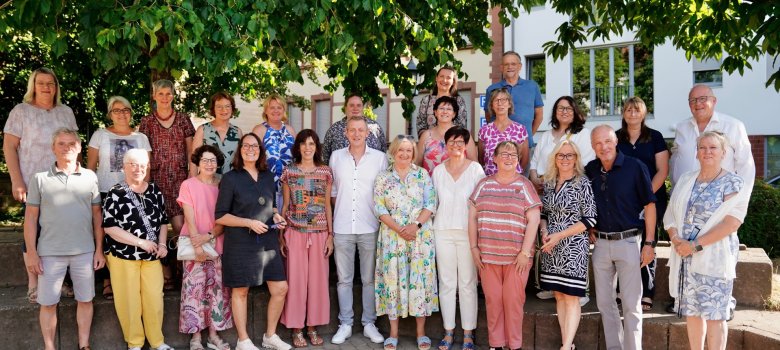
As it does every year, the certificate presentation ceremony for the Voluntary End-of-Life Care course took place last Friday, 10 July, at the community centre of the Caritas Centre in St. Ingbert. Ten women and two men completed the course – a group size that course leader Gabriele John-Neumann considers to be just right for the weekly sessions, which this time took place on Mondays, supplemented by five themed Saturdays and two additional Friday evenings.
Bernhard Bullacher, one of the two men in the group, explained what had prompted him to take the course. A friend of his had died of cancer, and every time he’d wanted to ring him, he’d had to force himself to do so. “I had absolutely no idea what to say. ‘How are you?’ That’s the stupid question, isn’t it?” The course had taken away precisely that fear of reaching out. Bullacher completed his work placement at the Haus am Schlossberg. There, he realised that the residents’ greatest enemy was time: “They just drift from one meal to the next and, basically, have no one to talk to.” Giving the gift of time had become, for him, the magic phrase in working with older people.
Sabine Wagner-Höh also gave a positive assessment. As a qualified social worker, working with older people is particularly close to her heart. She said she had deliberately chosen the course because very few residents ever leave a care home again. “The course was very good for me; lots of things were new and interesting, and above all, it was a great group,” she concluded.
The opening remarks at the certificate presentation ceremony were delivered by Regional Diaconal Pastor Albrecht Bähr. He paid tribute to the risk the participants had taken in undertaking the training: “You go to people in a very clear crisis situation and try to give them what they need.” He was convinced that, after this course, everyone would be a different person to the one they were before. One encounters people with their entire life stories and is privileged to recognise the value in accompanying them right to the end. Bähr wished the group “much strength, many blessings and much passion” for this work.
Peter Zwing, the new director of the Caritas Centre in Saarpfalz, took part for the first time this year. According to Zwing, without the personal and voluntary commitment of the graduates, many of the services provided to people in the region would simply not be possible. Choosing this path, he said, demonstrated “courage, drive, social responsibility and, above all, love for one’s neighbour”.
Petra Oberhauser, Gertrud Fickinger’s successor, spoke on behalf of the Catholic Adult Education Service (KEB). Illness, dying and death often trigger uncertainty, fear and a loss for words – “and this is precisely where hospice work comes in. It brings light, life, closeness and hope to places where life becomes fragile.” Hospice work, she explained, means being there when a cure is no longer possible, but when closeness, dignity and care become all the more important. According to Oberhauser, it is “a service that is not high-profile, but of inestimable value”.
Antoaneta Doggendorf, chair of the hospice association which provides financial support for the course, chose the image of a snowflake for her speech: each one, taken on its own, weighs nothing – and yet, at some point, it is precisely one of them that makes the difference and causes the branch to snap. “Let us not only hold the certificate in our hands today, but also carry in our hearts the realisation that, through this course, we can change a small part of the world. Perhaps only a little, each of us just a single snowflake – but one that carries weight.”
The sunflower was the symbol of this year’s event. Course leader Gabriele John-Neumann explained that the sunflowers had grown particularly large this year and therefore would not have fitted into the goody bags. They symbolised the personal growth of the graduates. She hoped that they would take away the feeling of having grown considerably during their time together, and wished them to keep the ‘sun in their hearts’ as they continue on their journey.
John-Neumann also expressed his pride in the strong network of hospice care in the region, as evidenced by the numerous external speakers who had helped to run the course over the course of the year.
To conclude, John-Neumann looked ahead: the actor Samuel Koch will be attending the opening of this year’s Hospice Days on 6 September at 11.00 am at the Saalbau Homburg. Anyone interested in training to become a volunteer end-of-life carer can put their name down now: the next course begins on 12 January 2027 with an information evening.
Info: Further information is available at www.oekumenische-hospizhilfe-pfalz-saarpfalz.de
Media report: Caritas Centre Saarpfalz / Sebastian Dingler