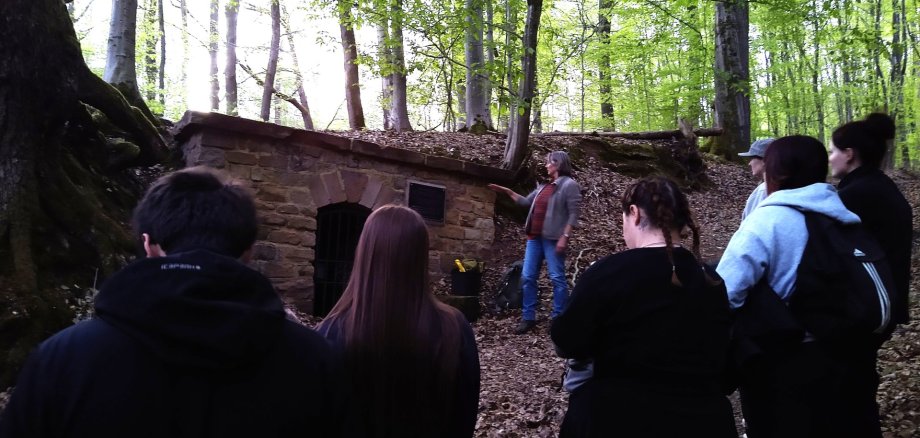
An interactive quiz at the beginning of the tour got the group excited. With exciting questions such as "How many young do bats have each year?" or "Who looks after the young while the mother bats are out hunting?", all participants were actively involved and showed great interest. As the hike progressed, the nocturnal hunters could be observed in their natural environment. The participants learnt that all native bat species orientate themselves using ultrasound and echolocation - normally imperceptible to humans. A special highlight was therefore the use of a detector that made the bat calls audible. As darkness fell, an impressive natural spectacle finally presented itself: In the light of torches, bats could be observed flying over the Glashütter Weiher pond in Rohrbach - an experience that made a lasting impression on the group.
Expert Silke Reinig emphasised the importance of bat conservation: "If you want to do something good for bats, it's crucial to provide enough insects. Anything that encourages insects - such as wild corners in the garden or insect hotels - also helps the bats." This is because the extinction of insect species means that bats have less to eat - and every time a bat hunts at night, it has to consume around half of its body weight as food. District Administrator Frank John also praised the commitment: "Such programmes are an important contribution to environmental education for young people. They create awareness for the protection of our native wildlife and show how exciting nature can be right on your own doorstep." The event was organised free of charge thanks to funding from the Foundation for Culture and the Environment of the Kreissparkasse Saarpfalz.
The Young Biosphere is also planning further exciting activities for young people in the future centred around nature, sustainability and environmental education. Up-to-date information on the events is available via social media at @jungebiosphaere and online at www.junge-biosphaere.de.